Hongyu Jiang , Haotian Yang , Siyue Qiu , Jialiang Nie , Meizhu Qin , Zihan Wang , Xinfeng Yang , Shaohua Zhang , Gang Liu , Wenlong Xu
{"title":"Synthesis strategy and application of multifunctional antifreeze hydrogels","authors":"Hongyu Jiang , Haotian Yang , Siyue Qiu , Jialiang Nie , Meizhu Qin , Zihan Wang , Xinfeng Yang , Shaohua Zhang , Gang Liu , Wenlong Xu","doi":"10.1039/d5py00346f","DOIUrl":null,"url":null,"abstract":"<div><div>Hydrogels, renowned for their exceptional mechanical properties, superior swelling capacity, excellent biocompatibility, and notable ionic conductivity, have demonstrated significant potential across diverse fields, including biomedicine, the food industry, and flexible electronics. However, conventional hydrogels face a significant limitation in cold environments: the internal water within these materials tends to freeze at low temperatures. This freezing process not only compromises the structural integrity of the hydrogels but also drastically reduces their performance, severely limiting their utility in cold environments. As a result, the development of antifreeze hydrogels has become a critical area of research. These advanced hydrogels are designed to effectively inhibit the formation and growth of ice crystals, enabling them to maintain optimal performance even under low-temperature conditions. This article provides a comprehensive and in-depth review of the current research progress on antifreeze hydrogels, meticulously analyzing their antifreeze mechanisms and synthesis strategies. Furthermore, we systematically discuss the unique properties of antifreeze hydrogels and their specific applications across various fields. Finally, we present insights into the current challenges and future directions for the development of antifreeze hydrogels.</div></div>","PeriodicalId":100,"journal":{"name":"Polymer Chemistry","volume":"16 19","pages":"Pages 2182-2210"},"PeriodicalIF":3.9000,"publicationDate":"2025-04-24","publicationTypes":"Journal Article","fieldsOfStudy":null,"isOpenAccess":false,"openAccessPdf":"","citationCount":"0","resultStr":null,"platform":"Semanticscholar","paperid":null,"PeriodicalName":"Polymer Chemistry","FirstCategoryId":"92","ListUrlMain":"https://www.sciencedirect.com/org/science/article/pii/S1759995425001445","RegionNum":2,"RegionCategory":"化学","ArticlePicture":[],"TitleCN":null,"AbstractTextCN":null,"PMCID":null,"EPubDate":"","PubModel":"","JCR":"Q2","JCRName":"POLYMER SCIENCE","Score":null,"Total":0}
引用次数: 0
Abstract
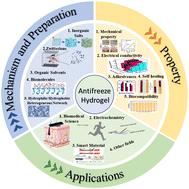
Hydrogels, renowned for their exceptional mechanical properties, superior swelling capacity, excellent biocompatibility, and notable ionic conductivity, have demonstrated significant potential across diverse fields, including biomedicine, the food industry, and flexible electronics. However, conventional hydrogels face a significant limitation in cold environments: the internal water within these materials tends to freeze at low temperatures. This freezing process not only compromises the structural integrity of the hydrogels but also drastically reduces their performance, severely limiting their utility in cold environments. As a result, the development of antifreeze hydrogels has become a critical area of research. These advanced hydrogels are designed to effectively inhibit the formation and growth of ice crystals, enabling them to maintain optimal performance even under low-temperature conditions. This article provides a comprehensive and in-depth review of the current research progress on antifreeze hydrogels, meticulously analyzing their antifreeze mechanisms and synthesis strategies. Furthermore, we systematically discuss the unique properties of antifreeze hydrogels and their specific applications across various fields. Finally, we present insights into the current challenges and future directions for the development of antifreeze hydrogels.
期刊介绍:
Polymer Chemistry welcomes submissions in all areas of polymer science that have a strong focus on macromolecular chemistry. Manuscripts may cover a broad range of fields, yet no direct application focus is required.



 京公网安备 11010802042870号
京ICP备2023020795号-1
京公网安备 11010802042870号
京ICP备2023020795号-1

 分享
分享
 求助内容:
求助内容: 应助结果提醒方式:
 扫码关注我们
