Lauren E. Bird, Bangyan Xu, Andrew D. Hobbs, Alexander R. Ziegler, Nichollas E. Scott, Patrice Newton, David R. Thomas, Laura E. Edgington-Mitchell, Hayley J. Newton
{"title":"Coxiella burnetii manipulates the lysosomal protease cathepsin B to facilitate intracellular success","authors":"Lauren E. Bird, Bangyan Xu, Andrew D. Hobbs, Alexander R. Ziegler, Nichollas E. Scott, Patrice Newton, David R. Thomas, Laura E. Edgington-Mitchell, Hayley J. Newton","doi":"10.1038/s41467-025-59283-3","DOIUrl":null,"url":null,"abstract":"<p>The obligate intracellular bacterium <i>Coxiella burnetii</i> establishes an intracellular replicative niche termed the <i>Coxiella</i>-containing vacuole (CCV), which has been characterised as a bacterially modified phagolysosome. How <i>C. burnetii</i> withstands the acidic and degradative properties of this compartment is not well understood. We demonstrate that the key lysosomal protease cathepsin B is actively and selectively removed from <i>C. burnetii-</i>infected cells through a mechanism involving the Dot/Icm type IV-B secretion system effector CvpB. Overexpression of cathepsin B leads to defects in CCV biogenesis and bacterial replication, indicating that removal of this protein represents a strategy to reduce the hostility of the intracellular niche. In addition, we show that <i>C. burnetii</i> infection of mammalian cells induces the secretion of a wider cohort of lysosomal proteins, including cathepsin B, to the extracellular milieu via a mechanism dependent on retrograde traffic. This study reveals that <i>C. burnetii</i> is actively modulating the hydrolase cohort of its replicative niche to promote intracellular success and demonstrates that infection incites the secretory pathway to maintain lysosomal homoeostasis.</p>","PeriodicalId":19066,"journal":{"name":"Nature Communications","volume":"35 1","pages":""},"PeriodicalIF":15.7000,"publicationDate":"2025-04-24","publicationTypes":"Journal Article","fieldsOfStudy":null,"isOpenAccess":false,"openAccessPdf":"","citationCount":"0","resultStr":null,"platform":"Semanticscholar","paperid":null,"PeriodicalName":"Nature Communications","FirstCategoryId":"103","ListUrlMain":"https://doi.org/10.1038/s41467-025-59283-3","RegionNum":1,"RegionCategory":"综合性期刊","ArticlePicture":[],"TitleCN":null,"AbstractTextCN":null,"PMCID":null,"EPubDate":"","PubModel":"","JCR":"Q1","JCRName":"MULTIDISCIPLINARY SCIENCES","Score":null,"Total":0}
引用次数: 0
Abstract
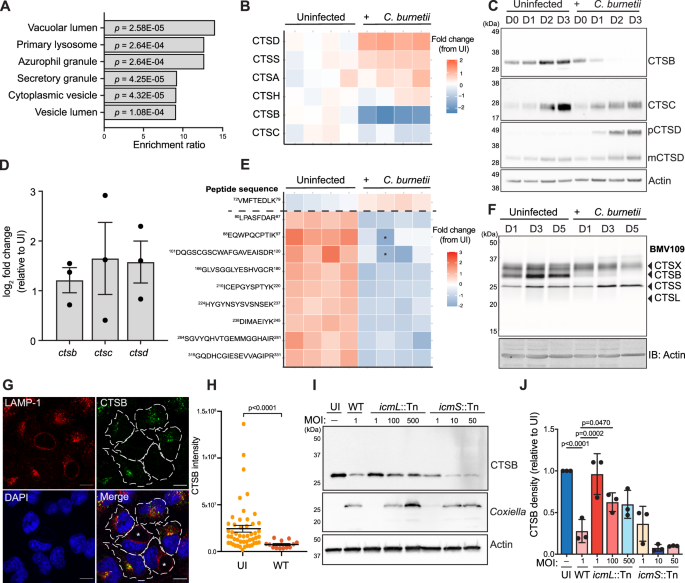
The obligate intracellular bacterium Coxiella burnetii establishes an intracellular replicative niche termed the Coxiella-containing vacuole (CCV), which has been characterised as a bacterially modified phagolysosome. How C. burnetii withstands the acidic and degradative properties of this compartment is not well understood. We demonstrate that the key lysosomal protease cathepsin B is actively and selectively removed from C. burnetii-infected cells through a mechanism involving the Dot/Icm type IV-B secretion system effector CvpB. Overexpression of cathepsin B leads to defects in CCV biogenesis and bacterial replication, indicating that removal of this protein represents a strategy to reduce the hostility of the intracellular niche. In addition, we show that C. burnetii infection of mammalian cells induces the secretion of a wider cohort of lysosomal proteins, including cathepsin B, to the extracellular milieu via a mechanism dependent on retrograde traffic. This study reveals that C. burnetii is actively modulating the hydrolase cohort of its replicative niche to promote intracellular success and demonstrates that infection incites the secretory pathway to maintain lysosomal homoeostasis.
期刊介绍:
Nature Communications, an open-access journal, publishes high-quality research spanning all areas of the natural sciences. Papers featured in the journal showcase significant advances relevant to specialists in each respective field. With a 2-year impact factor of 16.6 (2022) and a median time of 8 days from submission to the first editorial decision, Nature Communications is committed to rapid dissemination of research findings. As a multidisciplinary journal, it welcomes contributions from biological, health, physical, chemical, Earth, social, mathematical, applied, and engineering sciences, aiming to highlight important breakthroughs within each domain.



 京公网安备 11010802042870号
京ICP备2023020795号-1
京公网安备 11010802042870号
京ICP备2023020795号-1

 分享
分享
 求助内容:
求助内容: 应助结果提醒方式:
 扫码关注我们
