Ravi Teja Mittireddi , Mayank Dotiyal , Priyanka Hemani , Ranjan Kumar Singh , Emila Panda
{"title":"Microchemical induced magnetic changes in thermally oxidized Sm2(Co, Fe, Cu, Zr)17 alloys","authors":"Ravi Teja Mittireddi , Mayank Dotiyal , Priyanka Hemani , Ranjan Kumar Singh , Emila Panda","doi":"10.1016/j.jallcom.2025.180608","DOIUrl":null,"url":null,"abstract":"<div><div>Permanent loss of hard ferromagnetic characteristics in Sm<sub>2</sub>(Co, Fe, Cu, Zr)<sub>17</sub> (2:17) alloys on account of disruption in microchemical characteristics of their cellular nanostructure due to thermal oxidation, is a key determinant for their selection concerning prolonged application cycles under extreme conditions. However, studies in the context of microchemical induced magnetic changes in thermally oxidized 2:17 alloys are found to be limited in the literature. In this regard, this study systematically investigates the bulk and the surface magnetic changes induced in thermally oxidized (in the temperature range of 373 K to 973 K at <em>P</em> = 1.013 × 10<sup>5</sup> Pa) 2:17 permanent magnets of two different alloy grades. Changes in the bulk and the surface magnetic properties are then systematically correlated with the associated microchemical alterations observed in these oxidized alloys. Whereas formation of distinct deterioration zone(s), in varied volume fractions at different oxidation conditions at the expense of hard magnetic phases are attributed to the overall decline in the bulk magnetic characteristics, formation of transition-metal oxides, like, Fe<sub>3</sub>O<sub>4</sub>, Co<sub>3</sub>O<sub>4</sub>, CuO and Cu<sub>2</sub>O near the alloy/oxide-ambient interface are attributed to the observed increase in in-plane magnetic anisotropy. In the end, operating conditions and strategies to combat the irrecoverable losses of magnetic properties are outlined.</div></div>","PeriodicalId":344,"journal":{"name":"Journal of Alloys and Compounds","volume":"1027 ","pages":"Article 180608"},"PeriodicalIF":6.3000,"publicationDate":"2025-05-10","publicationTypes":"Journal Article","fieldsOfStudy":null,"isOpenAccess":false,"openAccessPdf":"","citationCount":"0","resultStr":null,"platform":"Semanticscholar","paperid":null,"PeriodicalName":"Journal of Alloys and Compounds","FirstCategoryId":"88","ListUrlMain":"https://www.sciencedirect.com/science/article/pii/S0925838825021693","RegionNum":2,"RegionCategory":"材料科学","ArticlePicture":[],"TitleCN":null,"AbstractTextCN":null,"PMCID":null,"EPubDate":"2025/4/24 0:00:00","PubModel":"Epub","JCR":"Q2","JCRName":"CHEMISTRY, PHYSICAL","Score":null,"Total":0}
引用次数: 0
Abstract
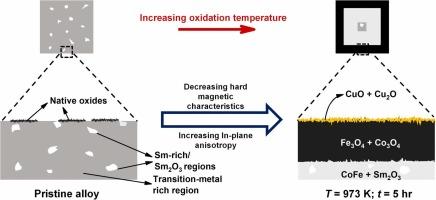
Permanent loss of hard ferromagnetic characteristics in Sm2(Co, Fe, Cu, Zr)17 (2:17) alloys on account of disruption in microchemical characteristics of their cellular nanostructure due to thermal oxidation, is a key determinant for their selection concerning prolonged application cycles under extreme conditions. However, studies in the context of microchemical induced magnetic changes in thermally oxidized 2:17 alloys are found to be limited in the literature. In this regard, this study systematically investigates the bulk and the surface magnetic changes induced in thermally oxidized (in the temperature range of 373 K to 973 K at P = 1.013 × 10⁵ Pa) 2:17 permanent magnets of two different alloy grades. Changes in the bulk and the surface magnetic properties are then systematically correlated with the associated microchemical alterations observed in these oxidized alloys. Whereas formation of distinct deterioration zone(s), in varied volume fractions at different oxidation conditions at the expense of hard magnetic phases are attributed to the overall decline in the bulk magnetic characteristics, formation of transition-metal oxides, like, Fe3O4, Co3O4, CuO and Cu2O near the alloy/oxide-ambient interface are attributed to the observed increase in in-plane magnetic anisotropy. In the end, operating conditions and strategies to combat the irrecoverable losses of magnetic properties are outlined.
期刊介绍:
The Journal of Alloys and Compounds is intended to serve as an international medium for the publication of work on solid materials comprising compounds as well as alloys. Its great strength lies in the diversity of discipline which it encompasses, drawing together results from materials science, solid-state chemistry and physics.



 京公网安备 11010802042870号
京ICP备2023020795号-1
京公网安备 11010802042870号
京ICP备2023020795号-1

 分享
分享
 求助内容:
求助内容: 应助结果提醒方式:
 扫码关注我们
