Improving the quality of egg yolk granules via cryogenic processing: A comprehensive analysis of structural, physicochemical, and functional properties
Fayez Khalaf Mourad , Haoyang Sun , Mahmoud Youssef , Sijie Mi , Dewei Shu , Zhaoxia Cai
{"title":"Improving the quality of egg yolk granules via cryogenic processing: A comprehensive analysis of structural, physicochemical, and functional properties","authors":"Fayez Khalaf Mourad , Haoyang Sun , Mahmoud Youssef , Sijie Mi , Dewei Shu , Zhaoxia Cai","doi":"10.1016/j.foodchem.2025.144504","DOIUrl":null,"url":null,"abstract":"<div><div>Egg yolk granules (EYGs) show great potential in the functional food and pharmaceutical industries, but their limited functionality restricts broader applications. This study investigates the effects of various freezing pretreatments on lyophilized EYGs, comparing prefreezing at −20 °C and − 80 °C, immersion in liquid nitrogen (LN), and grinding in LN. SEM, FTIR, and LF-NMR analyses showed that conventional freezing generated large ice crystals, compromising EYGs' properties. In contrast, LN immersion produced tiny crystals that preserved structural integrity and increased surface area, enhancing drying and molecular interactions. LN-immersed EYGs exhibited improved protein solubility (∼80 %), structural flexibility (∼11 %), surface hydrophobicity, emulsification properties (>20 %), and water distribution compared to freezing at −20 °C. Additional enhancements were observed, including α-helix content (∼19 %), ζ-potential (∼19 %), water/oil-binding capacities (∼11 %), sulfhydryl groups (∼3 %), and tyrosine content (∼20 %). This research demonstrates that rapid freezing effectively preserves EYGs' functional and structural characteristics, expanding their potential for broader industrial applications.</div></div>","PeriodicalId":318,"journal":{"name":"Food Chemistry","volume":"485 ","pages":"Article 144504"},"PeriodicalIF":9.8000,"publicationDate":"2025-09-01","publicationTypes":"Journal Article","fieldsOfStudy":null,"isOpenAccess":false,"openAccessPdf":"","citationCount":"0","resultStr":null,"platform":"Semanticscholar","paperid":null,"PeriodicalName":"Food Chemistry","FirstCategoryId":"97","ListUrlMain":"https://www.sciencedirect.com/science/article/pii/S0308814625017558","RegionNum":1,"RegionCategory":"农林科学","ArticlePicture":[],"TitleCN":null,"AbstractTextCN":null,"PMCID":null,"EPubDate":"2025/4/24 0:00:00","PubModel":"Epub","JCR":"Q1","JCRName":"CHEMISTRY, APPLIED","Score":null,"Total":0}
引用次数: 0
Abstract
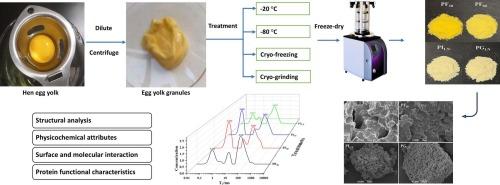
Egg yolk granules (EYGs) show great potential in the functional food and pharmaceutical industries, but their limited functionality restricts broader applications. This study investigates the effects of various freezing pretreatments on lyophilized EYGs, comparing prefreezing at −20 °C and − 80 °C, immersion in liquid nitrogen (LN), and grinding in LN. SEM, FTIR, and LF-NMR analyses showed that conventional freezing generated large ice crystals, compromising EYGs' properties. In contrast, LN immersion produced tiny crystals that preserved structural integrity and increased surface area, enhancing drying and molecular interactions. LN-immersed EYGs exhibited improved protein solubility (∼80 %), structural flexibility (∼11 %), surface hydrophobicity, emulsification properties (>20 %), and water distribution compared to freezing at −20 °C. Additional enhancements were observed, including α-helix content (∼19 %), ζ-potential (∼19 %), water/oil-binding capacities (∼11 %), sulfhydryl groups (∼3 %), and tyrosine content (∼20 %). This research demonstrates that rapid freezing effectively preserves EYGs' functional and structural characteristics, expanding their potential for broader industrial applications.
期刊介绍:
Food Chemistry publishes original research papers dealing with the advancement of the chemistry and biochemistry of foods or the analytical methods/ approach used. All papers should focus on the novelty of the research carried out.





 京公网安备 11010802042870号
京ICP备2023020795号-1
京公网安备 11010802042870号
京ICP备2023020795号-1

 分享
分享
 求助内容:
求助内容: 应助结果提醒方式:
 扫码关注我们
