An Experimental and Theoretical Investigation into [2π + 2π] Cycloaddition Reactions Catalyzed by a Cationic Cobalt(I) Complex Containing a Strong-Field PCNHCP Pincer Ligand
Tofayel Sheikh Mohammad, Yi Jin, Sakthi Raje, Katarzyna Młodzikowska-Pieńko, Zhi-Xiang Yu, Graham de Ruiter
{"title":"An Experimental and Theoretical Investigation into [2π + 2π] Cycloaddition Reactions Catalyzed by a Cationic Cobalt(I) Complex Containing a Strong-Field PCNHCP Pincer Ligand","authors":"Tofayel Sheikh Mohammad, Yi Jin, Sakthi Raje, Katarzyna Młodzikowska-Pieńko, Zhi-Xiang Yu, Graham de Ruiter","doi":"10.1021/jacs.5c00018","DOIUrl":null,"url":null,"abstract":"In the past decade, metal-catalyzed [2π + 2π] cycloaddition reactions have gained significant momentum for the synthesis of substituted cyclobutanes and bicyclo[3.2.0]-heptanes. To date, earth-abundant metals that contain redox non-innocent (radical)-type ligands are most commonly used in these cycloaddition reactions, whereby the redox non-innocent ligand plays a crucial role in stabilizing the oxidation and spin-state of the metal center. Classical π-accepting ligands, however, are inactive for these transformations. Here, we report efficient [2π + 2π] cycloaddition reactions that are catalyzed by a cobalt(I) complex containing a traditional π-accepting but redox innocent PC<sub>NHC</sub>P pincer ligand. Mechanistic and computational investigations revealed a classical Co(I)–Co(III) redox cycle on the singlet spin manifold, where oxidative cyclization is the rate-limiting step. Overall, the herein developed methodology exhibits a wide substrate scope and low catalyst loadings (<1 mol %) and is compatible with a variety of functional groups while occurring under mild conditions (40–60 °C, N<sub>2</sub>) with short reaction times.","PeriodicalId":49,"journal":{"name":"Journal of the American Chemical Society","volume":"11 2 1","pages":""},"PeriodicalIF":15.6000,"publicationDate":"2025-04-24","publicationTypes":"Journal Article","fieldsOfStudy":null,"isOpenAccess":false,"openAccessPdf":"","citationCount":"0","resultStr":null,"platform":"Semanticscholar","paperid":null,"PeriodicalName":"Journal of the American Chemical Society","FirstCategoryId":"92","ListUrlMain":"https://doi.org/10.1021/jacs.5c00018","RegionNum":1,"RegionCategory":"化学","ArticlePicture":[],"TitleCN":null,"AbstractTextCN":null,"PMCID":null,"EPubDate":"","PubModel":"","JCR":"Q1","JCRName":"CHEMISTRY, MULTIDISCIPLINARY","Score":null,"Total":0}
引用次数: 0
Abstract
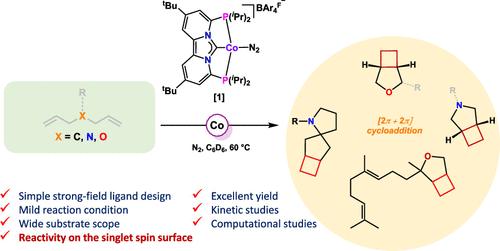
In the past decade, metal-catalyzed [2π + 2π] cycloaddition reactions have gained significant momentum for the synthesis of substituted cyclobutanes and bicyclo[3.2.0]-heptanes. To date, earth-abundant metals that contain redox non-innocent (radical)-type ligands are most commonly used in these cycloaddition reactions, whereby the redox non-innocent ligand plays a crucial role in stabilizing the oxidation and spin-state of the metal center. Classical π-accepting ligands, however, are inactive for these transformations. Here, we report efficient [2π + 2π] cycloaddition reactions that are catalyzed by a cobalt(I) complex containing a traditional π-accepting but redox innocent PCNHCP pincer ligand. Mechanistic and computational investigations revealed a classical Co(I)–Co(III) redox cycle on the singlet spin manifold, where oxidative cyclization is the rate-limiting step. Overall, the herein developed methodology exhibits a wide substrate scope and low catalyst loadings (<1 mol %) and is compatible with a variety of functional groups while occurring under mild conditions (40–60 °C, N2) with short reaction times.
期刊介绍:
The flagship journal of the American Chemical Society, known as the Journal of the American Chemical Society (JACS), has been a prestigious publication since its establishment in 1879. It holds a preeminent position in the field of chemistry and related interdisciplinary sciences. JACS is committed to disseminating cutting-edge research papers, covering a wide range of topics, and encompasses approximately 19,000 pages of Articles, Communications, and Perspectives annually. With a weekly publication frequency, JACS plays a vital role in advancing the field of chemistry by providing essential research.



 京公网安备 11010802042870号
京ICP备2023020795号-1
京公网安备 11010802042870号
京ICP备2023020795号-1

 分享
分享
 求助内容:
求助内容: 应助结果提醒方式:
 扫码关注我们
