Rational design of mixed-valence cobalt-based nanowires via simultaneous vanadium and iron modulations for enhanced alkaline electrochemical water splitting†
Weijiang Gan, Selvam Mathi, Jingting Li, Adewale K. Ipadeola, Jianqiu Deng, Aboubakr M. Abdullah, M.-Sadeeq Balogun and Zhongmin Wang
{"title":"Rational design of mixed-valence cobalt-based nanowires via simultaneous vanadium and iron modulations for enhanced alkaline electrochemical water splitting†","authors":"Weijiang Gan, Selvam Mathi, Jingting Li, Adewale K. Ipadeola, Jianqiu Deng, Aboubakr M. Abdullah, M.-Sadeeq Balogun and Zhongmin Wang","doi":"10.1039/D5NR00801H","DOIUrl":null,"url":null,"abstract":"<p >Strategic modulation of the electronic structure and surface chemistry of electrocatalysts is crucial for achieving highly efficient and cost-effective bifunctional catalysts for water splitting. This study demonstrated the strategic incorporation of redox-active elements (vanadium (V) and iron (Fe)) to optimize the catalytic interface of mixed-valence cobalt-based nanowires (Co<small><sub>5.47</sub></small>N and CoP), which enhanced their hydrogen evolution reaction (HER) and oxygen evolution reaction (OER) catalytic activity. Experimental and theoretical analyses revealed that the dual-cation doping increased the surface area and optimized the electronic structure of the nanowires, which promoted rapid water dissociation, favoured hydrogen adsorption kinetics, and stabilized the oxygen intermediates. Consequently, the V,Fe-Co<small><sub>5.47</sub></small>N and V,Fe-CoP nanowire electrocatalysts achieved low overpotentials of 55/251 and 63/265 mV for HER/OER at 10 mA cm<small><sup>−2</sup></small> in 1 M KOH electrolyte, respectively, outperforming their pristine and single-cation-doped counterparts. The alkaline overall water-splitting devices assembled based on these bifunctional catalysts required an overall voltage of only 1.64 V and 1.66 V at 100 mA cm<small><sup>−2</sup></small> and also demonstrated excellent durability. This work provides valuable insights into enhancing transition metal-based catalysts through the incorporation of redox-active elements for efficient water splitting.</p>","PeriodicalId":92,"journal":{"name":"Nanoscale","volume":" 20","pages":" 12660-12672"},"PeriodicalIF":5.1000,"publicationDate":"2025-04-24","publicationTypes":"Journal Article","fieldsOfStudy":null,"isOpenAccess":false,"openAccessPdf":"","citationCount":"0","resultStr":null,"platform":"Semanticscholar","paperid":null,"PeriodicalName":"Nanoscale","FirstCategoryId":"88","ListUrlMain":"https://pubs.rsc.org/en/content/articlelanding/2025/nr/d5nr00801h","RegionNum":3,"RegionCategory":"材料科学","ArticlePicture":[],"TitleCN":null,"AbstractTextCN":null,"PMCID":null,"EPubDate":"","PubModel":"","JCR":"Q1","JCRName":"CHEMISTRY, MULTIDISCIPLINARY","Score":null,"Total":0}
引用次数: 0
Abstract
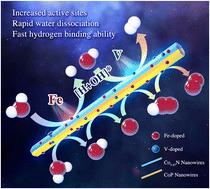
Strategic modulation of the electronic structure and surface chemistry of electrocatalysts is crucial for achieving highly efficient and cost-effective bifunctional catalysts for water splitting. This study demonstrated the strategic incorporation of redox-active elements (vanadium (V) and iron (Fe)) to optimize the catalytic interface of mixed-valence cobalt-based nanowires (Co5.47N and CoP), which enhanced their hydrogen evolution reaction (HER) and oxygen evolution reaction (OER) catalytic activity. Experimental and theoretical analyses revealed that the dual-cation doping increased the surface area and optimized the electronic structure of the nanowires, which promoted rapid water dissociation, favoured hydrogen adsorption kinetics, and stabilized the oxygen intermediates. Consequently, the V,Fe-Co5.47N and V,Fe-CoP nanowire electrocatalysts achieved low overpotentials of 55/251 and 63/265 mV for HER/OER at 10 mA cm−2 in 1 M KOH electrolyte, respectively, outperforming their pristine and single-cation-doped counterparts. The alkaline overall water-splitting devices assembled based on these bifunctional catalysts required an overall voltage of only 1.64 V and 1.66 V at 100 mA cm−2 and also demonstrated excellent durability. This work provides valuable insights into enhancing transition metal-based catalysts through the incorporation of redox-active elements for efficient water splitting.
期刊介绍:
Nanoscale is a high-impact international journal, publishing high-quality research across nanoscience and nanotechnology. Nanoscale publishes a full mix of research articles on experimental and theoretical work, including reviews, communications, and full papers.Highly interdisciplinary, this journal appeals to scientists, researchers and professionals interested in nanoscience and nanotechnology, quantum materials and quantum technology, including the areas of physics, chemistry, biology, medicine, materials, energy/environment, information technology, detection science, healthcare and drug discovery, and electronics.



 京公网安备 11010802042870号
京ICP备2023020795号-1
京公网安备 11010802042870号
京ICP备2023020795号-1

 分享
分享
 求助内容:
求助内容: 应助结果提醒方式:
 扫码关注我们
