{"title":"Percolating Anode Microstructures Underpin the Choice of Electrolyte Composition for a Stable Alkaline Zn Battery","authors":"Minghui Chen, Yilin Ma, Nuotong Li, Liangyu Li, Diwen Xiao, Chunyi Zhi, Qing Chen","doi":"10.1021/acsenergylett.5c00729","DOIUrl":null,"url":null,"abstract":"Rechargeable alkaline Zn batteries are promising alternatives to Li-ion batteries, but the cycle lives remain short at a moderate depth of discharge. The choice of electrolyte has a strong impact, whose exact mechanism has yet to be deciphered. Here, we understand the electrolyte effect from the perspective of passivation, the formation of a ZnO layer in the anode during battery discharging. We reveal that the porosity of the layer determines the failure mechanism. Too low porosity blocks ion transport in 4 M KOH, whereas too high porosity renders a large volume change in 6 M KOH and disrupts electron transport, both of which conform to continuum percolation theory. A Ca(OH)<sub>2</sub>-containing electrolyte results in a medium porosity and enables a stable NiOOH/Zn battery. The work provides not only a quantitative approach to understanding a Zn anode through its microstructure but also a guide to selecting electrolytes for stable Zn batteries.","PeriodicalId":16,"journal":{"name":"ACS Energy Letters ","volume":"22 1","pages":""},"PeriodicalIF":18.2000,"publicationDate":"2025-04-24","publicationTypes":"Journal Article","fieldsOfStudy":null,"isOpenAccess":false,"openAccessPdf":"","citationCount":"0","resultStr":null,"platform":"Semanticscholar","paperid":null,"PeriodicalName":"ACS Energy Letters ","FirstCategoryId":"88","ListUrlMain":"https://doi.org/10.1021/acsenergylett.5c00729","RegionNum":1,"RegionCategory":"材料科学","ArticlePicture":[],"TitleCN":null,"AbstractTextCN":null,"PMCID":null,"EPubDate":"","PubModel":"","JCR":"Q1","JCRName":"CHEMISTRY, PHYSICAL","Score":null,"Total":0}
引用次数: 0
Abstract
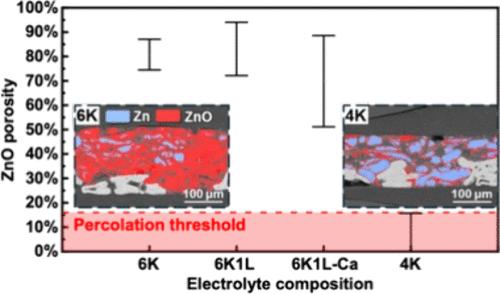
Rechargeable alkaline Zn batteries are promising alternatives to Li-ion batteries, but the cycle lives remain short at a moderate depth of discharge. The choice of electrolyte has a strong impact, whose exact mechanism has yet to be deciphered. Here, we understand the electrolyte effect from the perspective of passivation, the formation of a ZnO layer in the anode during battery discharging. We reveal that the porosity of the layer determines the failure mechanism. Too low porosity blocks ion transport in 4 M KOH, whereas too high porosity renders a large volume change in 6 M KOH and disrupts electron transport, both of which conform to continuum percolation theory. A Ca(OH)2-containing electrolyte results in a medium porosity and enables a stable NiOOH/Zn battery. The work provides not only a quantitative approach to understanding a Zn anode through its microstructure but also a guide to selecting electrolytes for stable Zn batteries.
可充电碱性锌电池有望成为锂离子电池的替代品,但在中等放电深度下,其循环寿命仍然很短。电解质的选择有很强的影响,其确切的机制尚未被破译。在这里,我们从钝化的角度来理解电解液的作用,即电池放电时阳极上形成氧化锌层。揭示了层的孔隙率决定了层的破坏机制。孔隙度过低会阻碍4 M KOH中离子的输运,而过高的孔隙度会导致6 M KOH中较大的体积变化,并破坏电子的输运,两者都符合连续渗流理论。含有Ca(OH)2的电解液具有中等孔隙率,可使NiOOH/Zn电池性能稳定。这项工作不仅提供了一种定量的方法来了解锌阳极的微观结构,而且为稳定的锌电池选择电解质提供了指导。
ACS Energy Letters Energy-Renewable Energy, Sustainability and the Environment
CiteScore
31.20
自引率
5.00%
发文量
469
审稿时长
1 months
期刊介绍:
ACS Energy Letters is a monthly journal that publishes papers reporting new scientific advances in energy research. The journal focuses on topics that are of interest to scientists working in the fundamental and applied sciences. Rapid publication is a central criterion for acceptance, and the journal is known for its quick publication times, with an average of 4-6 weeks from submission to web publication in As Soon As Publishable format.
ACS Energy Letters is ranked as the number one journal in the Web of Science Electrochemistry category. It also ranks within the top 10 journals for Physical Chemistry, Energy & Fuels, and Nanoscience & Nanotechnology.
The journal offers several types of articles, including Letters, Energy Express, Perspectives, Reviews, Editorials, Viewpoints and Energy Focus. Additionally, authors have the option to submit videos that summarize or support the information presented in a Perspective or Review article, which can be highlighted on the journal's website. ACS Energy Letters is abstracted and indexed in Chemical Abstracts Service/SciFinder, EBSCO-summon, PubMed, Web of Science, Scopus and Portico.



 京公网安备 11010802042870号
京ICP备2023020795号-1
京公网安备 11010802042870号
京ICP备2023020795号-1

 分享
分享
 求助内容:
求助内容: 应助结果提醒方式:
 扫码关注我们
