Xue Shao, Xudong Sun, Junjie Yuan, Yao Zhu, Jizhang Wang, Yuting Dai, Tao Zhang, Fengxian Qiu
{"title":"Agricultural Waste–Biochar (Reclaiming Phosphate from Wastewater)–Soil (Slow-Release Phosphate Fertilizer)–Plant (Peanut Growth) System: Economical and Environmentally Sustainable Strategy","authors":"Xue Shao, Xudong Sun, Junjie Yuan, Yao Zhu, Jizhang Wang, Yuting Dai, Tao Zhang, Fengxian Qiu","doi":"10.1021/acssuschemeng.5c02580","DOIUrl":null,"url":null,"abstract":"Excessive use of traditional phosphate fertilizers has led to excess phosphorus entering the environment through leaching, volatilization, and agricultural runoff, causing a series of problems such as eutrophication, soil degradation, and phosphorus resource exhaustion. Therefore, the reclamation of phosphorus from wastewater is essential for ecological protection and sustainable agricultural development. Herein, an effective strategy for the synthesis of calcium-modified porous biochar (CEBC) was provided and designed for the recovery of phosphorus from phosphorus-containing wastewater, followed by its application as a slow-release phosphorus fertilizer. CEBC exhibited an excellent phosphate recovery performance with a maximum adsorption capacity of 193.93 mg P/g. Furthermore, slow-release experiments demonstrated that the nutrient release rate of phosphorus-loaded biochar-based slow-release fertilizer (CEBC-P) was 8.95% within 24 h. After application of CEBC-P, the total biomass accumulation and net photosynthetic rate of peanuts increased by 2.54-fold and 4.91-fold, respectively. Mechanistic studies revealed that phosphate was retained within the biochar through precipitation, coordination, hydrogen bonding, and electrostatic attraction. Moreover, release kinetics optimally fitted the Peppas–Sahlin model (<i>R</i><sup>2</sup> = 0.996), suggesting that the nutrient release from CEBC-P was synergized by diffusion and dissolution. Overall, this study provides an economical and environmentally sustainable strategy for the recovery and recycling of phosphorus resources.","PeriodicalId":25,"journal":{"name":"ACS Sustainable Chemistry & Engineering","volume":"51 1","pages":""},"PeriodicalIF":7.3000,"publicationDate":"2025-04-24","publicationTypes":"Journal Article","fieldsOfStudy":null,"isOpenAccess":false,"openAccessPdf":"","citationCount":"0","resultStr":null,"platform":"Semanticscholar","paperid":null,"PeriodicalName":"ACS Sustainable Chemistry & Engineering","FirstCategoryId":"92","ListUrlMain":"https://doi.org/10.1021/acssuschemeng.5c02580","RegionNum":1,"RegionCategory":"化学","ArticlePicture":[],"TitleCN":null,"AbstractTextCN":null,"PMCID":null,"EPubDate":"","PubModel":"","JCR":"Q1","JCRName":"CHEMISTRY, MULTIDISCIPLINARY","Score":null,"Total":0}
引用次数: 0
Abstract
Excessive use of traditional phosphate fertilizers has led to excess phosphorus entering the environment through leaching, volatilization, and agricultural runoff, causing a series of problems such as eutrophication, soil degradation, and phosphorus resource exhaustion. Therefore, the reclamation of phosphorus from wastewater is essential for ecological protection and sustainable agricultural development. Herein, an effective strategy for the synthesis of calcium-modified porous biochar (CEBC) was provided and designed for the recovery of phosphorus from phosphorus-containing wastewater, followed by its application as a slow-release phosphorus fertilizer. CEBC exhibited an excellent phosphate recovery performance with a maximum adsorption capacity of 193.93 mg P/g. Furthermore, slow-release experiments demonstrated that the nutrient release rate of phosphorus-loaded biochar-based slow-release fertilizer (CEBC-P) was 8.95% within 24 h. After application of CEBC-P, the total biomass accumulation and net photosynthetic rate of peanuts increased by 2.54-fold and 4.91-fold, respectively. Mechanistic studies revealed that phosphate was retained within the biochar through precipitation, coordination, hydrogen bonding, and electrostatic attraction. Moreover, release kinetics optimally fitted the Peppas–Sahlin model (R2 = 0.996), suggesting that the nutrient release from CEBC-P was synergized by diffusion and dissolution. Overall, this study provides an economical and environmentally sustainable strategy for the recovery and recycling of phosphorus resources.
期刊介绍:
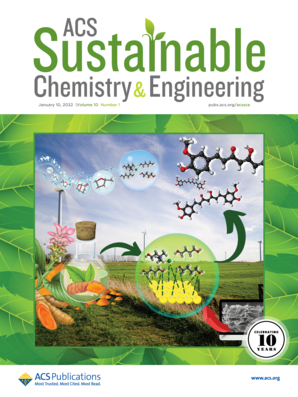
ACS Sustainable Chemistry & Engineering is a prestigious weekly peer-reviewed scientific journal published by the American Chemical Society. Dedicated to advancing the principles of green chemistry and green engineering, it covers a wide array of research topics including green chemistry, green engineering, biomass, alternative energy, and life cycle assessment.
The journal welcomes submissions in various formats, including Letters, Articles, Features, and Perspectives (Reviews), that address the challenges of sustainability in the chemical enterprise and contribute to the advancement of sustainable practices. Join us in shaping the future of sustainable chemistry and engineering.




 京公网安备 11010802042870号
京ICP备2023020795号-1
京公网安备 11010802042870号
京ICP备2023020795号-1

 分享
分享
 求助内容:
求助内容: 应助结果提醒方式:
 扫码关注我们
