Lifang Wu, Rong Zhang, Xinran Wang, Wenyao Zeng, Lanhui Zhang, Yining Gao, Jiyong Liu, Lingbing Kong, Jiaxin Chen and Liliang Wang
{"title":"Cumulative 2c–2e vs. 3c–2e π-back donations: conformation preferences in germylene gold(i) complexes†","authors":"Lifang Wu, Rong Zhang, Xinran Wang, Wenyao Zeng, Lanhui Zhang, Yining Gao, Jiyong Liu, Lingbing Kong, Jiaxin Chen and Liliang Wang","doi":"10.1039/D5QI00539F","DOIUrl":null,"url":null,"abstract":"<p >The first homoleptic and heteroleptic cationic germylene-gold(<small>I</small>) complexes <strong>3</strong>, <strong>4</strong>, and <strong>7</strong> have been synthesized and structurally characterized, accompanied by the discovery of novel types of π-back donations. These complexes exhibit distinct conformation preferences (vertical <em>vs.</em> quasi-planar) modulated by the π-acceptor capacity of germylene and NHC ligands. Our bonding analyses further indicated that the homoleptic complex <strong>3</strong> exhibits marvellous cumulative two-center–two-electron (2c–2e) π-back donations, whereas the heteroleptic complexes <strong>4</strong> and <strong>7</strong> demonstrate extraordinary three-center–two-electron (3c–2e) π-back donations. These findings offer a comprehensive explanation for the atypical disruption of extensive π-systems, along with the transition from quasi-planar to vertical conformations.</p>","PeriodicalId":79,"journal":{"name":"Inorganic Chemistry Frontiers","volume":" 17","pages":" 5152-5158"},"PeriodicalIF":6.4000,"publicationDate":"2025-04-24","publicationTypes":"Journal Article","fieldsOfStudy":null,"isOpenAccess":false,"openAccessPdf":"","citationCount":"0","resultStr":null,"platform":"Semanticscholar","paperid":null,"PeriodicalName":"Inorganic Chemistry Frontiers","FirstCategoryId":"92","ListUrlMain":"https://pubs.rsc.org/en/content/articlelanding/2025/qi/d5qi00539f","RegionNum":1,"RegionCategory":"化学","ArticlePicture":[],"TitleCN":null,"AbstractTextCN":null,"PMCID":null,"EPubDate":"","PubModel":"","JCR":"Q1","JCRName":"CHEMISTRY, INORGANIC & NUCLEAR","Score":null,"Total":0}
引用次数: 0
Abstract
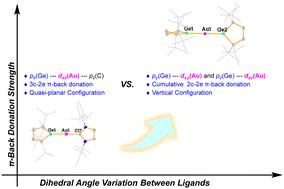
The first homoleptic and heteroleptic cationic germylene-gold(I) complexes 3, 4, and 7 have been synthesized and structurally characterized, accompanied by the discovery of novel types of π-back donations. These complexes exhibit distinct conformation preferences (vertical vs. quasi-planar) modulated by the π-acceptor capacity of germylene and NHC ligands. Our bonding analyses further indicated that the homoleptic complex 3 exhibits marvellous cumulative two-center–two-electron (2c–2e) π-back donations, whereas the heteroleptic complexes 4 and 7 demonstrate extraordinary three-center–two-electron (3c–2e) π-back donations. These findings offer a comprehensive explanation for the atypical disruption of extensive π-systems, along with the transition from quasi-planar to vertical conformations.



 京公网安备 11010802042870号
京ICP备2023020795号-1
京公网安备 11010802042870号
京ICP备2023020795号-1

 分享
分享
 求助内容:
求助内容: 应助结果提醒方式:
 扫码关注我们
