Jia Cao, Xiongyi Liang, Wei Gao, Di Yin, Xiuming Bu, Siwei Yang, Chuqian Xiao, Shaoyan Wang, Xiao Cheng Zeng, Johnny C. Ho and Xianying Wang
{"title":"Reversible lattice oxygen participation in Ru1−xO2−x for superior acidic oxygen evolution reaction†","authors":"Jia Cao, Xiongyi Liang, Wei Gao, Di Yin, Xiuming Bu, Siwei Yang, Chuqian Xiao, Shaoyan Wang, Xiao Cheng Zeng, Johnny C. Ho and Xianying Wang","doi":"10.1039/D5TA01484K","DOIUrl":null,"url":null,"abstract":"<p >A stable and efficient RuO<small><sub>2</sub></small>-based electrocatalyst for the acidic oxygen evolution reaction (OER) is essential to replace the current IrO<small><sub>2</sub></small> anode in proton-exchange membrane water electrolysis (PEMWE). Herein, we introduce RuO<small><sub>2</sub></small> catalysts designed with coexisting oxygen and ruthenium vacancies using a metal–organic pyrolysis method. In 0.5 M H<small><sub>2</sub></small>SO<small><sub>4</sub></small> using a three-electrode configuration, the catalyst delivers a low overpotential of 193 mV at 10 mA cm<small><sup>−2</sup></small>. Experimental and theoretical analyses reveal facet-dependent mechanisms: oxygen vacancies stabilize (110) and (101) facets by suppressing excessive Ru vacancy formation during reconstruction, while Ru vacancies on (101) uniquely activate lattice oxygen to enable a reversible lattice oxygen-mediated (LOM) cycle. DFT calculations rationalize this behavior: Ru vacancies lower the deprotonation of adsorbed hydroxyl (RDS) to 1.51 eV on (101) facets, while lattice oxygen coupling <em>via</em> the LOM proceeds at a remarkably low barrier of 1.02 eV, synergistically promoting rapid oxygen replenishment and durable cycling. In contrast, the (110) facet suffers from prohibitive barriers (>2.0 eV) in both adsorbate-driven and lattice oxygen pathways. Consequently, the (101)-dominant catalyst operates stably at 100 mA cm<small><sup>−2</sup></small> in PEMWE for 200 h, outperforming the conventional IrO<small><sub>2</sub></small> benchmark.</p>","PeriodicalId":82,"journal":{"name":"Journal of Materials Chemistry A","volume":" 22","pages":" 16807-16815"},"PeriodicalIF":9.5000,"publicationDate":"2025-04-24","publicationTypes":"Journal Article","fieldsOfStudy":null,"isOpenAccess":false,"openAccessPdf":"","citationCount":"0","resultStr":null,"platform":"Semanticscholar","paperid":null,"PeriodicalName":"Journal of Materials Chemistry A","FirstCategoryId":"88","ListUrlMain":"https://pubs.rsc.org/en/content/articlelanding/2025/ta/d5ta01484k","RegionNum":2,"RegionCategory":"材料科学","ArticlePicture":[],"TitleCN":null,"AbstractTextCN":null,"PMCID":null,"EPubDate":"","PubModel":"","JCR":"Q1","JCRName":"CHEMISTRY, PHYSICAL","Score":null,"Total":0}
引用次数: 0
Abstract
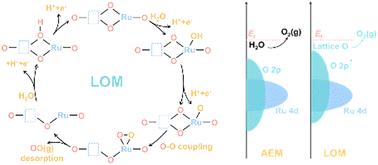
A stable and efficient RuO2-based electrocatalyst for the acidic oxygen evolution reaction (OER) is essential to replace the current IrO2 anode in proton-exchange membrane water electrolysis (PEMWE). Herein, we introduce RuO2 catalysts designed with coexisting oxygen and ruthenium vacancies using a metal–organic pyrolysis method. In 0.5 M H2SO4 using a three-electrode configuration, the catalyst delivers a low overpotential of 193 mV at 10 mA cm−2. Experimental and theoretical analyses reveal facet-dependent mechanisms: oxygen vacancies stabilize (110) and (101) facets by suppressing excessive Ru vacancy formation during reconstruction, while Ru vacancies on (101) uniquely activate lattice oxygen to enable a reversible lattice oxygen-mediated (LOM) cycle. DFT calculations rationalize this behavior: Ru vacancies lower the deprotonation of adsorbed hydroxyl (RDS) to 1.51 eV on (101) facets, while lattice oxygen coupling via the LOM proceeds at a remarkably low barrier of 1.02 eV, synergistically promoting rapid oxygen replenishment and durable cycling. In contrast, the (110) facet suffers from prohibitive barriers (>2.0 eV) in both adsorbate-driven and lattice oxygen pathways. Consequently, the (101)-dominant catalyst operates stably at 100 mA cm−2 in PEMWE for 200 h, outperforming the conventional IrO2 benchmark.
一种稳定高效的基于ruo2的酸性析氧反应(OER)电催化剂是取代目前质子交换膜电解(PEMWE)中IrO2阳极的必要条件。在本研究中,我们采用金属-有机热解法设计了氧和钌空位共存的RuO2催化剂。我们的实验和理论分析表明,OER通路在不同方面有所不同。氧空位是至关重要的,因为它们在原位表面重建过程中提高了额外Ru空位形成的能量势垒,从而稳定了(110)和(101)面。值得注意的是,(101)面中的Ru空位激活晶格氧,允许快速补充耗尽的晶格氧,并实现可逆的晶格氧参与(LOM)循环过程。因此,催化剂主要暴露在(101)面,表现出出色的稳定性,通过LOM途径在定制组装的PEMWEs中以100 mA cm-2连续工作200小时。这一进步为水电解应用中更强大、更高效的催化剂打开了大门。
期刊介绍:
The Journal of Materials Chemistry A, B & C covers a wide range of high-quality studies in the field of materials chemistry, with each section focusing on specific applications of the materials studied. Journal of Materials Chemistry A emphasizes applications in energy and sustainability, including topics such as artificial photosynthesis, batteries, and fuel cells. Journal of Materials Chemistry B focuses on applications in biology and medicine, while Journal of Materials Chemistry C covers applications in optical, magnetic, and electronic devices. Example topic areas within the scope of Journal of Materials Chemistry A include catalysis, green/sustainable materials, sensors, and water treatment, among others.



 京公网安备 11010802042870号
京ICP备2023020795号-1
京公网安备 11010802042870号
京ICP备2023020795号-1

 分享
分享
 求助内容:
求助内容: 应助结果提醒方式:
 扫码关注我们
