{"title":"Metal-Organic Cages Assembled From {Ni6} Nodes for Selective CO2 Reduction","authors":"Man-Ting Lv, Meng-Di Cui, Kai-Peng Bai, Yu Jiang, Wei-Peng Chen, Na-Na Sun, Xiang-Quan Hu, Chang Huang, Qing-Yuan Yang, Yan-Zhen Zheng","doi":"10.1002/anie.202506838","DOIUrl":null,"url":null,"abstract":"<p>Constructing cluster-based nodes and using them as catalytic sites can bring new structure and function for metal-organic cages (MOCs). However, successful examples are very limited. Herein, we found that a 2-mercapto-5-methyl-1,3,4-thiadiazole (Hmmt) based {Ni<sub>6</sub>} subunit is robust in building such MOCs. The {Ni<sub>6</sub>} node is based on the central Ni<sub>4</sub> cubane and two wing Ni(II) ions with virtually three or four connected features. When various carboxylate ligands are incorporated the triangular prismatic [Ni<sub>18</sub>(Hmmt)<sub>3</sub>(mmt)<sub>12</sub>(BPDC)<sub>6</sub>(CH<sub>3</sub>O)<sub>12</sub>(H<sub>2</sub>O)<sub>6</sub>(DMF)<sub>6</sub>] (<b>4</b>/MOC-18N, H<sub>2</sub>BPDC = biphenyl-4,4′-dicarboxylic acid), tetrahedral-like [Ni<sub>24</sub>(Hmmt)<sub>4</sub>(mmt)<sub>16</sub>(BTC)<sub>4</sub>(CH<sub>3</sub>O)<sub>16</sub>Cl<sub>4</sub>(H<sub>2</sub>O)<sub>4</sub>(DMF)<sub>5</sub>(CH<sub>3</sub>OH)<sub>3</sub>] (<b>5</b>/MOC-24N, H<sub>3</sub>BTC = 1,3,5-benzenetricarboxylic acid) and the octahedral [Ni<sub>36</sub>(Hmmt)<sub>6</sub>(mmt)<sub>24</sub>(BTC)<sub>8</sub>(CH<sub>3</sub>O)<sub>24</sub>(H<sub>2</sub>O)<sub>12</sub>(DMF)<sub>12</sub>] (<b>6</b>/MOC-36N) can be isolated. Interestingly, MOCs <b>4–6</b> can uptake CO<sub>2</sub> in solid states. Moreover, they can effectively and selectively convert CO<sub>2</sub> into CO under visible light owing to the active wing Ni(II) ions, which are ancillarily coordinated with solvent molecules. All of them show turnover frequencies larger than 3500 µmol·g<sup>−1</sup>·h<sup>−1</sup> and selectivity higher than 90%. This is a much higher performance compared to the usage of cage space for CO<sub>2</sub> reduction in previously reported MOCs and competitive to most Ni(II)-based simple coordination complexes. As such, this work may open a new paradigm for designing node based catalytic function for MOCs.</p>","PeriodicalId":125,"journal":{"name":"Angewandte Chemie International Edition","volume":"64 27","pages":""},"PeriodicalIF":16.9000,"publicationDate":"2025-04-24","publicationTypes":"Journal Article","fieldsOfStudy":null,"isOpenAccess":false,"openAccessPdf":"","citationCount":"0","resultStr":null,"platform":"Semanticscholar","paperid":null,"PeriodicalName":"Angewandte Chemie International Edition","FirstCategoryId":"92","ListUrlMain":"https://onlinelibrary.wiley.com/doi/10.1002/anie.202506838","RegionNum":1,"RegionCategory":"化学","ArticlePicture":[],"TitleCN":null,"AbstractTextCN":null,"PMCID":null,"EPubDate":"","PubModel":"","JCR":"Q1","JCRName":"CHEMISTRY, MULTIDISCIPLINARY","Score":null,"Total":0}
引用次数: 0
Abstract
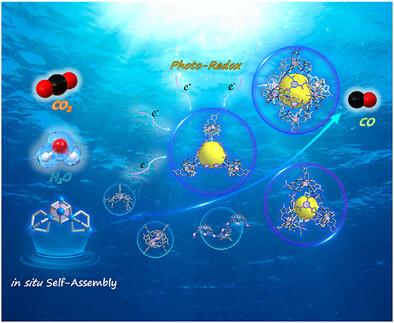
Constructing cluster-based nodes and using them as catalytic sites can bring new structure and function for metal-organic cages (MOCs). However, successful examples are very limited. Herein, we found that a 2-mercapto-5-methyl-1,3,4-thiadiazole (Hmmt) based {Ni6} subunit is robust in building such MOCs. The {Ni6} node is based on the central Ni4 cubane and two wing Ni(II) ions with virtually three or four connected features. When various carboxylate ligands are incorporated the triangular prismatic [Ni18(Hmmt)3(mmt)12(BPDC)6(CH3O)12(H2O)6(DMF)6] (4/MOC-18N, H2BPDC = biphenyl-4,4′-dicarboxylic acid), tetrahedral-like [Ni24(Hmmt)4(mmt)16(BTC)4(CH3O)16Cl4(H2O)4(DMF)5(CH3OH)3] (5/MOC-24N, H3BTC = 1,3,5-benzenetricarboxylic acid) and the octahedral [Ni36(Hmmt)6(mmt)24(BTC)8(CH3O)24(H2O)12(DMF)12] (6/MOC-36N) can be isolated. Interestingly, MOCs 4–6 can uptake CO2 in solid states. Moreover, they can effectively and selectively convert CO2 into CO under visible light owing to the active wing Ni(II) ions, which are ancillarily coordinated with solvent molecules. All of them show turnover frequencies larger than 3500 µmol·g−1·h−1 and selectivity higher than 90%. This is a much higher performance compared to the usage of cage space for CO2 reduction in previously reported MOCs and competitive to most Ni(II)-based simple coordination complexes. As such, this work may open a new paradigm for designing node based catalytic function for MOCs.
期刊介绍:
Angewandte Chemie, a journal of the German Chemical Society (GDCh), maintains a leading position among scholarly journals in general chemistry with an impressive Impact Factor of 16.6 (2022 Journal Citation Reports, Clarivate, 2023). Published weekly in a reader-friendly format, it features new articles almost every day. Established in 1887, Angewandte Chemie is a prominent chemistry journal, offering a dynamic blend of Review-type articles, Highlights, Communications, and Research Articles on a weekly basis, making it unique in the field.




 京公网安备 11010802042870号
京ICP备2023020795号-1
京公网安备 11010802042870号
京ICP备2023020795号-1

 分享
分享
 求助内容:
求助内容: 应助结果提醒方式:
 扫码关注我们
