Dr. Volker Klein, Florian Schuster, Jonas Amthor, Dr. Harald Maid, Prabhakar Bijalwan, Prof. Dr. Fahmi Himo, Prof. Dr. Stefano Santoro, Prof. Dr. Svetlana B. Tsogoeva
{"title":"Development of an Organoautocatalyzed Double σ-Bond C(sp2)-N Transamination Metathesis Reaction","authors":"Dr. Volker Klein, Florian Schuster, Jonas Amthor, Dr. Harald Maid, Prabhakar Bijalwan, Prof. Dr. Fahmi Himo, Prof. Dr. Stefano Santoro, Prof. Dr. Svetlana B. Tsogoeva","doi":"10.1002/anie.202505275","DOIUrl":null,"url":null,"abstract":"<p>The transamination reaction, which involves the conversion of one amine to another, traditionally relies on biological enzyme catalysts. Although chemists have recently developed a few transition metal-catalyzed methods, mimicking these enzymes to interconvert amine groups in acyclic substrates via transamination metathesis of a single C(sp<sup>2</sup>)─N bond, transamination of cyclic tertiary amines has remained a challenge in synthetic chemistry. Here, we present the development of organoautocatalyzed transamination metathesis of two C(sp<sup>2</sup>)─N bonds in a cyclic substrate that allows for the challenging transformation to take place with up to 95% yield under exceptionally mild reaction conditions at room temperature without external catalysts and/or additives. The reaction mechanism has been studied in detail through time-resolved <sup>1</sup>H-NMR, 2D NMR, and computational methods. Remarkably, in situ-formed pyrrolidinium salt acts as a hydrogen bond donor (HBD) organoautocatalyst in this multi-step domino process. The new organoautocatalyzed methodology gives environmentally friendly, atom-economical, straightforward, and rapid access to <i>N</i>-substituted 3,5-dinitro-1,4-dihydropyridines (DNDHPs), thus offering facile entry to privileged bioactive compounds.</p>","PeriodicalId":125,"journal":{"name":"Angewandte Chemie International Edition","volume":"64 28","pages":""},"PeriodicalIF":16.9000,"publicationDate":"2025-04-24","publicationTypes":"Journal Article","fieldsOfStudy":null,"isOpenAccess":false,"openAccessPdf":"https://onlinelibrary.wiley.com/doi/epdf/10.1002/anie.202505275","citationCount":"0","resultStr":null,"platform":"Semanticscholar","paperid":null,"PeriodicalName":"Angewandte Chemie International Edition","FirstCategoryId":"92","ListUrlMain":"https://onlinelibrary.wiley.com/doi/10.1002/anie.202505275","RegionNum":1,"RegionCategory":"化学","ArticlePicture":[],"TitleCN":null,"AbstractTextCN":null,"PMCID":null,"EPubDate":"","PubModel":"","JCR":"Q1","JCRName":"CHEMISTRY, MULTIDISCIPLINARY","Score":null,"Total":0}
引用次数: 0
Abstract
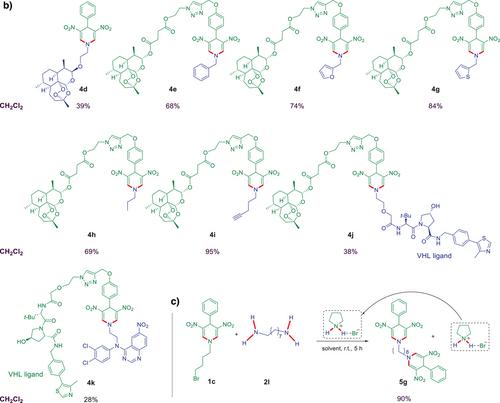
The transamination reaction, which involves the conversion of one amine to another, traditionally relies on biological enzyme catalysts. Although chemists have recently developed a few transition metal-catalyzed methods, mimicking these enzymes to interconvert amine groups in acyclic substrates via transamination metathesis of a single C(sp2)─N bond, transamination of cyclic tertiary amines has remained a challenge in synthetic chemistry. Here, we present the development of organoautocatalyzed transamination metathesis of two C(sp2)─N bonds in a cyclic substrate that allows for the challenging transformation to take place with up to 95% yield under exceptionally mild reaction conditions at room temperature without external catalysts and/or additives. The reaction mechanism has been studied in detail through time-resolved 1H-NMR, 2D NMR, and computational methods. Remarkably, in situ-formed pyrrolidinium salt acts as a hydrogen bond donor (HBD) organoautocatalyst in this multi-step domino process. The new organoautocatalyzed methodology gives environmentally friendly, atom-economical, straightforward, and rapid access to N-substituted 3,5-dinitro-1,4-dihydropyridines (DNDHPs), thus offering facile entry to privileged bioactive compounds.
期刊介绍:
Angewandte Chemie, a journal of the German Chemical Society (GDCh), maintains a leading position among scholarly journals in general chemistry with an impressive Impact Factor of 16.6 (2022 Journal Citation Reports, Clarivate, 2023). Published weekly in a reader-friendly format, it features new articles almost every day. Established in 1887, Angewandte Chemie is a prominent chemistry journal, offering a dynamic blend of Review-type articles, Highlights, Communications, and Research Articles on a weekly basis, making it unique in the field.



 京公网安备 11010802042870号
京ICP备2023020795号-1
京公网安备 11010802042870号
京ICP备2023020795号-1

 分享
分享
 求助内容:
求助内容: 应助结果提醒方式:
 扫码关注我们
