Douglas E. Soutar, Ho Fung Mack, Melissa Ligorio, Akalabya Bissoyi, Alexander N. Baker and Matthew I. Gibson
{"title":"PVAylation: precision end-functionalized poly(vinyl alcohol) for site-selective bioconjugation†","authors":"Douglas E. Soutar, Ho Fung Mack, Melissa Ligorio, Akalabya Bissoyi, Alexander N. Baker and Matthew I. Gibson","doi":"10.1039/D5SC00772K","DOIUrl":null,"url":null,"abstract":"<p >The (bio)conjugation of polymers onto proteins enhances their pharmacokinetics and stability, most commonly using PEG (polyethylene glycol), but there is a need for alternatives. Poly(vinyl alcohol), PVA, is a water-soluble, biocompatible and environmentally degradable polymer, which also has the unique function of ice recrystallisation inhibition (IRI) which can aid the cryopreservation of biologics. Site-specific PVA bioconjugation (“PVAylation”) is underexplored due to the challenge of obtaining homogenous mono end-functional PVA. Here we show that following deprotection of the acetate (from the precursor poly(vinyl acetate)), the concurrent xanthate end-group reduction leads to a diversity of ambiguous end-groups which prevented precision conjugation. This is overcome by using a photo-catalyzed reduction of the omega-terminal xanthates to C–H, which is orthogonal to active-ester bioconjugation functionality at the alpha-chain terminus, demonstrated by MALDI-TOF mass spectrometry. This strategy enabled the preparation of well-defined mono-functional PVA displaying alkyne, biotin and O<small><sup>6</sup></small>-benzylguanine chain-end functionalities, which are each then used for covalent or non-covalent site-specific modification of three model proteins, introduce ice-binding function. These results will enable the synthesis of new bioconjugates containing PVA and be of particular benefit for low-temperature applications.</p>","PeriodicalId":9909,"journal":{"name":"Chemical Science","volume":" 21","pages":" 9264-9275"},"PeriodicalIF":7.4000,"publicationDate":"2025-04-24","publicationTypes":"Journal Article","fieldsOfStudy":null,"isOpenAccess":false,"openAccessPdf":"https://pubs.rsc.org/en/content/articlepdf/2025/sc/d5sc00772k?page=search","citationCount":"0","resultStr":null,"platform":"Semanticscholar","paperid":null,"PeriodicalName":"Chemical Science","FirstCategoryId":"92","ListUrlMain":"https://pubs.rsc.org/en/content/articlelanding/2025/sc/d5sc00772k","RegionNum":1,"RegionCategory":"化学","ArticlePicture":[],"TitleCN":null,"AbstractTextCN":null,"PMCID":null,"EPubDate":"","PubModel":"","JCR":"Q1","JCRName":"CHEMISTRY, MULTIDISCIPLINARY","Score":null,"Total":0}
引用次数: 0
Abstract
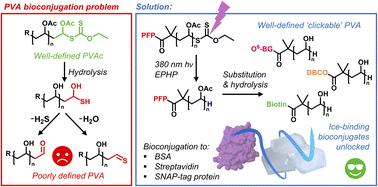
The (bio)conjugation of polymers onto proteins enhances their pharmacokinetics and stability, most commonly using PEG (polyethylene glycol), but there is a need for alternatives. Poly(vinyl alcohol), PVA, is a water-soluble, biocompatible and environmentally degradable polymer, which also has the unique function of ice recrystallisation inhibition (IRI) which can aid the cryopreservation of biologics. Site-specific PVA bioconjugation (“PVAylation”) is underexplored due to the challenge of obtaining homogenous mono end-functional PVA. Here we show that following deprotection of the acetate (from the precursor poly(vinyl acetate)), the concurrent xanthate end-group reduction leads to a diversity of ambiguous end-groups which prevented precision conjugation. This is overcome by using a photo-catalyzed reduction of the omega-terminal xanthates to C–H, which is orthogonal to active-ester bioconjugation functionality at the alpha-chain terminus, demonstrated by MALDI-TOF mass spectrometry. This strategy enabled the preparation of well-defined mono-functional PVA displaying alkyne, biotin and O6-benzylguanine chain-end functionalities, which are each then used for covalent or non-covalent site-specific modification of three model proteins, introduce ice-binding function. These results will enable the synthesis of new bioconjugates containing PVA and be of particular benefit for low-temperature applications.
期刊介绍:
Chemical Science is a journal that encompasses various disciplines within the chemical sciences. Its scope includes publishing ground-breaking research with significant implications for its respective field, as well as appealing to a wider audience in related areas. To be considered for publication, articles must showcase innovative and original advances in their field of study and be presented in a manner that is understandable to scientists from diverse backgrounds. However, the journal generally does not publish highly specialized research.





 京公网安备 11010802042870号
京ICP备2023020795号-1
京公网安备 11010802042870号
京ICP备2023020795号-1

 分享
分享
 求助内容:
求助内容: 应助结果提醒方式:
 扫码关注我们
