Hou-Ji Cao, Jia-Xin Li, Jia-Hui Yan, Miao-Xin Liu, Qianyi Zhao, Jie Zhang, Ju Zhang and Hong Yan
{"title":"Post-coordination of Ru(ii) controlled regioselective B(4)–H acylmethylation of o-carboranes with sulfoxonium ylides†","authors":"Hou-Ji Cao, Jia-Xin Li, Jia-Hui Yan, Miao-Xin Liu, Qianyi Zhao, Jie Zhang, Ju Zhang and Hong Yan","doi":"10.1039/D5SC01576F","DOIUrl":null,"url":null,"abstract":"<p >Despite significant progress in the B–H functionalization of carboranes, the development of cost-effective catalytic systems devoid of noble metals, coupled with mechanistic validation of regioselectivity control, remains a formidable challenge. Herein, we disclose an Ag salt-free, redox-neutral, and inexpensive ruthenium(<small>II</small>)-catalyzed protocol that enables exclusive B(4)–H acylmethylation of <em>o</em>-carboranes through a novel post-coordination strategy. By exploiting weakly coordinating carboxylic acid as a traceless directing group, this method achieves excellent mono-site selectivity for B–C(sp<small><sup>3</sup></small>) bond formation using diverse sulfoxonium ylides, demonstrating both functional group tolerance and synthetic scalability. This work not only establishes a practical synthetic platform but also addresses critical mechanistic questions unresolved in prior analogous studies. Through deuterium labeling, <em>in situ</em> high-resolution mass spectrometry (HRMS) tracking, and single-crystal X-ray analysis of critical Ru intermediates, we unequivocally demonstrate that the mono-site selectivity originates from a unique post-coordination mode of Ru(<small>II</small>). The Ru catalyst simultaneously engages both the carboxylic acid and the enolizable acylmethyl moiety in the mono-acylated intermediate, thereby dictating the B(4)–H activation trajectory. Our findings establish a generalizable platform for regiocontrolled carborane functionalization while defining mechanistic paradigms in transition metal-mediated B–H activation chemistry.</p>","PeriodicalId":9909,"journal":{"name":"Chemical Science","volume":" 21","pages":" 9406-9412"},"PeriodicalIF":7.4000,"publicationDate":"2025-04-24","publicationTypes":"Journal Article","fieldsOfStudy":null,"isOpenAccess":false,"openAccessPdf":"https://pubs.rsc.org/en/content/articlepdf/2025/sc/d5sc01576f?page=search","citationCount":"0","resultStr":null,"platform":"Semanticscholar","paperid":null,"PeriodicalName":"Chemical Science","FirstCategoryId":"92","ListUrlMain":"https://pubs.rsc.org/en/content/articlelanding/2025/sc/d5sc01576f","RegionNum":1,"RegionCategory":"化学","ArticlePicture":[],"TitleCN":null,"AbstractTextCN":null,"PMCID":null,"EPubDate":"","PubModel":"","JCR":"Q1","JCRName":"CHEMISTRY, MULTIDISCIPLINARY","Score":null,"Total":0}
引用次数: 0
Abstract
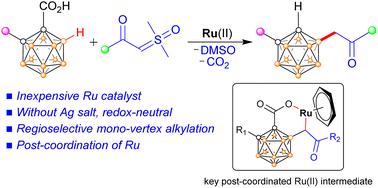
Despite significant progress in the B–H functionalization of carboranes, the development of cost-effective catalytic systems devoid of noble metals, coupled with mechanistic validation of regioselectivity control, remains a formidable challenge. Herein, we disclose an Ag salt-free, redox-neutral, and inexpensive ruthenium(II)-catalyzed protocol that enables exclusive B(4)–H acylmethylation of o-carboranes through a novel post-coordination strategy. By exploiting weakly coordinating carboxylic acid as a traceless directing group, this method achieves excellent mono-site selectivity for B–C(sp3) bond formation using diverse sulfoxonium ylides, demonstrating both functional group tolerance and synthetic scalability. This work not only establishes a practical synthetic platform but also addresses critical mechanistic questions unresolved in prior analogous studies. Through deuterium labeling, in situ high-resolution mass spectrometry (HRMS) tracking, and single-crystal X-ray analysis of critical Ru intermediates, we unequivocally demonstrate that the mono-site selectivity originates from a unique post-coordination mode of Ru(II). The Ru catalyst simultaneously engages both the carboxylic acid and the enolizable acylmethyl moiety in the mono-acylated intermediate, thereby dictating the B(4)–H activation trajectory. Our findings establish a generalizable platform for regiocontrolled carborane functionalization while defining mechanistic paradigms in transition metal-mediated B–H activation chemistry.
期刊介绍:
Chemical Science is a journal that encompasses various disciplines within the chemical sciences. Its scope includes publishing ground-breaking research with significant implications for its respective field, as well as appealing to a wider audience in related areas. To be considered for publication, articles must showcase innovative and original advances in their field of study and be presented in a manner that is understandable to scientists from diverse backgrounds. However, the journal generally does not publish highly specialized research.




 京公网安备 11010802042870号
京ICP备2023020795号-1
京公网安备 11010802042870号
京ICP备2023020795号-1

 分享
分享
 求助内容:
求助内容: 应助结果提醒方式:
 扫码关注我们
