{"title":"SLC7A11 is an unconventional H+ transporter in lysosomes","authors":"Nan Zhou, Jingzhi Chen, Meiqin Hu, Na Wen, Weijie Cai, Ping Li, Liding Zhao, Yaping Meng, Dongdong Zhao, Xiaotong Yang, Siyu Liu, Fangqian Huang, Cheng Zhao, Xinghua Feng, Zikai Jiang, Enjun Xie, Hongxu Pan, Zhidong Cen, Xinhui Chen, Wei Luo, Haoxing Xu","doi":"10.1016/j.cell.2025.04.004","DOIUrl":null,"url":null,"abstract":"Lysosomes maintain an acidic pH of 4.5–5.0, optimal for macromolecular degradation. Whereas proton influx is produced by a V-type H<sup>+</sup> ATPase, proton efflux is mediated by a fast H<sup>+</sup> leak through TMEM175 channels, as well as an unidentified slow pathway. A candidate screen on an orphan lysosome membrane protein (OLMP) library enabled us to discover that SLC7A11, the protein target of the ferroptosis-inducing compound erastin, mediates a slow lysosomal H<sup>+</sup> leak through downward flux of cystine and glutamate, two H<sup>+</sup> equivalents with uniquely large but opposite concentration gradients across lysosomal membranes. SLC7A11 deficiency or inhibition caused lysosomal over-acidification, reduced degradation, accumulation of storage materials, and ferroptosis, as well as facilitated α-synuclein aggregation in neurons. Correction of abnormal lysosomal acidity restored lysosome homeostasis and prevented ferroptosis. These studies have revealed an unconventional H<sup>+</sup> transport conduit that is integral to lysosomal flux of protonatable metabolites to regulate lysosome function, ferroptosis, and Parkinson’s disease (PD) pathology.","PeriodicalId":9656,"journal":{"name":"Cell","volume":"28 1","pages":""},"PeriodicalIF":42.5000,"publicationDate":"2025-04-24","publicationTypes":"Journal Article","fieldsOfStudy":null,"isOpenAccess":false,"openAccessPdf":"","citationCount":"0","resultStr":null,"platform":"Semanticscholar","paperid":null,"PeriodicalName":"Cell","FirstCategoryId":"99","ListUrlMain":"https://doi.org/10.1016/j.cell.2025.04.004","RegionNum":1,"RegionCategory":"生物学","ArticlePicture":[],"TitleCN":null,"AbstractTextCN":null,"PMCID":null,"EPubDate":"","PubModel":"","JCR":"Q1","JCRName":"BIOCHEMISTRY & MOLECULAR BIOLOGY","Score":null,"Total":0}
引用次数: 0
Abstract
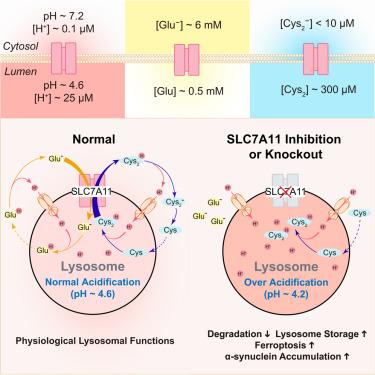
Lysosomes maintain an acidic pH of 4.5–5.0, optimal for macromolecular degradation. Whereas proton influx is produced by a V-type H+ ATPase, proton efflux is mediated by a fast H+ leak through TMEM175 channels, as well as an unidentified slow pathway. A candidate screen on an orphan lysosome membrane protein (OLMP) library enabled us to discover that SLC7A11, the protein target of the ferroptosis-inducing compound erastin, mediates a slow lysosomal H+ leak through downward flux of cystine and glutamate, two H+ equivalents with uniquely large but opposite concentration gradients across lysosomal membranes. SLC7A11 deficiency or inhibition caused lysosomal over-acidification, reduced degradation, accumulation of storage materials, and ferroptosis, as well as facilitated α-synuclein aggregation in neurons. Correction of abnormal lysosomal acidity restored lysosome homeostasis and prevented ferroptosis. These studies have revealed an unconventional H+ transport conduit that is integral to lysosomal flux of protonatable metabolites to regulate lysosome function, ferroptosis, and Parkinson’s disease (PD) pathology.
期刊介绍:
Cells is an international, peer-reviewed, open access journal that focuses on cell biology, molecular biology, and biophysics. It is affiliated with several societies, including the Spanish Society for Biochemistry and Molecular Biology (SEBBM), Nordic Autophagy Society (NAS), Spanish Society of Hematology and Hemotherapy (SEHH), and Society for Regenerative Medicine (Russian Federation) (RPO).
The journal publishes research findings of significant importance in various areas of experimental biology, such as cell biology, molecular biology, neuroscience, immunology, virology, microbiology, cancer, human genetics, systems biology, signaling, and disease mechanisms and therapeutics. The primary criterion for considering papers is whether the results contribute to significant conceptual advances or raise thought-provoking questions and hypotheses related to interesting and important biological inquiries.
In addition to primary research articles presented in four formats, Cells also features review and opinion articles in its "leading edge" section, discussing recent research advancements and topics of interest to its wide readership.



 京公网安备 11010802042870号
京ICP备2023020795号-1
京公网安备 11010802042870号
京ICP备2023020795号-1

 分享
分享
 求助内容:
求助内容: 应助结果提醒方式:
 扫码关注我们
