Yang Yang , Jiafu Shi , Yu Chen , Shihao Li , Han Wang , Wenping Li , Shusong Liu , Xinyu Mao , Hong Wu , Zhongyi Jiang
{"title":"Bifunctional COF-templated synthesis of immobilized enzyme catalysts for efficient bioconversion","authors":"Yang Yang , Jiafu Shi , Yu Chen , Shihao Li , Han Wang , Wenping Li , Shusong Liu , Xinyu Mao , Hong Wu , Zhongyi Jiang","doi":"10.1016/j.ces.2025.121717","DOIUrl":null,"url":null,"abstract":"<div><div>Rational design of immobilized enzyme catalysts based on covalent organic framework (COF) with high enzyme loading and superior robustness is highly desired. Herein, we designed an immobilized enzyme catalyst based on bifunctional COF. The quaternary ammonium-functionalized COF nanosheets adsorbed enzymes and subsequently induced the in-situ formation of silica coating without additional reagents. The ultrathin COF nanosheets guaranteed high enzyme loading of 3.4 mg mg<sup>−1</sup>. Meanwhile, quaternary ammonium groups on COF induced the formation of silica coating on the surface of COF, where the as-formed silica coating protected the fragile enzyme. The stability of the enzyme in immobilization form increased by 165 %, 113 % and 44 %, respectively, compared to the enzyme directly adsorbed on COF under different conditions (50 °C, pH 11, or after five cycles). Furthermore, given the high enzyme loading of COF nanosheets, an immobilized multi-enzyme catalytic system was constructed to convert methanol to ethylene glycol via a four-enzyme cascade reaction, which exhibited 143 % increase in catalytic activity by contrast with free enzymes system. This study provides a promising approach for enzyme immobilization and extends the application of COF in biocatalysis.</div></div>","PeriodicalId":271,"journal":{"name":"Chemical Engineering Science","volume":"313 ","pages":"Article 121717"},"PeriodicalIF":4.3000,"publicationDate":"2025-07-01","publicationTypes":"Journal Article","fieldsOfStudy":null,"isOpenAccess":false,"openAccessPdf":"","citationCount":"0","resultStr":null,"platform":"Semanticscholar","paperid":null,"PeriodicalName":"Chemical Engineering Science","FirstCategoryId":"5","ListUrlMain":"https://www.sciencedirect.com/science/article/pii/S0009250925005408","RegionNum":2,"RegionCategory":"工程技术","ArticlePicture":[],"TitleCN":null,"AbstractTextCN":null,"PMCID":null,"EPubDate":"2025/4/23 0:00:00","PubModel":"Epub","JCR":"Q2","JCRName":"ENGINEERING, CHEMICAL","Score":null,"Total":0}
引用次数: 0
Abstract
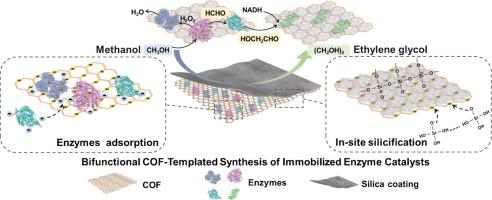
Rational design of immobilized enzyme catalysts based on covalent organic framework (COF) with high enzyme loading and superior robustness is highly desired. Herein, we designed an immobilized enzyme catalyst based on bifunctional COF. The quaternary ammonium-functionalized COF nanosheets adsorbed enzymes and subsequently induced the in-situ formation of silica coating without additional reagents. The ultrathin COF nanosheets guaranteed high enzyme loading of 3.4 mg mg−1. Meanwhile, quaternary ammonium groups on COF induced the formation of silica coating on the surface of COF, where the as-formed silica coating protected the fragile enzyme. The stability of the enzyme in immobilization form increased by 165 %, 113 % and 44 %, respectively, compared to the enzyme directly adsorbed on COF under different conditions (50 °C, pH 11, or after five cycles). Furthermore, given the high enzyme loading of COF nanosheets, an immobilized multi-enzyme catalytic system was constructed to convert methanol to ethylene glycol via a four-enzyme cascade reaction, which exhibited 143 % increase in catalytic activity by contrast with free enzymes system. This study provides a promising approach for enzyme immobilization and extends the application of COF in biocatalysis.
期刊介绍:
Chemical engineering enables the transformation of natural resources and energy into useful products for society. It draws on and applies natural sciences, mathematics and economics, and has developed fundamental engineering science that underpins the discipline.
Chemical Engineering Science (CES) has been publishing papers on the fundamentals of chemical engineering since 1951. CES is the platform where the most significant advances in the discipline have ever since been published. Chemical Engineering Science has accompanied and sustained chemical engineering through its development into the vibrant and broad scientific discipline it is today.




 京公网安备 11010802042870号
京ICP备2023020795号-1
京公网安备 11010802042870号
京ICP备2023020795号-1

 分享
分享
 求助内容:
求助内容: 应助结果提醒方式:
 扫码关注我们
