Xingyu Lin , Hongsheng Lu , Ruoxin Zhang , Ziteng Yang , Yingjiang Chen , Baiwen Huang
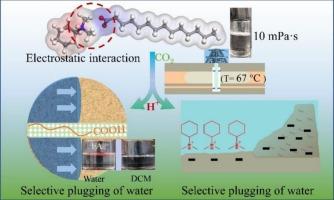
{"title":"CO2-induced phase separation in ionic liquid aqueous solutions: enhancing CO2 storage capacity in CO2 flooding","authors":"Xingyu Lin , Hongsheng Lu , Ruoxin Zhang , Ziteng Yang , Yingjiang Chen , Baiwen Huang","doi":"10.1016/j.ces.2025.121718","DOIUrl":null,"url":null,"abstract":"<div><div>CO<sub>2</sub> flooding offers dual benefits by enhancing oil recovery and facilitating CO<sub>2</sub> storage. However, reservoir heterogeneity and clay swelling can significantly limit CO<sub>2</sub> storage capacity. Here, a novel strategy for in-situ formation of particle profile control agent and clay swelling inhibitor was established by CO<sub>2</sub>-responsive ionic liquids (ILs). Two fatty acid (FA)-based ILs were synthesized by reacting <em>N, N</em>-dimethylcyclohexylamine (DMCHA) with myristic acid (C14) and palmitic acid (C16). After CO<sub>2</sub> injection, FA was precipitated again as a particle profile control agent with a particle size exceeding 10.65 μm, while the protonated DMCHA in the remaining liquid phase serves as a clay swelling inhibitor. Notably, the precipitation of FA within the core increases the CO<sub>2</sub> storage capacity by 1.96 times. This innovative approach holds great promise for enhancing the efficiency and sustainability of CO<sub>2</sub> injection, benefiting both the petroleum industry and environmental protection.</div></div>","PeriodicalId":271,"journal":{"name":"Chemical Engineering Science","volume":"313 ","pages":"Article 121718"},"PeriodicalIF":4.3000,"publicationDate":"2025-07-01","publicationTypes":"Journal Article","fieldsOfStudy":null,"isOpenAccess":false,"openAccessPdf":"","citationCount":"0","resultStr":null,"platform":"Semanticscholar","paperid":null,"PeriodicalName":"Chemical Engineering Science","FirstCategoryId":"5","ListUrlMain":"https://www.sciencedirect.com/science/article/pii/S000925092500541X","RegionNum":2,"RegionCategory":"工程技术","ArticlePicture":[],"TitleCN":null,"AbstractTextCN":null,"PMCID":null,"EPubDate":"2025/4/23 0:00:00","PubModel":"Epub","JCR":"Q2","JCRName":"ENGINEERING, CHEMICAL","Score":null,"Total":0}
引用次数: 0
Abstract
CO2 flooding offers dual benefits by enhancing oil recovery and facilitating CO2 storage. However, reservoir heterogeneity and clay swelling can significantly limit CO2 storage capacity. Here, a novel strategy for in-situ formation of particle profile control agent and clay swelling inhibitor was established by CO2-responsive ionic liquids (ILs). Two fatty acid (FA)-based ILs were synthesized by reacting N, N-dimethylcyclohexylamine (DMCHA) with myristic acid (C14) and palmitic acid (C16). After CO2 injection, FA was precipitated again as a particle profile control agent with a particle size exceeding 10.65 μm, while the protonated DMCHA in the remaining liquid phase serves as a clay swelling inhibitor. Notably, the precipitation of FA within the core increases the CO2 storage capacity by 1.96 times. This innovative approach holds great promise for enhancing the efficiency and sustainability of CO2 injection, benefiting both the petroleum industry and environmental protection.
期刊介绍:
Chemical engineering enables the transformation of natural resources and energy into useful products for society. It draws on and applies natural sciences, mathematics and economics, and has developed fundamental engineering science that underpins the discipline.
Chemical Engineering Science (CES) has been publishing papers on the fundamentals of chemical engineering since 1951. CES is the platform where the most significant advances in the discipline have ever since been published. Chemical Engineering Science has accompanied and sustained chemical engineering through its development into the vibrant and broad scientific discipline it is today.




 京公网安备 11010802042870号
京ICP备2023020795号-1
京公网安备 11010802042870号
京ICP备2023020795号-1

 分享
分享
 求助内容:
求助内容: 应助结果提醒方式:
 扫码关注我们
