Ji Feng, Tong Gao, Fabrice Morlet-Savary, Michael Schmitt, Celine Dietlin, Jing Zhang, Xiaotong Peng, Pu Xiao, Frédéric Dumur, Jacques Lalevée
{"title":"Donor-π-Acceptor Photoinitiators for High-Efficiency Visible LED and Sunlight Polymerization and High-Precision 3D Printing","authors":"Ji Feng, Tong Gao, Fabrice Morlet-Savary, Michael Schmitt, Celine Dietlin, Jing Zhang, Xiaotong Peng, Pu Xiao, Frédéric Dumur, Jacques Lalevée","doi":"10.1002/anie.202425198","DOIUrl":null,"url":null,"abstract":"<p>This study presents the development and evaluation of five dyes with varying conjugated energy levels and donor-π-acceptor (D-π-A) structures as photoinitiators for free radical polymerization. Their photoinitiation efficiencies are systematically assessed under both visible-light LED and sunlight. Notably, the conversions reach up to 81% within just 30 s under sunlight, demonstrating the ultrafast and efficient polymerization capabilities of the dyes. The efficient electron transfer is facilitated by the D-π-A structure, where the conjugation is reduced or interrupted by the high distortion between the electron-withdrawing and the electron-releasing units. This distortion can prevent the overlap of frontier molecular orbitals, decreasing the energy difference between the ground state and the excited state of dyes, thereby enhancing the electron transfer reactivity with additives. Additionally, we propose a chemical mechanism for the electron transfer reaction in the three-component systems. The study also explores the application of naphtho[2,3-<i>d</i>]thiazole-4,9-dione-based dyes as donors in additive manufacturing demonstrating their effectiveness in three different 3D printing technologies, i.e., direct laser writing (DLW), digital light processing (DLP), and liquid crystal display (LCD). These three-component formulations achieve high-precision 3D printed objects, with detailed characterization and comparison of the resulting structures.</p>","PeriodicalId":125,"journal":{"name":"Angewandte Chemie International Edition","volume":"64 27","pages":""},"PeriodicalIF":16.9000,"publicationDate":"2025-04-24","publicationTypes":"Journal Article","fieldsOfStudy":null,"isOpenAccess":false,"openAccessPdf":"https://onlinelibrary.wiley.com/doi/epdf/10.1002/anie.202425198","citationCount":"0","resultStr":null,"platform":"Semanticscholar","paperid":null,"PeriodicalName":"Angewandte Chemie International Edition","FirstCategoryId":"92","ListUrlMain":"https://onlinelibrary.wiley.com/doi/10.1002/anie.202425198","RegionNum":1,"RegionCategory":"化学","ArticlePicture":[],"TitleCN":null,"AbstractTextCN":null,"PMCID":null,"EPubDate":"","PubModel":"","JCR":"Q1","JCRName":"CHEMISTRY, MULTIDISCIPLINARY","Score":null,"Total":0}
引用次数: 0
Abstract
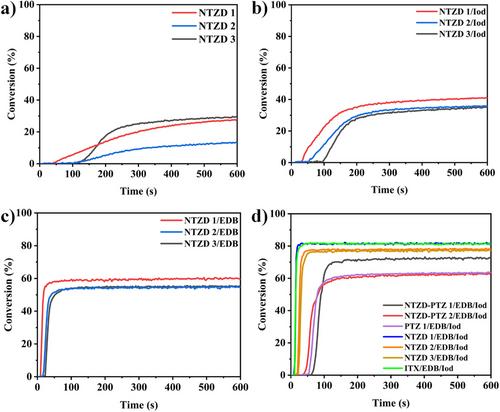
This study presents the development and evaluation of five dyes with varying conjugated energy levels and donor-π-acceptor (D-π-A) structures as photoinitiators for free radical polymerization. Their photoinitiation efficiencies are systematically assessed under both visible-light LED and sunlight. Notably, the conversions reach up to 81% within just 30 s under sunlight, demonstrating the ultrafast and efficient polymerization capabilities of the dyes. The efficient electron transfer is facilitated by the D-π-A structure, where the conjugation is reduced or interrupted by the high distortion between the electron-withdrawing and the electron-releasing units. This distortion can prevent the overlap of frontier molecular orbitals, decreasing the energy difference between the ground state and the excited state of dyes, thereby enhancing the electron transfer reactivity with additives. Additionally, we propose a chemical mechanism for the electron transfer reaction in the three-component systems. The study also explores the application of naphtho[2,3-d]thiazole-4,9-dione-based dyes as donors in additive manufacturing demonstrating their effectiveness in three different 3D printing technologies, i.e., direct laser writing (DLW), digital light processing (DLP), and liquid crystal display (LCD). These three-component formulations achieve high-precision 3D printed objects, with detailed characterization and comparison of the resulting structures.
期刊介绍:
Angewandte Chemie, a journal of the German Chemical Society (GDCh), maintains a leading position among scholarly journals in general chemistry with an impressive Impact Factor of 16.6 (2022 Journal Citation Reports, Clarivate, 2023). Published weekly in a reader-friendly format, it features new articles almost every day. Established in 1887, Angewandte Chemie is a prominent chemistry journal, offering a dynamic blend of Review-type articles, Highlights, Communications, and Research Articles on a weekly basis, making it unique in the field.



 京公网安备 11010802042870号
京ICP备2023020795号-1
京公网安备 11010802042870号
京ICP备2023020795号-1

 分享
分享
 求助内容:
求助内容: 应助结果提醒方式:
 扫码关注我们
