M. U. Muzaffar, Kai-Zhi Bai, Wei Qin, Guohua Cao, Bo Fu, Ping Cui, Shun-Qing Shen, Zhenyu Zhang
{"title":"Ferroelectrically Switchable Half-Quantized Hall Effect","authors":"M. U. Muzaffar, Kai-Zhi Bai, Wei Qin, Guohua Cao, Bo Fu, Ping Cui, Shun-Qing Shen, Zhenyu Zhang","doi":"10.1021/acs.nanolett.5c00550","DOIUrl":null,"url":null,"abstract":"Integrating ferroelectricity, antiferromagnetism, and topological quantum transport within a single material is rare but crucial for developing next-generation quantum devices. Here, we propose a multiferroic heterostructure consisting of an antiferromagnetic MnBi<sub>2</sub>Te<sub>4</sub> bilayer and an Sb<sub>2</sub>Te<sub>3</sub> film is able to harbor the half-quantized Hall (HQH) effect with a ferroelectrically switchable Hall conductivity of ± <i>e</i><sup>2</sup>/2<i>h</i>. We first show that, in the energetically stable configuration, the antiferromagnetic MnBi<sub>2</sub>Te<sub>4</sub> bilayer opens a gap in the top surface bands of Sb<sub>2</sub>Te<sub>3</sub> through the proximity effect, while its bottom surface bands remain gapless; consequently, an HQH conductivity of <i>e</i><sup>2</sup>/2<i>h</i> can be sustained clockwise or counterclockwise, depending on the antiferromagnetic configuration of the MnBi<sub>2</sub>Te<sub>4</sub>. Remarkably, when interlayer sliding is applied within the MnBi<sub>2</sub>Te<sub>4</sub> bilayer, its electric polarization direction associated with parity-time reversal symmetry breaking is reversed, accompanied by a reversal of the HQH conductivity. The proposed approach offers a powerful route to control topological quantum transport in antiferromagnetic materials by ferroelectricity.","PeriodicalId":53,"journal":{"name":"Nano Letters","volume":"32 1","pages":""},"PeriodicalIF":9.1000,"publicationDate":"2025-04-24","publicationTypes":"Journal Article","fieldsOfStudy":null,"isOpenAccess":false,"openAccessPdf":"","citationCount":"0","resultStr":null,"platform":"Semanticscholar","paperid":null,"PeriodicalName":"Nano Letters","FirstCategoryId":"88","ListUrlMain":"https://doi.org/10.1021/acs.nanolett.5c00550","RegionNum":1,"RegionCategory":"材料科学","ArticlePicture":[],"TitleCN":null,"AbstractTextCN":null,"PMCID":null,"EPubDate":"","PubModel":"","JCR":"Q1","JCRName":"CHEMISTRY, MULTIDISCIPLINARY","Score":null,"Total":0}
引用次数: 0
Abstract
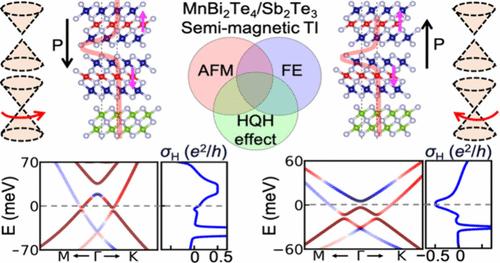
Integrating ferroelectricity, antiferromagnetism, and topological quantum transport within a single material is rare but crucial for developing next-generation quantum devices. Here, we propose a multiferroic heterostructure consisting of an antiferromagnetic MnBi2Te4 bilayer and an Sb2Te3 film is able to harbor the half-quantized Hall (HQH) effect with a ferroelectrically switchable Hall conductivity of ± e2/2h. We first show that, in the energetically stable configuration, the antiferromagnetic MnBi2Te4 bilayer opens a gap in the top surface bands of Sb2Te3 through the proximity effect, while its bottom surface bands remain gapless; consequently, an HQH conductivity of e2/2h can be sustained clockwise or counterclockwise, depending on the antiferromagnetic configuration of the MnBi2Te4. Remarkably, when interlayer sliding is applied within the MnBi2Te4 bilayer, its electric polarization direction associated with parity-time reversal symmetry breaking is reversed, accompanied by a reversal of the HQH conductivity. The proposed approach offers a powerful route to control topological quantum transport in antiferromagnetic materials by ferroelectricity.
期刊介绍:
Nano Letters serves as a dynamic platform for promptly disseminating original results in fundamental, applied, and emerging research across all facets of nanoscience and nanotechnology. A pivotal criterion for inclusion within Nano Letters is the convergence of at least two different areas or disciplines, ensuring a rich interdisciplinary scope. The journal is dedicated to fostering exploration in diverse areas, including:
- Experimental and theoretical findings on physical, chemical, and biological phenomena at the nanoscale
- Synthesis, characterization, and processing of organic, inorganic, polymer, and hybrid nanomaterials through physical, chemical, and biological methodologies
- Modeling and simulation of synthetic, assembly, and interaction processes
- Realization of integrated nanostructures and nano-engineered devices exhibiting advanced performance
- Applications of nanoscale materials in living and environmental systems
Nano Letters is committed to advancing and showcasing groundbreaking research that intersects various domains, fostering innovation and collaboration in the ever-evolving field of nanoscience and nanotechnology.



 京公网安备 11010802042870号
京ICP备2023020795号-1
京公网安备 11010802042870号
京ICP备2023020795号-1

 分享
分享
 求助内容:
求助内容: 应助结果提醒方式:
 扫码关注我们
