{"title":"Hydrophilic Single-Atom Interface Empowered Pure Formic Acid Fuel Cells","authors":"Kai Wei, Mingzi Sun, Xiaoke Xi, Tongtong Yang, Meijian Tang, Kangcheng Wang, Siming Gao, Ruiguo Cao, Xian Wang, Bolong Huang, Junjie Ge","doi":"10.1021/jacs.5c01842","DOIUrl":null,"url":null,"abstract":"Single-atom catalysts (SACs), offering high mass activity and enhanced resistance to poisoning, are regarded as superior alternatives to traditional Pt/Pd nanocatalysts for direct formic acid fuel cells (DFAFCs). However, failure toward operation in concentrated formic acid (FA), which is critical for portable electronics, challenges their antipoisoning advantage and highlights a missing part in the understanding of the reaction. We herein demonstrate that the interfacial hydrophilicity of SACs is pivotal for high-performance DFAFCs, enabling, for the first time, stable operation with pure FA (>99%). By incorporating transition metal single atoms (Co, Fe, Ni, Ru) into Ir/NC catalysts, we engineered highly hydrophilic interfaces, as validated by molecular dynamics simulations and experimental studies. The optimized IrCo/NC anode exhibited a mass activity 342 times higher than that of nanoparticle-based catalysts and represented as the first SAC to achieve a higher peak power density (107.7 mW cm<sup>–2</sup>). A new reaction mechanism is revealed, where CO acts as a reactive intermediate rather than a poison. Further, in situ spectroscopy and isotope kinetic analyses identified water intermediate involvement in the rate-determining step, underscoring the critical role of hydrophilic interface engineering in DFAFC.","PeriodicalId":49,"journal":{"name":"Journal of the American Chemical Society","volume":"1 1","pages":""},"PeriodicalIF":15.6000,"publicationDate":"2025-04-25","publicationTypes":"Journal Article","fieldsOfStudy":null,"isOpenAccess":false,"openAccessPdf":"","citationCount":"0","resultStr":null,"platform":"Semanticscholar","paperid":null,"PeriodicalName":"Journal of the American Chemical Society","FirstCategoryId":"92","ListUrlMain":"https://doi.org/10.1021/jacs.5c01842","RegionNum":1,"RegionCategory":"化学","ArticlePicture":[],"TitleCN":null,"AbstractTextCN":null,"PMCID":null,"EPubDate":"","PubModel":"","JCR":"Q1","JCRName":"CHEMISTRY, MULTIDISCIPLINARY","Score":null,"Total":0}
引用次数: 0
Abstract
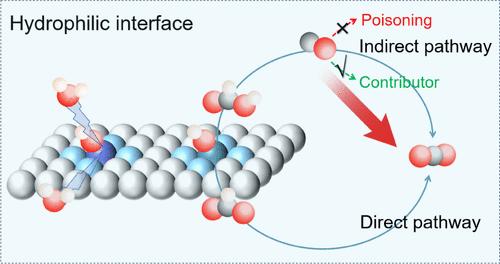
Single-atom catalysts (SACs), offering high mass activity and enhanced resistance to poisoning, are regarded as superior alternatives to traditional Pt/Pd nanocatalysts for direct formic acid fuel cells (DFAFCs). However, failure toward operation in concentrated formic acid (FA), which is critical for portable electronics, challenges their antipoisoning advantage and highlights a missing part in the understanding of the reaction. We herein demonstrate that the interfacial hydrophilicity of SACs is pivotal for high-performance DFAFCs, enabling, for the first time, stable operation with pure FA (>99%). By incorporating transition metal single atoms (Co, Fe, Ni, Ru) into Ir/NC catalysts, we engineered highly hydrophilic interfaces, as validated by molecular dynamics simulations and experimental studies. The optimized IrCo/NC anode exhibited a mass activity 342 times higher than that of nanoparticle-based catalysts and represented as the first SAC to achieve a higher peak power density (107.7 mW cm–2). A new reaction mechanism is revealed, where CO acts as a reactive intermediate rather than a poison. Further, in situ spectroscopy and isotope kinetic analyses identified water intermediate involvement in the rate-determining step, underscoring the critical role of hydrophilic interface engineering in DFAFC.
期刊介绍:
The flagship journal of the American Chemical Society, known as the Journal of the American Chemical Society (JACS), has been a prestigious publication since its establishment in 1879. It holds a preeminent position in the field of chemistry and related interdisciplinary sciences. JACS is committed to disseminating cutting-edge research papers, covering a wide range of topics, and encompasses approximately 19,000 pages of Articles, Communications, and Perspectives annually. With a weekly publication frequency, JACS plays a vital role in advancing the field of chemistry by providing essential research.



 京公网安备 11010802042870号
京ICP备2023020795号-1
京公网安备 11010802042870号
京ICP备2023020795号-1

 分享
分享
 求助内容:
求助内容: 应助结果提醒方式:
 扫码关注我们
