Xinyi Lu , Yanyan Xia , Yihui Bao , Zhencheng Ye , Houyang Chen , Haicai Huang
{"title":"Interlayer-confined-enabled dual-site synergy strategy: A bilayer FeN4 catalyst for enhanced CO2 reduction and C-C coupling","authors":"Xinyi Lu , Yanyan Xia , Yihui Bao , Zhencheng Ye , Houyang Chen , Haicai Huang","doi":"10.1016/j.ces.2025.121728","DOIUrl":null,"url":null,"abstract":"<div><div>We propose a dual-active-site catalytic system with an interlayer confinement effect, inducing a vertical synergistic interaction to enhance CO<sub>2</sub> reduction reaction (CO<sub>2</sub>RR) activity and selectivity. Using density functional theory (DFT) calculations, we systematically explore how interlayer distance influences CO<sub>2</sub> adsorption and key reaction intermediates. Our results reveal that confinement enhances electronic interactions, but excessive confinement induces steric hindrance, reducing catalytic activity. We identify two distinct carbon–carbon (C<img>C) coupling mechanisms: a single-site adsorption pathway involving *CO desorption followed by *CO + *CO coupling and a dual-site adsorption pathway enabled by *CHO rotation and subsequent *CO + *CHO coupling. Strong confinement enhances dual-site coupling. The optimal interlayer distance for ethanol production is 6.5 Å (limiting potential: 0.7 V), while 7.5 Å favors CH<sub>4</sub> selectivity. This study establishes a theoretical framework for confined dual-site catalysis, providing design principles of interlayer-confined-enabled vertically aligned dual-site synergy approach for next-generation CO<sub>2</sub> electrocatalysts.</div></div>","PeriodicalId":271,"journal":{"name":"Chemical Engineering Science","volume":"314 ","pages":"Article 121728"},"PeriodicalIF":4.3000,"publicationDate":"2025-08-01","publicationTypes":"Journal Article","fieldsOfStudy":null,"isOpenAccess":false,"openAccessPdf":"","citationCount":"0","resultStr":null,"platform":"Semanticscholar","paperid":null,"PeriodicalName":"Chemical Engineering Science","FirstCategoryId":"5","ListUrlMain":"https://www.sciencedirect.com/science/article/pii/S0009250925005512","RegionNum":2,"RegionCategory":"工程技术","ArticlePicture":[],"TitleCN":null,"AbstractTextCN":null,"PMCID":null,"EPubDate":"2025/4/24 0:00:00","PubModel":"Epub","JCR":"Q2","JCRName":"ENGINEERING, CHEMICAL","Score":null,"Total":0}
引用次数: 0
Abstract
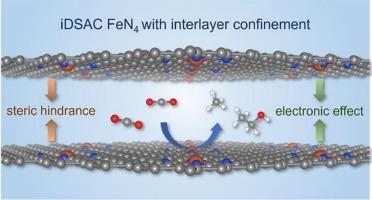
We propose a dual-active-site catalytic system with an interlayer confinement effect, inducing a vertical synergistic interaction to enhance CO2 reduction reaction (CO2RR) activity and selectivity. Using density functional theory (DFT) calculations, we systematically explore how interlayer distance influences CO2 adsorption and key reaction intermediates. Our results reveal that confinement enhances electronic interactions, but excessive confinement induces steric hindrance, reducing catalytic activity. We identify two distinct carbon–carbon (CC) coupling mechanisms: a single-site adsorption pathway involving *CO desorption followed by *CO + *CO coupling and a dual-site adsorption pathway enabled by *CHO rotation and subsequent *CO + *CHO coupling. Strong confinement enhances dual-site coupling. The optimal interlayer distance for ethanol production is 6.5 Å (limiting potential: 0.7 V), while 7.5 Å favors CH4 selectivity. This study establishes a theoretical framework for confined dual-site catalysis, providing design principles of interlayer-confined-enabled vertically aligned dual-site synergy approach for next-generation CO2 electrocatalysts.
期刊介绍:
Chemical engineering enables the transformation of natural resources and energy into useful products for society. It draws on and applies natural sciences, mathematics and economics, and has developed fundamental engineering science that underpins the discipline.
Chemical Engineering Science (CES) has been publishing papers on the fundamentals of chemical engineering since 1951. CES is the platform where the most significant advances in the discipline have ever since been published. Chemical Engineering Science has accompanied and sustained chemical engineering through its development into the vibrant and broad scientific discipline it is today.




 京公网安备 11010802042870号
京ICP备2023020795号-1
京公网安备 11010802042870号
京ICP备2023020795号-1

 分享
分享
 求助内容:
求助内容: 应助结果提醒方式:
 扫码关注我们
