Dr. Yali Hou, Yingjie Li, Dengke Han, Dr. Zeyuan Zhang, Dr. Jinping Zhang, Shijin Jian, Zixuan Li, Prof. Dr. Xianglong Duan, Prof. Dr. Haonan Peng, Prof. Dr. Yu Fang, Prof. Dr. Mingming Zhang
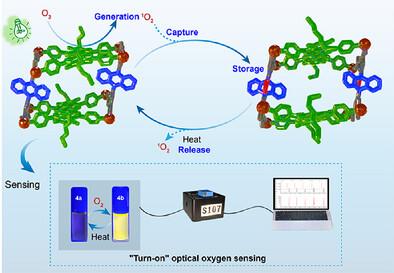
{"title":"Generation, Capture, Storage, and Release of Singlet Oxygen from a Perylene Diimide-Based Metallacage for Oxygen Sensing","authors":"Dr. Yali Hou, Yingjie Li, Dengke Han, Dr. Zeyuan Zhang, Dr. Jinping Zhang, Shijin Jian, Zixuan Li, Prof. Dr. Xianglong Duan, Prof. Dr. Haonan Peng, Prof. Dr. Yu Fang, Prof. Dr. Mingming Zhang","doi":"10.1002/anie.202507112","DOIUrl":null,"url":null,"abstract":"<p>The controlled generation and utilization of singlet oxygen (<sup>1</sup>O<sub>2</sub>) are crucial for its diverse applications but remain challenging due to its high reactivity and short-lived nature. Here, we report a box-shaped metallacage prepared via multicomponent coordination-driven self-assembly using tetrapyridyl perylene diimide (PDI) and tetracarboxylate anthracene as building blocks. Upon photo-irradiation, the PDI faces act as photosensitizers to generate <sup>1</sup>O<sub>2</sub>, which reacts with the anthracene pillars to form a peroxidized metallacage, where <sup>1</sup>O<sub>2</sub> is captured and stored as anthracene peroxides. Heating releases <sup>1</sup>O<sub>2</sub> quantitatively, restoring the original metallacage structure. Both states are stable at room temperature, as confirmed by X-ray diffraction. Additionally, photoinduced electron transfer (PET) from anthracene pillars to PDI faces quenches the emission of the metallacage, while oxidation of anthracene inhibits PET, yielding bright fluorescence for the peroxidized metallacage. This reversible emission change enables the metallacage to function as a “turn-on” fluorescence sensor for dissolved oxygen, with a detection limit of 1.1 × 10<sup>−3</sup> mg L<sup>−1</sup>. This study demonstrates a metallacage that can generate, capture, store, and release <sup>1</sup>O<sub>2</sub> for oxygen sensing, offering insights for designing stimuli-responsive smart materials.</p>","PeriodicalId":125,"journal":{"name":"Angewandte Chemie International Edition","volume":"64 27","pages":""},"PeriodicalIF":16.9000,"publicationDate":"2025-04-25","publicationTypes":"Journal Article","fieldsOfStudy":null,"isOpenAccess":false,"openAccessPdf":"","citationCount":"0","resultStr":null,"platform":"Semanticscholar","paperid":null,"PeriodicalName":"Angewandte Chemie International Edition","FirstCategoryId":"92","ListUrlMain":"https://onlinelibrary.wiley.com/doi/10.1002/anie.202507112","RegionNum":1,"RegionCategory":"化学","ArticlePicture":[],"TitleCN":null,"AbstractTextCN":null,"PMCID":null,"EPubDate":"","PubModel":"","JCR":"Q1","JCRName":"CHEMISTRY, MULTIDISCIPLINARY","Score":null,"Total":0}
引用次数: 0
Abstract
The controlled generation and utilization of singlet oxygen (1O2) are crucial for its diverse applications but remain challenging due to its high reactivity and short-lived nature. Here, we report a box-shaped metallacage prepared via multicomponent coordination-driven self-assembly using tetrapyridyl perylene diimide (PDI) and tetracarboxylate anthracene as building blocks. Upon photo-irradiation, the PDI faces act as photosensitizers to generate 1O2, which reacts with the anthracene pillars to form a peroxidized metallacage, where 1O2 is captured and stored as anthracene peroxides. Heating releases 1O2 quantitatively, restoring the original metallacage structure. Both states are stable at room temperature, as confirmed by X-ray diffraction. Additionally, photoinduced electron transfer (PET) from anthracene pillars to PDI faces quenches the emission of the metallacage, while oxidation of anthracene inhibits PET, yielding bright fluorescence for the peroxidized metallacage. This reversible emission change enables the metallacage to function as a “turn-on” fluorescence sensor for dissolved oxygen, with a detection limit of 1.1 × 10⁻³ mg L−1. This study demonstrates a metallacage that can generate, capture, store, and release 1O2 for oxygen sensing, offering insights for designing stimuli-responsive smart materials.
期刊介绍:
Angewandte Chemie, a journal of the German Chemical Society (GDCh), maintains a leading position among scholarly journals in general chemistry with an impressive Impact Factor of 16.6 (2022 Journal Citation Reports, Clarivate, 2023). Published weekly in a reader-friendly format, it features new articles almost every day. Established in 1887, Angewandte Chemie is a prominent chemistry journal, offering a dynamic blend of Review-type articles, Highlights, Communications, and Research Articles on a weekly basis, making it unique in the field.



 京公网安备 11010802042870号
京ICP备2023020795号-1
京公网安备 11010802042870号
京ICP备2023020795号-1

 分享
分享
 求助内容:
求助内容: 应助结果提醒方式:
 扫码关注我们
