Ryo Fukuoka, Yusuke Yano, Nozomi Hara, Chihiro Sadamoto, Andres D. Maturana, Masaki Kita
{"title":"Hyperpolarization Modulation of the T-Type hCav3.2 Channel by Human Synenkephalin [1–53], a Shrew Neurotoxin Analogue without Paralytic Effects","authors":"Ryo Fukuoka, Yusuke Yano, Nozomi Hara, Chihiro Sadamoto, Andres D. Maturana, Masaki Kita","doi":"10.1002/anie.202503891","DOIUrl":null,"url":null,"abstract":"<p>Mammalian secreted venoms mainly consist of peptides and proteases used for defense or predation. <i>Blarina</i> paralytic peptides (BPPs), mealworm-targeting neurotoxins from shrew, are very similar to human synenkephalin. This peptide is released from proenkephalin in the brain along with opioid peptides that mediate analgesic and antidepressant effects, though its physiological function is unclear. Here, we synthesized and characterized human synenkephalin [1–53] (hSYN) and reveal its disulfide bond connectivity. Similar to BPP2, hSYN caused a hyperpolarizing shift in the human T-type voltage-gated calcium channel (hCa<sub>v</sub>3.2) at 0.74 µM, but did not paralyze mealworms. Molecular docking and molecular dynamics simulations showed that hSYN and BPP2 interact with hCa<sub>v</sub>3.2 channel differently, due to differences in polar residues. Since Ca<sub>v</sub>3.2 channel regulates neuronal excitability and is implicated in conditions like autism and epilepsy, our findings on hSYN could provide insight into the channel gating and agonistic mechanisms, along with potential pathways for developing treatments for neurological disorders.</p>","PeriodicalId":125,"journal":{"name":"Angewandte Chemie International Edition","volume":"64 27","pages":""},"PeriodicalIF":16.9000,"publicationDate":"2025-04-24","publicationTypes":"Journal Article","fieldsOfStudy":null,"isOpenAccess":false,"openAccessPdf":"https://onlinelibrary.wiley.com/doi/epdf/10.1002/anie.202503891","citationCount":"0","resultStr":null,"platform":"Semanticscholar","paperid":null,"PeriodicalName":"Angewandte Chemie International Edition","FirstCategoryId":"92","ListUrlMain":"https://onlinelibrary.wiley.com/doi/10.1002/anie.202503891","RegionNum":1,"RegionCategory":"化学","ArticlePicture":[],"TitleCN":null,"AbstractTextCN":null,"PMCID":null,"EPubDate":"","PubModel":"","JCR":"Q1","JCRName":"CHEMISTRY, MULTIDISCIPLINARY","Score":null,"Total":0}
引用次数: 0
Abstract
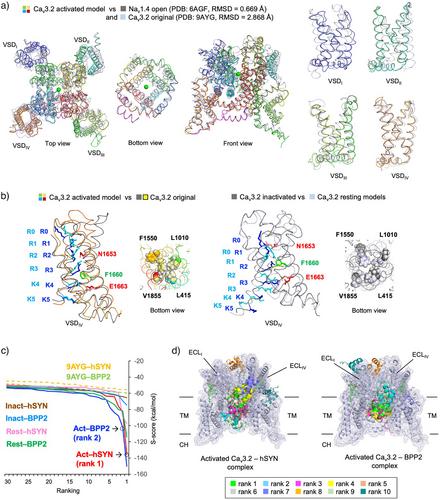
Mammalian secreted venoms mainly consist of peptides and proteases used for defense or predation. Blarina paralytic peptides (BPPs), mealworm-targeting neurotoxins from shrew, are very similar to human synenkephalin. This peptide is released from proenkephalin in the brain along with opioid peptides that mediate analgesic and antidepressant effects, though its physiological function is unclear. Here, we synthesized and characterized human synenkephalin [1–53] (hSYN) and reveal its disulfide bond connectivity. Similar to BPP2, hSYN caused a hyperpolarizing shift in the human T-type voltage-gated calcium channel (hCav3.2) at 0.74 µM, but did not paralyze mealworms. Molecular docking and molecular dynamics simulations showed that hSYN and BPP2 interact with hCav3.2 channel differently, due to differences in polar residues. Since Cav3.2 channel regulates neuronal excitability and is implicated in conditions like autism and epilepsy, our findings on hSYN could provide insight into the channel gating and agonistic mechanisms, along with potential pathways for developing treatments for neurological disorders.
期刊介绍:
Angewandte Chemie, a journal of the German Chemical Society (GDCh), maintains a leading position among scholarly journals in general chemistry with an impressive Impact Factor of 16.6 (2022 Journal Citation Reports, Clarivate, 2023). Published weekly in a reader-friendly format, it features new articles almost every day. Established in 1887, Angewandte Chemie is a prominent chemistry journal, offering a dynamic blend of Review-type articles, Highlights, Communications, and Research Articles on a weekly basis, making it unique in the field.



 京公网安备 11010802042870号
京ICP备2023020795号-1
京公网安备 11010802042870号
京ICP备2023020795号-1

 分享
分享
 求助内容:
求助内容: 应助结果提醒方式:
 扫码关注我们
