Pyrethroid insecticides have been a primary strategy for managing Dalbulus maidis (Hemiptera: Cicadellidae) in Brazil. Howeve, failures in the control of D. maidis with pyrethroids have been reported. In this study, we selected a bifenthrin-resistant strain of D. maidis under laboratory cage conditions to investigate the inheritance pattern of resistance, cross-resistance to other insecticides, and resistance stability.
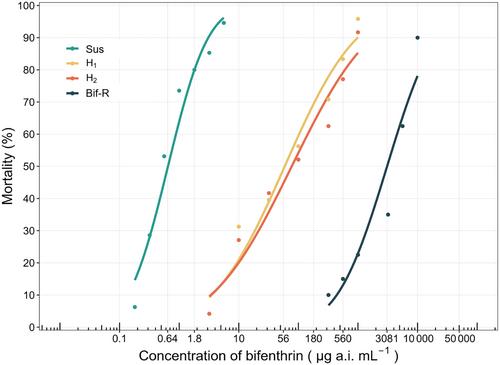
The estimated LC50 of the Bif-R was 2,055.72 μg a.i. mL−1, while that of the susceptible (Sus) strain was 0.64 μg a.i. mL−1, resulting in a 3,170-fold resistance ratio (RR). Reciprocal crosses (H1: Bif-R ♀ × Sus ♂ and H2: Bif-R ♂ × Sus ♀) and backcrosses between heterozygous H1 and H2 with the Sus strain indicated autosomal, incompletely dominant, and polygenic resistance. Potential cross or multiple-resistance was observed between Bif-R and lambda-cyhalothrin, imidacloprid, and acetamiprid, with resistance ratios varying from 300- to 2,000-fold. No cross-resistance was detected between Bif-R and methomyl, carbosulfan or acephate. Cage studies with different proportions of Sus and Bif-R strains revealed that resistance of D. maidis to bifenthrin is unstable. A decrease in the LC50 of the field-collected population from 113.61 to 10.73 μg bifenthrin mL−1 was detected in the absence of selection pressure.
Our findings provide insights into the evolution of resistance of D. maidis to bifenthrin. This study is the first comprehensive analysis of pyrethroid resistance in D. maidis and will contribute to insect resistance management (IRM) strategies to preserve the efficacy of bifenthrin and other insecticides. © 2025 The Author(s). Pest Management Science published by John Wiley & Sons Ltd on behalf of Society of Chemical Industry.





 京公网安备 11010802042870号
京ICP备2023020795号-1
京公网安备 11010802042870号
京ICP备2023020795号-1

 分享
分享
 求助内容:
求助内容: 应助结果提醒方式:
 扫码关注我们
