Stephen J. Turrell, Yi Liang, Tiancheng Cai, Ben Jagger, Mauro Pasta
{"title":"Origin of Stability in the Solid Electrolyte Interphase formed between Lithium and Lithium Phosphorus Oxynitride","authors":"Stephen J. Turrell, Yi Liang, Tiancheng Cai, Ben Jagger, Mauro Pasta","doi":"10.1021/acs.chemmater.5c00483","DOIUrl":null,"url":null,"abstract":"Lithium phosphorus oxynitride (LiPON) is one of the few solid electrolytes that form a truly passivating solid electrolyte interphase (SEI) when in contact with metallic lithium. Investigations into the origin of this stability may provide the insights needed to replicate it in the SEIs of alternative solid electrolyte materials. In this study, we used in situ lithium plating X-ray photoelectron spectroscopy (XPS) to investigate the formation and evolution of the Li-LiPON SEI. We show that the SEI is chemically and structurally inhomogeneous, with the fully reduced compounds identified in previous studies (Li<sub>2</sub>O, Li<sub>3</sub>N, and Li<sub>3</sub>P) concentrated near the lithium metal side and partially lithiated species, including Li<sub><i>x</i></sub>P, predominant closer to the LiPON side. Li<sub>3</sub>P and Li<sub><i>x</i></sub>P have recently been suggested as enablers of continuous SEI growth in thiophosphate solid electrolytes. We suggest that the stability of the Li-LiPON SEI is derived from a combination of the LiPON reduction potential (0.68 V vs Li<sup>+</sup>/Li), which is below the oxidation potentials of the fully reduced SEI compounds, and the graded structure of the SEI, which ensures that the most reduced species are not in physical or electrical contact with the LiPON layer.","PeriodicalId":33,"journal":{"name":"Chemistry of Materials","volume":"3 1","pages":""},"PeriodicalIF":7.0000,"publicationDate":"2025-04-25","publicationTypes":"Journal Article","fieldsOfStudy":null,"isOpenAccess":false,"openAccessPdf":"","citationCount":"0","resultStr":null,"platform":"Semanticscholar","paperid":null,"PeriodicalName":"Chemistry of Materials","FirstCategoryId":"88","ListUrlMain":"https://doi.org/10.1021/acs.chemmater.5c00483","RegionNum":2,"RegionCategory":"材料科学","ArticlePicture":[],"TitleCN":null,"AbstractTextCN":null,"PMCID":null,"EPubDate":"","PubModel":"","JCR":"Q2","JCRName":"CHEMISTRY, PHYSICAL","Score":null,"Total":0}
引用次数: 0
Abstract
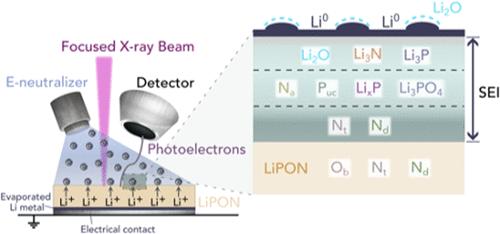
Lithium phosphorus oxynitride (LiPON) is one of the few solid electrolytes that form a truly passivating solid electrolyte interphase (SEI) when in contact with metallic lithium. Investigations into the origin of this stability may provide the insights needed to replicate it in the SEIs of alternative solid electrolyte materials. In this study, we used in situ lithium plating X-ray photoelectron spectroscopy (XPS) to investigate the formation and evolution of the Li-LiPON SEI. We show that the SEI is chemically and structurally inhomogeneous, with the fully reduced compounds identified in previous studies (Li2O, Li3N, and Li3P) concentrated near the lithium metal side and partially lithiated species, including LixP, predominant closer to the LiPON side. Li3P and LixP have recently been suggested as enablers of continuous SEI growth in thiophosphate solid electrolytes. We suggest that the stability of the Li-LiPON SEI is derived from a combination of the LiPON reduction potential (0.68 V vs Li+/Li), which is below the oxidation potentials of the fully reduced SEI compounds, and the graded structure of the SEI, which ensures that the most reduced species are not in physical or electrical contact with the LiPON layer.
氮化磷锂(LiPON)是为数不多的固体电解质之一,当与金属锂接触时,形成真正钝化的固体电解质界面(SEI)。对这种稳定性的起源的研究可能提供在替代固体电解质材料的sei中复制它所需的见解。在本研究中,我们使用原位镀锂x射线光电子能谱(XPS)研究Li-LiPON SEI的形成和演化。我们发现SEI在化学和结构上都是不均匀的,在之前的研究中发现的完全还原的化合物(Li2O, Li3N和Li3P)集中在锂金属侧附近,而部分锂化的物质,包括LixP,主要集中在靠近LiPON侧。Li3P和LixP最近被认为是硫磷固体电解质中SEI持续生长的促进剂。我们认为Li-LiPON SEI的稳定性源于LiPON还原电位(0.68 V vs Li+/Li)的结合,它低于完全还原的SEI化合物的氧化电位,以及SEI的分级结构,这确保了大多数还原物质不会与LiPON层发生物理或电接触。
期刊介绍:
The journal Chemistry of Materials focuses on publishing original research at the intersection of materials science and chemistry. The studies published in the journal involve chemistry as a prominent component and explore topics such as the design, synthesis, characterization, processing, understanding, and application of functional or potentially functional materials. The journal covers various areas of interest, including inorganic and organic solid-state chemistry, nanomaterials, biomaterials, thin films and polymers, and composite/hybrid materials. The journal particularly seeks papers that highlight the creation or development of innovative materials with novel optical, electrical, magnetic, catalytic, or mechanical properties. It is essential that manuscripts on these topics have a primary focus on the chemistry of materials and represent a significant advancement compared to prior research. Before external reviews are sought, submitted manuscripts undergo a review process by a minimum of two editors to ensure their appropriateness for the journal and the presence of sufficient evidence of a significant advance that will be of broad interest to the materials chemistry community.



 京公网安备 11010802042870号
京ICP备2023020795号-1
京公网安备 11010802042870号
京ICP备2023020795号-1

 分享
分享
 求助内容:
求助内容: 应助结果提醒方式:
 扫码关注我们
