Integrating the Preparation of a Tissue Section on Adhesive Tape with an Adsorption Platform Device for Simplified Ambient Mass Spectrometry Imaging Analysis
{"title":"Integrating the Preparation of a Tissue Section on Adhesive Tape with an Adsorption Platform Device for Simplified Ambient Mass Spectrometry Imaging Analysis","authors":"Yingfeng Xue, Jinyi Li, Zhehui Zhao, Jiaheng Li, Xin Li, Ruiping Zhang, Ling Ren, Lulu Wang, Wenxuan Zhang, Zhigang Luo, Zeper Abliz","doi":"10.1021/acs.analchem.5c01648","DOIUrl":null,"url":null,"abstract":"As a visualization technology for the in situ characterization of surface material molecules, mass spectrometry imaging (MSI) analysis is being increasingly used in various fields, especially in the biomedical field. However, the preparation of biological tissue section samples for MSI analysis remains time-consuming and labor-intensive, and sample loss or damage occurs frequently. The inability to stably and consecutively obtain suitable section samples and perform concise and efficient imaging analysis limits the analysis throughput. Herein, a preparation method is proposed. It enables consecutive sectioning, batch preservation, and dry processing through the use of ordinary adhesive tape, enhancing the adhesion between section and tape and rapid freeze-drying. Furthermore, based on the air flow assisted desorption electrospray ionization (AFADESI) MSI system, a vacuum adsorption platform is introduced, which simplifies the process of MSI analysis. Moreover, compared with general tape-based MSI methods, the signal intensity of 73%–85% of the annotated ions is improved for positive ion mode. The signal-to-noise (<i>S</i>/<i>N</i>) ratios of characteristic ions in the corresponding regions in the images of the tissue section samples increase by an average of more than two times, and a clearer organ outline can be seen in the images. By integrating the sample preparation method with the adsorption platform, high-throughput imaging of serial whole-body or scattered organ tissue sections can be conducted more easily and concise and efficient MSI analysis can be performed, which will provide a new strategy to meet rapidly growing MSI research demands.","PeriodicalId":27,"journal":{"name":"Analytical Chemistry","volume":"74 1","pages":""},"PeriodicalIF":6.7000,"publicationDate":"2025-04-25","publicationTypes":"Journal Article","fieldsOfStudy":null,"isOpenAccess":false,"openAccessPdf":"","citationCount":"0","resultStr":null,"platform":"Semanticscholar","paperid":null,"PeriodicalName":"Analytical Chemistry","FirstCategoryId":"92","ListUrlMain":"https://doi.org/10.1021/acs.analchem.5c01648","RegionNum":1,"RegionCategory":"化学","ArticlePicture":[],"TitleCN":null,"AbstractTextCN":null,"PMCID":null,"EPubDate":"","PubModel":"","JCR":"Q1","JCRName":"CHEMISTRY, ANALYTICAL","Score":null,"Total":0}
引用次数: 0
Abstract
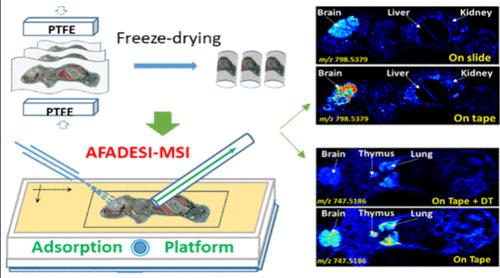
As a visualization technology for the in situ characterization of surface material molecules, mass spectrometry imaging (MSI) analysis is being increasingly used in various fields, especially in the biomedical field. However, the preparation of biological tissue section samples for MSI analysis remains time-consuming and labor-intensive, and sample loss or damage occurs frequently. The inability to stably and consecutively obtain suitable section samples and perform concise and efficient imaging analysis limits the analysis throughput. Herein, a preparation method is proposed. It enables consecutive sectioning, batch preservation, and dry processing through the use of ordinary adhesive tape, enhancing the adhesion between section and tape and rapid freeze-drying. Furthermore, based on the air flow assisted desorption electrospray ionization (AFADESI) MSI system, a vacuum adsorption platform is introduced, which simplifies the process of MSI analysis. Moreover, compared with general tape-based MSI methods, the signal intensity of 73%–85% of the annotated ions is improved for positive ion mode. The signal-to-noise (S/N) ratios of characteristic ions in the corresponding regions in the images of the tissue section samples increase by an average of more than two times, and a clearer organ outline can be seen in the images. By integrating the sample preparation method with the adsorption platform, high-throughput imaging of serial whole-body or scattered organ tissue sections can be conducted more easily and concise and efficient MSI analysis can be performed, which will provide a new strategy to meet rapidly growing MSI research demands.
期刊介绍:
Analytical Chemistry, a peer-reviewed research journal, focuses on disseminating new and original knowledge across all branches of analytical chemistry. Fundamental articles may explore general principles of chemical measurement science and need not directly address existing or potential analytical methodology. They can be entirely theoretical or report experimental results. Contributions may cover various phases of analytical operations, including sampling, bioanalysis, electrochemistry, mass spectrometry, microscale and nanoscale systems, environmental analysis, separations, spectroscopy, chemical reactions and selectivity, instrumentation, imaging, surface analysis, and data processing. Papers discussing known analytical methods should present a significant, original application of the method, a notable improvement, or results on an important analyte.



 京公网安备 11010802042870号
京ICP备2023020795号-1
京公网安备 11010802042870号
京ICP备2023020795号-1

 分享
分享
 求助内容:
求助内容: 应助结果提醒方式:
 扫码关注我们
