Zhen Liu , Guo-Qing Wei , Wei Ye , Gang Yao , Yi-Fan Zhang , Lai-Ma Luo , Yu-Cheng Wu
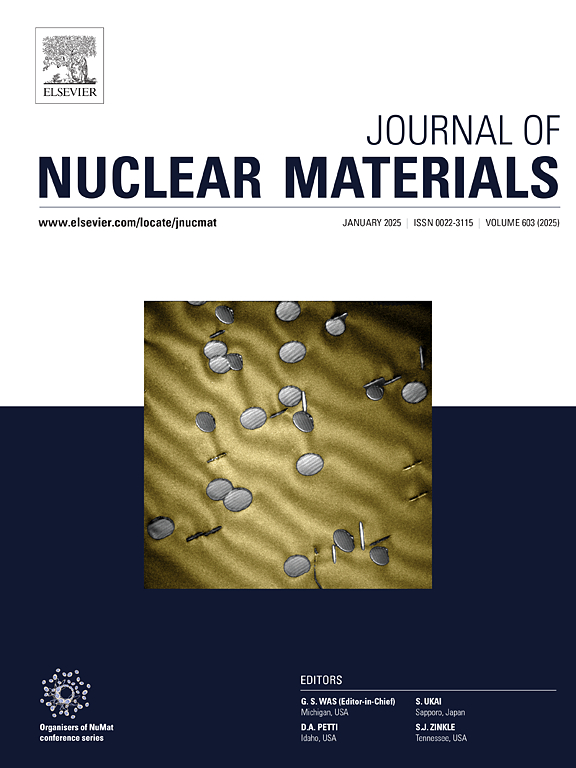
{"title":"Surface damage evolution during helium plasma irradiation of W-Y2O3 composite materials in different grain orientations","authors":"Zhen Liu , Guo-Qing Wei , Wei Ye , Gang Yao , Yi-Fan Zhang , Lai-Ma Luo , Yu-Cheng Wu","doi":"10.1016/j.jnucmat.2025.155840","DOIUrl":null,"url":null,"abstract":"<div><div>Tungsten (W) is the preferred material for first walls. In this study, a linear plasma device was employed to irradiate two surfaces of a W-Y<sub>2</sub>O<sub>3</sub> (WYO) composite rod with low-energy helium plasma, with one surface perpendicular and the other parallel to the rod’s axial direction. The evolution of surface damage on WYO due to plasma irradiation was characterized by scanning electron microscopy, while the effect of grain orientation on irradiation damage resistance was analyzed through electron backscatter diffraction and white light interferometry. Results reveal that under varying irradiation doses, the surface of polycrystalline W exhibits three distinct morphologies: wavy, pyramidal, and step-like structures. A comparison of the two surfaces shows that the extent of irradiation damage is highly dependent on grain orientation. Specifically, grains oriented along the [101] direction demonstrate the strongest resistance to irradiation damage, whereas those with a [111] orientation exhibit the weakest resistance. Further analysis suggests that differences in atomic binding energies on various crystal planes, along with the channeling effect of adjacent planes, may significantly influence the observed surface morphologies.</div></div>","PeriodicalId":373,"journal":{"name":"Journal of Nuclear Materials","volume":"612 ","pages":"Article 155840"},"PeriodicalIF":3.2000,"publicationDate":"2025-06-01","publicationTypes":"Journal Article","fieldsOfStudy":null,"isOpenAccess":false,"openAccessPdf":"","citationCount":"0","resultStr":null,"platform":"Semanticscholar","paperid":null,"PeriodicalName":"Journal of Nuclear Materials","FirstCategoryId":"5","ListUrlMain":"https://www.sciencedirect.com/science/article/pii/S002231152500234X","RegionNum":2,"RegionCategory":"工程技术","ArticlePicture":[],"TitleCN":null,"AbstractTextCN":null,"PMCID":null,"EPubDate":"2025/4/21 0:00:00","PubModel":"Epub","JCR":"Q3","JCRName":"MATERIALS SCIENCE, MULTIDISCIPLINARY","Score":null,"Total":0}
引用次数: 0
Abstract
Tungsten (W) is the preferred material for first walls. In this study, a linear plasma device was employed to irradiate two surfaces of a W-Y2O3 (WYO) composite rod with low-energy helium plasma, with one surface perpendicular and the other parallel to the rod’s axial direction. The evolution of surface damage on WYO due to plasma irradiation was characterized by scanning electron microscopy, while the effect of grain orientation on irradiation damage resistance was analyzed through electron backscatter diffraction and white light interferometry. Results reveal that under varying irradiation doses, the surface of polycrystalline W exhibits three distinct morphologies: wavy, pyramidal, and step-like structures. A comparison of the two surfaces shows that the extent of irradiation damage is highly dependent on grain orientation. Specifically, grains oriented along the [101] direction demonstrate the strongest resistance to irradiation damage, whereas those with a [111] orientation exhibit the weakest resistance. Further analysis suggests that differences in atomic binding energies on various crystal planes, along with the channeling effect of adjacent planes, may significantly influence the observed surface morphologies.
期刊介绍:
The Journal of Nuclear Materials publishes high quality papers in materials research for nuclear applications, primarily fission reactors, fusion reactors, and similar environments including radiation areas of charged particle accelerators. Both original research and critical review papers covering experimental, theoretical, and computational aspects of either fundamental or applied nature are welcome.
The breadth of the field is such that a wide range of processes and properties in the field of materials science and engineering is of interest to the readership, spanning atom-scale processes, microstructures, thermodynamics, mechanical properties, physical properties, and corrosion, for example.
Topics covered by JNM
Fission reactor materials, including fuels, cladding, core structures, pressure vessels, coolant interactions with materials, moderator and control components, fission product behavior.
Materials aspects of the entire fuel cycle.
Materials aspects of the actinides and their compounds.
Performance of nuclear waste materials; materials aspects of the immobilization of wastes.
Fusion reactor materials, including first walls, blankets, insulators and magnets.
Neutron and charged particle radiation effects in materials, including defects, transmutations, microstructures, phase changes and macroscopic properties.
Interaction of plasmas, ion beams, electron beams and electromagnetic radiation with materials relevant to nuclear systems.



 京公网安备 11010802042870号
京ICP备2023020795号-1
京公网安备 11010802042870号
京ICP备2023020795号-1

 分享
分享
 求助内容:
求助内容: 应助结果提醒方式:
 扫码关注我们
