{"title":"Light-Induced Molecular Motion Breaks Fluorescence Quenching in Aggregated π-Conjugated Luminophores","authors":"Long-Qi Yang, Xiao-Ming Jiang, Guo-Cong Guo","doi":"10.1021/acs.chemmater.5c00259","DOIUrl":null,"url":null,"abstract":"Luminescent organic materials play an indispensable role in various aspects of human life and modern society; however, their photophysical processes in the aggregated state remain inadequately understood. Here, we introduce an experimental scheme to monitor in situ the evolution of charge density and noncovalent interactions in aggregated molecules under dark conditions and 360 nm laser irradiation. Application to 9,10-diphenylanthracene (<b>DPA</b>) crystals reveals an unexpected light-induced molecular shift and rotation. Topological analysis of the in situ charge density indicates that the overall molecular shift within <b>DPA</b> crystals strengthens intermolecular C–H···π interactions while weakening π···π interactions. Moreover, significant rotation of the phenyls occurs upon light exposure, resulting in a change in the dihedral angle between their plane and the anthracene core from 66.621 to 66.344°, which enhances the intramolecular conjugation across the entire molecule. This structural evolution leads to a reduction in excitation energy and an increase in the radiative transition rate, as demonstrated by theoretical calculations, ultimately resulting in the observation of strong emission. The motion-induced enhancement mechanism uncovered in this study addresses the long-standing debate surrounding photophysical processes in traditional luminescent aggregates, providing a foundation for the development of novel luminescent materials with improved performance and versatility.","PeriodicalId":33,"journal":{"name":"Chemistry of Materials","volume":"35 1","pages":""},"PeriodicalIF":7.0000,"publicationDate":"2025-04-25","publicationTypes":"Journal Article","fieldsOfStudy":null,"isOpenAccess":false,"openAccessPdf":"","citationCount":"0","resultStr":null,"platform":"Semanticscholar","paperid":null,"PeriodicalName":"Chemistry of Materials","FirstCategoryId":"88","ListUrlMain":"https://doi.org/10.1021/acs.chemmater.5c00259","RegionNum":2,"RegionCategory":"材料科学","ArticlePicture":[],"TitleCN":null,"AbstractTextCN":null,"PMCID":null,"EPubDate":"","PubModel":"","JCR":"Q2","JCRName":"CHEMISTRY, PHYSICAL","Score":null,"Total":0}
引用次数: 0
Abstract
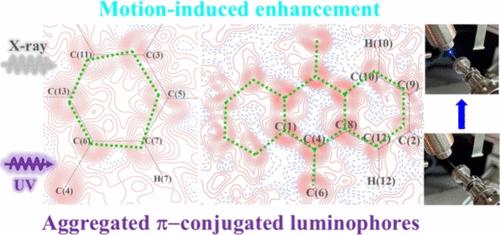
Luminescent organic materials play an indispensable role in various aspects of human life and modern society; however, their photophysical processes in the aggregated state remain inadequately understood. Here, we introduce an experimental scheme to monitor in situ the evolution of charge density and noncovalent interactions in aggregated molecules under dark conditions and 360 nm laser irradiation. Application to 9,10-diphenylanthracene (DPA) crystals reveals an unexpected light-induced molecular shift and rotation. Topological analysis of the in situ charge density indicates that the overall molecular shift within DPA crystals strengthens intermolecular C–H···π interactions while weakening π···π interactions. Moreover, significant rotation of the phenyls occurs upon light exposure, resulting in a change in the dihedral angle between their plane and the anthracene core from 66.621 to 66.344°, which enhances the intramolecular conjugation across the entire molecule. This structural evolution leads to a reduction in excitation energy and an increase in the radiative transition rate, as demonstrated by theoretical calculations, ultimately resulting in the observation of strong emission. The motion-induced enhancement mechanism uncovered in this study addresses the long-standing debate surrounding photophysical processes in traditional luminescent aggregates, providing a foundation for the development of novel luminescent materials with improved performance and versatility.
期刊介绍:
The journal Chemistry of Materials focuses on publishing original research at the intersection of materials science and chemistry. The studies published in the journal involve chemistry as a prominent component and explore topics such as the design, synthesis, characterization, processing, understanding, and application of functional or potentially functional materials. The journal covers various areas of interest, including inorganic and organic solid-state chemistry, nanomaterials, biomaterials, thin films and polymers, and composite/hybrid materials. The journal particularly seeks papers that highlight the creation or development of innovative materials with novel optical, electrical, magnetic, catalytic, or mechanical properties. It is essential that manuscripts on these topics have a primary focus on the chemistry of materials and represent a significant advancement compared to prior research. Before external reviews are sought, submitted manuscripts undergo a review process by a minimum of two editors to ensure their appropriateness for the journal and the presence of sufficient evidence of a significant advance that will be of broad interest to the materials chemistry community.



 京公网安备 11010802042870号
京ICP备2023020795号-1
京公网安备 11010802042870号
京ICP备2023020795号-1

 分享
分享
 求助内容:
求助内容: 应助结果提醒方式:
 扫码关注我们
