Diane D. Shao, Andrea J. Kriz, Daniel A. Snellings, Zinan Zhou, Yifan Zhao, Liz Enyenihi, Christopher Walsh
{"title":"Advances in single-cell DNA sequencing enable insights into human somatic mosaicism","authors":"Diane D. Shao, Andrea J. Kriz, Daniel A. Snellings, Zinan Zhou, Yifan Zhao, Liz Enyenihi, Christopher Walsh","doi":"10.1038/s41576-025-00832-3","DOIUrl":null,"url":null,"abstract":"DNA sequencing from bulk or clonal human tissues has shown that genetic mosaicism is common and contributes to both cancer and non-cancerous disorders. However, single-cell resolution is required to understand the full genetic heterogeneity that exists within a tissue and the mechanisms that lead to somatic mosaicism. Single-cell DNA-sequencing technologies have traditionally trailed behind those of single-cell transcriptomics and epigenomics, largely because most applications require whole-genome amplification before costly whole-genome sequencing. Now, recent technological and computational advances are enabling the use of single-cell DNA sequencing to tackle previously intractable problems, such as delineating the genetic landscape of tissues with complex clonal patterns, of samples where cellular material is scarce and of non-cycling, postmitotic cells. Single-cell genomes are also revealing the mutational patterns that arise from biological processes or disease states, and have made it possible to track cell lineage in human tissues. These advances in our understanding of tissue biology and our ability to identify disease mechanisms will ultimately transform how disease is diagnosed and monitored. In this Review, Shao et al. discuss experimental and computational advances in single-cell DNA sequencing, insights into somatic genetic variation during normal development and in disease, and the potential use of single-cell somatic mutations for lineage tracing, diagnostics and biomarkers.","PeriodicalId":19067,"journal":{"name":"Nature Reviews Genetics","volume":"26 11","pages":"761-774"},"PeriodicalIF":52.0000,"publicationDate":"2025-04-25","publicationTypes":"Journal Article","fieldsOfStudy":null,"isOpenAccess":false,"openAccessPdf":"","citationCount":"0","resultStr":null,"platform":"Semanticscholar","paperid":null,"PeriodicalName":"Nature Reviews Genetics","FirstCategoryId":"99","ListUrlMain":"https://www.nature.com/articles/s41576-025-00832-3","RegionNum":1,"RegionCategory":"生物学","ArticlePicture":[],"TitleCN":null,"AbstractTextCN":null,"PMCID":null,"EPubDate":"","PubModel":"","JCR":"Q1","JCRName":"GENETICS & HEREDITY","Score":null,"Total":0}
引用次数: 0
Abstract
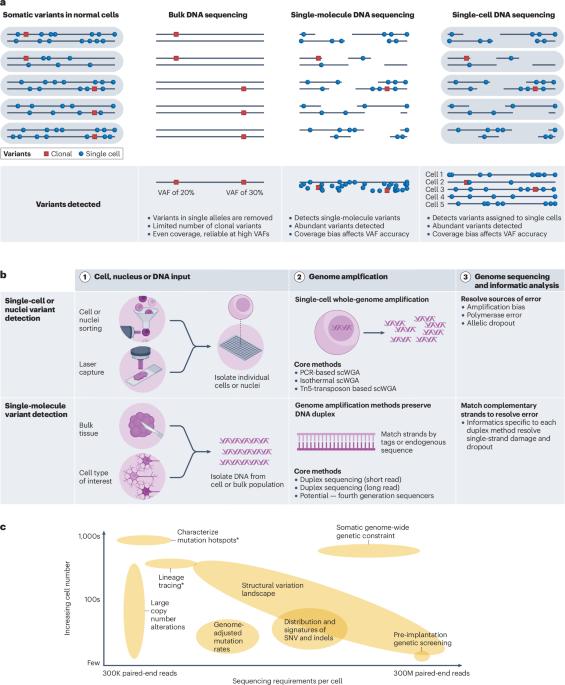
DNA sequencing from bulk or clonal human tissues has shown that genetic mosaicism is common and contributes to both cancer and non-cancerous disorders. However, single-cell resolution is required to understand the full genetic heterogeneity that exists within a tissue and the mechanisms that lead to somatic mosaicism. Single-cell DNA-sequencing technologies have traditionally trailed behind those of single-cell transcriptomics and epigenomics, largely because most applications require whole-genome amplification before costly whole-genome sequencing. Now, recent technological and computational advances are enabling the use of single-cell DNA sequencing to tackle previously intractable problems, such as delineating the genetic landscape of tissues with complex clonal patterns, of samples where cellular material is scarce and of non-cycling, postmitotic cells. Single-cell genomes are also revealing the mutational patterns that arise from biological processes or disease states, and have made it possible to track cell lineage in human tissues. These advances in our understanding of tissue biology and our ability to identify disease mechanisms will ultimately transform how disease is diagnosed and monitored. In this Review, Shao et al. discuss experimental and computational advances in single-cell DNA sequencing, insights into somatic genetic variation during normal development and in disease, and the potential use of single-cell somatic mutations for lineage tracing, diagnostics and biomarkers.
期刊介绍:
At Nature Reviews Genetics, our goal is to be the leading source of reviews and commentaries for the scientific communities we serve. We are dedicated to publishing authoritative articles that are easily accessible to our readers. We believe in enhancing our articles with clear and understandable figures, tables, and other display items. Our aim is to provide an unparalleled service to authors, referees, and readers, and we are committed to maximizing the usefulness and impact of each article we publish.
Within our journal, we publish a range of content including Research Highlights, Comments, Reviews, and Perspectives that are relevant to geneticists and genomicists. With our broad scope, we ensure that the articles we publish reach the widest possible audience.
As part of the Nature Reviews portfolio of journals, we strive to uphold the high standards and reputation associated with this esteemed collection of publications.





 京公网安备 11010802042870号
京ICP备2023020795号-1
京公网安备 11010802042870号
京ICP备2023020795号-1

 分享
分享
 求助内容:
求助内容: 应助结果提醒方式:
 扫码关注我们
