Wenmeng Liu , Kunfeng Liu , David Julian McClements , Zhengyu Jin , Long Chen
{"title":"Development and characterization of edible bigels based on starch hydrogels and monoglyceride oleogels for dysphagia food","authors":"Wenmeng Liu , Kunfeng Liu , David Julian McClements , Zhengyu Jin , Long Chen","doi":"10.1016/j.foodchem.2025.144506","DOIUrl":null,"url":null,"abstract":"<div><div>With the increasing dysphagia of the elderly, the development of dysphagia diet has become a research hotspot. This study focused on the synthesis of bigels composed of monoglyceride-based oleogels and starch-based hydrogels stabilized by chitosan-betaine-vanillin system. The impact of hydrogel/oleogel ratio on the rheological, oil-binding, and structural properties of the bigels were characterized. The structure of the bigels changed from oil-in-water (< 50 % oleogel) to bicontinuous (≈ 50 % oleogel) to water-in-oil (> 50 % oleogel). The viscoelasticity of the bigels were improved as the oleogel-to-hydrogel ratio decreased. The oil binding capacity of the bigels with oil-in-water stable cross-linked network structure was more than 95 %. The potential of using these bigels as dysphagia foods was assessed using standardized dysphagia test, which showed that they could be classified as grade four dysphagia foods. These findings provide new insights for designing and developing sustainable and healthy foods for people with swallowing difficulties.</div></div>","PeriodicalId":318,"journal":{"name":"Food Chemistry","volume":"485 ","pages":"Article 144506"},"PeriodicalIF":9.8000,"publicationDate":"2025-09-01","publicationTypes":"Journal Article","fieldsOfStudy":null,"isOpenAccess":false,"openAccessPdf":"","citationCount":"0","resultStr":null,"platform":"Semanticscholar","paperid":null,"PeriodicalName":"Food Chemistry","FirstCategoryId":"97","ListUrlMain":"https://www.sciencedirect.com/science/article/pii/S0308814625017571","RegionNum":1,"RegionCategory":"农林科学","ArticlePicture":[],"TitleCN":null,"AbstractTextCN":null,"PMCID":null,"EPubDate":"2025/4/25 0:00:00","PubModel":"Epub","JCR":"Q1","JCRName":"CHEMISTRY, APPLIED","Score":null,"Total":0}
引用次数: 0
Abstract
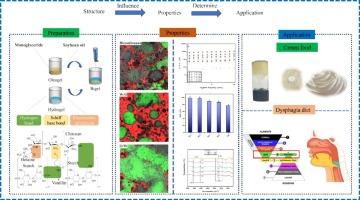
With the increasing dysphagia of the elderly, the development of dysphagia diet has become a research hotspot. This study focused on the synthesis of bigels composed of monoglyceride-based oleogels and starch-based hydrogels stabilized by chitosan-betaine-vanillin system. The impact of hydrogel/oleogel ratio on the rheological, oil-binding, and structural properties of the bigels were characterized. The structure of the bigels changed from oil-in-water (< 50 % oleogel) to bicontinuous (≈ 50 % oleogel) to water-in-oil (> 50 % oleogel). The viscoelasticity of the bigels were improved as the oleogel-to-hydrogel ratio decreased. The oil binding capacity of the bigels with oil-in-water stable cross-linked network structure was more than 95 %. The potential of using these bigels as dysphagia foods was assessed using standardized dysphagia test, which showed that they could be classified as grade four dysphagia foods. These findings provide new insights for designing and developing sustainable and healthy foods for people with swallowing difficulties.
期刊介绍:
Food Chemistry publishes original research papers dealing with the advancement of the chemistry and biochemistry of foods or the analytical methods/ approach used. All papers should focus on the novelty of the research carried out.




 京公网安备 11010802042870号
京ICP备2023020795号-1
京公网安备 11010802042870号
京ICP备2023020795号-1

 分享
分享
 求助内容:
求助内容: 应助结果提醒方式:
 扫码关注我们
