Construction of sodium alginate/ginkgo biloba polysaccharide based films embedded with ginkgo biloba extract and its application in postharvest quality stabilization of sweet cherries
Keyu Sun , Ziwuzhen Wang , Wenxin Xiang , Shuhong Ye , Huiping Wan
{"title":"Construction of sodium alginate/ginkgo biloba polysaccharide based films embedded with ginkgo biloba extract and its application in postharvest quality stabilization of sweet cherries","authors":"Keyu Sun , Ziwuzhen Wang , Wenxin Xiang , Shuhong Ye , Huiping Wan","doi":"10.1016/j.foodchem.2025.144533","DOIUrl":null,"url":null,"abstract":"<div><div>Sweet cherries, abundant in nutrients and antioxidants, are prone to quality loss from mechanical damage and pathogens. Eco-friendly sodium alginate/<em>ginkgo biloba</em> polysaccharide composite hydrogel films (SP) embedded with <em>ginkgo biloba</em> leaf extract (GBE) was invented to enhance sweet cherry preservation. Structural analyses (XRD, FTIR, SEM) confirmed that <em>ginkgo biloba</em> polysaccharide improved hydrogel cross-linking, resolving sodium alginate's rapid surface gelation issue. GBE imparted antioxidant and antimicrobial properties against pathogens, with XPS confirming successful encapsulation rather than surface loading. The composite film demonstrated enhanced mechanical strength (tensile strength increased 38 %), improved water vapor barrier properties (25 % reduction), and antioxidant capacity. The optimized 2 % GBE formulation extended shelf life by 4 days compared to unpackaged fruit, achieving only 33.3 % decay incidence after 14 days versus 86.7 % in controls. Films maintained fruit homeostasis by blocking external exchange, demonstrating their potential as effective freshness-preserving packaging for fruit postharvest management.</div></div>","PeriodicalId":318,"journal":{"name":"Food Chemistry","volume":"485 ","pages":"Article 144533"},"PeriodicalIF":9.8000,"publicationDate":"2025-09-01","publicationTypes":"Journal Article","fieldsOfStudy":null,"isOpenAccess":false,"openAccessPdf":"","citationCount":"0","resultStr":null,"platform":"Semanticscholar","paperid":null,"PeriodicalName":"Food Chemistry","FirstCategoryId":"97","ListUrlMain":"https://www.sciencedirect.com/science/article/pii/S0308814625017844","RegionNum":1,"RegionCategory":"农林科学","ArticlePicture":[],"TitleCN":null,"AbstractTextCN":null,"PMCID":null,"EPubDate":"2025/4/25 0:00:00","PubModel":"Epub","JCR":"Q1","JCRName":"CHEMISTRY, APPLIED","Score":null,"Total":0}
引用次数: 0
Abstract
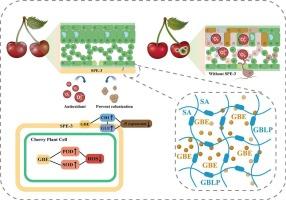
Sweet cherries, abundant in nutrients and antioxidants, are prone to quality loss from mechanical damage and pathogens. Eco-friendly sodium alginate/ginkgo biloba polysaccharide composite hydrogel films (SP) embedded with ginkgo biloba leaf extract (GBE) was invented to enhance sweet cherry preservation. Structural analyses (XRD, FTIR, SEM) confirmed that ginkgo biloba polysaccharide improved hydrogel cross-linking, resolving sodium alginate's rapid surface gelation issue. GBE imparted antioxidant and antimicrobial properties against pathogens, with XPS confirming successful encapsulation rather than surface loading. The composite film demonstrated enhanced mechanical strength (tensile strength increased 38 %), improved water vapor barrier properties (25 % reduction), and antioxidant capacity. The optimized 2 % GBE formulation extended shelf life by 4 days compared to unpackaged fruit, achieving only 33.3 % decay incidence after 14 days versus 86.7 % in controls. Films maintained fruit homeostasis by blocking external exchange, demonstrating their potential as effective freshness-preserving packaging for fruit postharvest management.
期刊介绍:
Food Chemistry publishes original research papers dealing with the advancement of the chemistry and biochemistry of foods or the analytical methods/ approach used. All papers should focus on the novelty of the research carried out.




 京公网安备 11010802042870号
京ICP备2023020795号-1
京公网安备 11010802042870号
京ICP备2023020795号-1

 分享
分享
 求助内容:
求助内容: 应助结果提醒方式:
 扫码关注我们
