Hang Liu , Chen Yang , Xiaolin Wu , Shengfeng Peng , Lei Zhou , David Julian McClements , Wei Liu
{"title":"Influence of the maturity on the characteristics of orange-derived extracellular vesicles and their delivery performance for curcumin","authors":"Hang Liu , Chen Yang , Xiaolin Wu , Shengfeng Peng , Lei Zhou , David Julian McClements , Wei Liu","doi":"10.1016/j.foodchem.2025.144518","DOIUrl":null,"url":null,"abstract":"<div><div>Plant-derived extracellular vesicles have considerable potential as natural pharmaceutical and nutraceutical delivery systems. However, the impact of plant maturity on the physicochemical and structural properties of isolated extracellular vesicles is currently unknown. In this work, extracellular vesicles isolated from oranges at different maturity stages were first characterized and compared. Afterwards, polyphenol-load orange juices were successfully prepared by incorporating polyphenols (mainly curcumin) into extracellular vesicles originated from orange juices. Encapsulation in vesicles was found to increase the solubility, stability, bioaccessibility, and antioxidant activity of curcumin, but the effects depended on the maturity of oranges. Specifically, the vesicles from unripe and ripe orange juices were more effective for curcumin delivery than those from overripe orange juice. Conclusively, this study has provided important new information about the optimum maturity for isolating fruit-derived extracellular vesicles. Moreover, the extracellular vesicle-based delivery systems developed in this study may facilitate the design of more effective functional foods and beverages.</div></div>","PeriodicalId":318,"journal":{"name":"Food Chemistry","volume":"485 ","pages":"Article 144518"},"PeriodicalIF":9.8000,"publicationDate":"2025-09-01","publicationTypes":"Journal Article","fieldsOfStudy":null,"isOpenAccess":false,"openAccessPdf":"","citationCount":"0","resultStr":null,"platform":"Semanticscholar","paperid":null,"PeriodicalName":"Food Chemistry","FirstCategoryId":"97","ListUrlMain":"https://www.sciencedirect.com/science/article/pii/S0308814625017698","RegionNum":1,"RegionCategory":"农林科学","ArticlePicture":[],"TitleCN":null,"AbstractTextCN":null,"PMCID":null,"EPubDate":"2025/4/25 0:00:00","PubModel":"Epub","JCR":"Q1","JCRName":"CHEMISTRY, APPLIED","Score":null,"Total":0}
引用次数: 0
Abstract
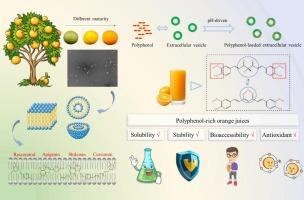
Plant-derived extracellular vesicles have considerable potential as natural pharmaceutical and nutraceutical delivery systems. However, the impact of plant maturity on the physicochemical and structural properties of isolated extracellular vesicles is currently unknown. In this work, extracellular vesicles isolated from oranges at different maturity stages were first characterized and compared. Afterwards, polyphenol-load orange juices were successfully prepared by incorporating polyphenols (mainly curcumin) into extracellular vesicles originated from orange juices. Encapsulation in vesicles was found to increase the solubility, stability, bioaccessibility, and antioxidant activity of curcumin, but the effects depended on the maturity of oranges. Specifically, the vesicles from unripe and ripe orange juices were more effective for curcumin delivery than those from overripe orange juice. Conclusively, this study has provided important new information about the optimum maturity for isolating fruit-derived extracellular vesicles. Moreover, the extracellular vesicle-based delivery systems developed in this study may facilitate the design of more effective functional foods and beverages.
期刊介绍:
Food Chemistry publishes original research papers dealing with the advancement of the chemistry and biochemistry of foods or the analytical methods/ approach used. All papers should focus on the novelty of the research carried out.




 京公网安备 11010802042870号
京ICP备2023020795号-1
京公网安备 11010802042870号
京ICP备2023020795号-1

 分享
分享
 求助内容:
求助内容: 应助结果提醒方式:
 扫码关注我们
