{"title":"Heterometallic Aluminum Metal–Organic Frameworks","authors":"Wei Wang, Yichong Chen, Xianhui Bu, Pingyun Feng","doi":"10.1021/jacs.4c18251","DOIUrl":null,"url":null,"abstract":"From spinel gemstone (MgAl<sub>2</sub>O<sub>4</sub>) to layered double hydroxides, nature has long relied on combinations between charge-complementary metal ions such as divalent metal ions (M<sup>2+</sup>) and Al<sup>3+</sup> to create diverse valuable materials. However, for metal–organic frameworks (MOFs), heterometallic combinations such as Mg–Al are conspicuously absent. Here, we report a breakthrough in the synthesis of heterometallic Al-MOFs containing M<sup>2+</sup>/Al<sup>3+</sup> trimeric clusters (M = Mg, Mn, Co, Ni). The synergistic effect between M(II) chlorides and aluminum lactate plays a critical role in the cooperative crystallization of M<sup>2+</sup> and Al<sup>3+</sup> into pore-space-partitioned MOFs (partitioned acs topology) with fast crystallization kinetics (about 3 h). New M<sup>2+</sup>/Al<sup>3+</sup> MOFs exhibit highly tunable porosity and extraordinarily high uptakes for CO<sub>2</sub> and small hydrocarbon molecules (112 cm<sup>3</sup>/g for CO<sub>2</sub>, 176 cm<sup>3</sup>/g for C<sub>2</sub>H<sub>2</sub>, 156 cm<sup>3</sup>/g for C<sub>2</sub>H<sub>4</sub>, and 163 cm<sup>3</sup>/g for C<sub>2</sub>H<sub>6</sub>) at 298 K and 1 bar. The high uptake capacity coupled with high selectivity (up to 8.5 for C<sub>2</sub>H<sub>2</sub>/CO<sub>2</sub>, 10.8 for C<sub>2</sub>H<sub>2</sub>/C<sub>2</sub>H<sub>4</sub>) gives rise to efficient separations of either C<sub>2</sub>H<sub>2</sub>/CO<sub>2</sub> or C<sub>2</sub>H<sub>2</sub>/C<sub>2</sub>H<sub>4</sub> gas mixtures, as confirmed by experimental breakthrough experiments.","PeriodicalId":49,"journal":{"name":"Journal of the American Chemical Society","volume":"72 1","pages":""},"PeriodicalIF":15.6000,"publicationDate":"2025-04-26","publicationTypes":"Journal Article","fieldsOfStudy":null,"isOpenAccess":false,"openAccessPdf":"","citationCount":"0","resultStr":null,"platform":"Semanticscholar","paperid":null,"PeriodicalName":"Journal of the American Chemical Society","FirstCategoryId":"92","ListUrlMain":"https://doi.org/10.1021/jacs.4c18251","RegionNum":1,"RegionCategory":"化学","ArticlePicture":[],"TitleCN":null,"AbstractTextCN":null,"PMCID":null,"EPubDate":"","PubModel":"","JCR":"Q1","JCRName":"CHEMISTRY, MULTIDISCIPLINARY","Score":null,"Total":0}
引用次数: 0
Abstract
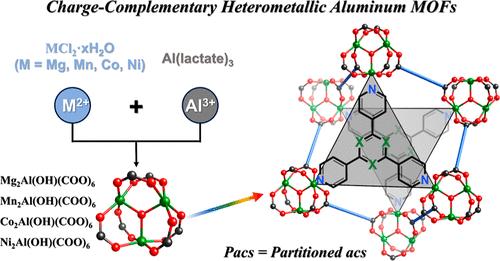
From spinel gemstone (MgAl2O4) to layered double hydroxides, nature has long relied on combinations between charge-complementary metal ions such as divalent metal ions (M2+) and Al3+ to create diverse valuable materials. However, for metal–organic frameworks (MOFs), heterometallic combinations such as Mg–Al are conspicuously absent. Here, we report a breakthrough in the synthesis of heterometallic Al-MOFs containing M2+/Al3+ trimeric clusters (M = Mg, Mn, Co, Ni). The synergistic effect between M(II) chlorides and aluminum lactate plays a critical role in the cooperative crystallization of M2+ and Al3+ into pore-space-partitioned MOFs (partitioned acs topology) with fast crystallization kinetics (about 3 h). New M2+/Al3+ MOFs exhibit highly tunable porosity and extraordinarily high uptakes for CO2 and small hydrocarbon molecules (112 cm3/g for CO2, 176 cm3/g for C2H2, 156 cm3/g for C2H4, and 163 cm3/g for C2H6) at 298 K and 1 bar. The high uptake capacity coupled with high selectivity (up to 8.5 for C2H2/CO2, 10.8 for C2H2/C2H4) gives rise to efficient separations of either C2H2/CO2 or C2H2/C2H4 gas mixtures, as confirmed by experimental breakthrough experiments.
期刊介绍:
The flagship journal of the American Chemical Society, known as the Journal of the American Chemical Society (JACS), has been a prestigious publication since its establishment in 1879. It holds a preeminent position in the field of chemistry and related interdisciplinary sciences. JACS is committed to disseminating cutting-edge research papers, covering a wide range of topics, and encompasses approximately 19,000 pages of Articles, Communications, and Perspectives annually. With a weekly publication frequency, JACS plays a vital role in advancing the field of chemistry by providing essential research.



 京公网安备 11010802042870号
京ICP备2023020795号-1
京公网安备 11010802042870号
京ICP备2023020795号-1

 分享
分享
 求助内容:
求助内容: 应助结果提醒方式:
 扫码关注我们
