{"title":"Electrochemical dechlorination promotes syngas production in N-heterocyclic carbene protected Au13 nanoclusters†","authors":"Zhimin Chen, Dongjie Zuo, Lancheng Zhao, Yuping Chen, Fang Sun, Likai Wang, Hui Shen and Qing Tang","doi":"10.1039/D5SC00896D","DOIUrl":null,"url":null,"abstract":"<p >Surface ligands play an important role in dictating the structure and catalytic properties of metal nanoclusters. Recently, a novel class of Au clusters protected by N-heterocyclic carbenes (NHCs) and halogens has been synthesized; however, the dynamic stability of the Au–NHCs/Au–halogen interface in real electrochemical environments as well as the influence of the ligand layer on the catalytic process remains obscure. Herein, we combined first-principles simulations with experiments to investigate the metal–ligand interface interaction of the classical [Au<small><sub>13</sub></small>(NHC<small><sup>Me</sup></small>)<small><sub>9</sub></small>Cl<small><sub>3</sub></small>]<small><sup>2+</sup></small> cluster and its unique potential to promote electrocatalytic CO<small><sub>2</sub></small> reduction to syngas. Our simulations revealed the facile shedding of chlorine ligands from the surface of the Au<small><sub>13</sub></small> core upon electrochemical biasing, and the more negative the applied potential, the faster the kinetics of the Au–Cl bond cleavage. By contrast, the Au–NHC interface is highly stable, indicating the greater stability of Au–C bonds over the Au–Cl bonds under electrochemical conditions. Interestingly, the exposed icosahedral Au in dechlorinated [Au<small><sub>13</sub></small>(NHC<small><sup>Me</sup></small>)<small><sub>9</sub></small>Cl<small><sub>2</sub></small>]<small><sup>3+</sup></small> cluster is capable of efficiently catalyzing electrochemical CO<small><sub>2</sub></small> reduction to generate CO and H<small><sub>2</sub></small> with comparable barriers in a wide potential range, showcasing its strong potential for syngas formation. Our predictions are further corroborated by experimental electrochemical data, where X-ray photoelectron spectroscopy (XPS) verified halogen stripping under acid or neutral media, and the activated Au<small><sub>13</sub></small> cluster demonstrated enhanced catalytic efficacy for syngas formation with a CO : H<small><sub>2</sub></small> ratio of approximately 0.8 to 1.2 across a broad potential range of −0.50 to −1.20 V. This work reveals an exciting frontier in the understanding of ligand etching dynamics in NHC-protected metal nanoclusters, and particularly, the catalytic preference for syngas production is revealed for the first time in gold-based nanoclusters, which is distinctive from previously reported Au nanoclusters that mainly produce CO.</p>","PeriodicalId":9909,"journal":{"name":"Chemical Science","volume":" 23","pages":" 10397-10413"},"PeriodicalIF":7.4000,"publicationDate":"2025-04-28","publicationTypes":"Journal Article","fieldsOfStudy":null,"isOpenAccess":false,"openAccessPdf":"https://pubs.rsc.org/en/content/articlepdf/2025/sc/d5sc00896d?page=search","citationCount":"0","resultStr":null,"platform":"Semanticscholar","paperid":null,"PeriodicalName":"Chemical Science","FirstCategoryId":"92","ListUrlMain":"https://pubs.rsc.org/en/content/articlelanding/2025/sc/d5sc00896d","RegionNum":1,"RegionCategory":"化学","ArticlePicture":[],"TitleCN":null,"AbstractTextCN":null,"PMCID":null,"EPubDate":"","PubModel":"","JCR":"Q1","JCRName":"CHEMISTRY, MULTIDISCIPLINARY","Score":null,"Total":0}
引用次数: 0
Abstract
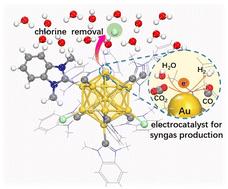
Surface ligands play an important role in dictating the structure and catalytic properties of metal nanoclusters. Recently, a novel class of Au clusters protected by N-heterocyclic carbenes (NHCs) and halogens has been synthesized; however, the dynamic stability of the Au–NHCs/Au–halogen interface in real electrochemical environments as well as the influence of the ligand layer on the catalytic process remains obscure. Herein, we combined first-principles simulations with experiments to investigate the metal–ligand interface interaction of the classical [Au13(NHCMe)9Cl3]2+ cluster and its unique potential to promote electrocatalytic CO2 reduction to syngas. Our simulations revealed the facile shedding of chlorine ligands from the surface of the Au13 core upon electrochemical biasing, and the more negative the applied potential, the faster the kinetics of the Au–Cl bond cleavage. By contrast, the Au–NHC interface is highly stable, indicating the greater stability of Au–C bonds over the Au–Cl bonds under electrochemical conditions. Interestingly, the exposed icosahedral Au in dechlorinated [Au13(NHCMe)9Cl2]3+ cluster is capable of efficiently catalyzing electrochemical CO2 reduction to generate CO and H2 with comparable barriers in a wide potential range, showcasing its strong potential for syngas formation. Our predictions are further corroborated by experimental electrochemical data, where X-ray photoelectron spectroscopy (XPS) verified halogen stripping under acid or neutral media, and the activated Au13 cluster demonstrated enhanced catalytic efficacy for syngas formation with a CO : H2 ratio of approximately 0.8 to 1.2 across a broad potential range of −0.50 to −1.20 V. This work reveals an exciting frontier in the understanding of ligand etching dynamics in NHC-protected metal nanoclusters, and particularly, the catalytic preference for syngas production is revealed for the first time in gold-based nanoclusters, which is distinctive from previously reported Au nanoclusters that mainly produce CO.
期刊介绍:
Chemical Science is a journal that encompasses various disciplines within the chemical sciences. Its scope includes publishing ground-breaking research with significant implications for its respective field, as well as appealing to a wider audience in related areas. To be considered for publication, articles must showcase innovative and original advances in their field of study and be presented in a manner that is understandable to scientists from diverse backgrounds. However, the journal generally does not publish highly specialized research.




 京公网安备 11010802042870号
京ICP备2023020795号-1
京公网安备 11010802042870号
京ICP备2023020795号-1

 分享
分享
 求助内容:
求助内容: 应助结果提醒方式:
 扫码关注我们
