{"title":"Branched Biobased Diesters with Exceptional Low Temperature and Flow Properties for Use in Lubricant Formulations","authors":"Latchmi Raghunanan, Suresh S. Narine*","doi":"10.1021/acssuschemeng.5b01686","DOIUrl":null,"url":null,"abstract":"<p >A vegetable oil based diester (1,6-hexyldioleate) was branched with propanoic acid (C3) using a green synthetic approach involving solvent- and catalyst-free epoxide ring opening followed by in situ normal esterification. A total of three branched ester derivatives possessing varied numbers of internal protruding branched ester and hydroxyl groups were obtained. All of the pure branched derivatives were comprised of mixtures of positional and/or stereoisomers. Differential scanning calorimetry showed that, regardless of the compositional inhomogeneity of each branched derivative, crystallization was suppressed completely in all of the branched compounds and they all demonstrated glass transitions below ?65 °C. This unique thermal behavior is attributed to the internal protruding branched moieties and hydroxyl groups which dramatically slowed mass transfer. The viscosity of the branched compounds was 1 order of magnitude larger than that of the starting diester due to the increased resistance to flow associated with increased branching and hydrogen bonding introduced by the OH groups. Overall, these branched diesters demonstrated superior low temperature and flow properties comparable to existing nonsustainable commercial lubricants and analogous biobased materials, making them suitable alternatives for use in lubricant formulations, particularly in high performance industrial gear and bearing biolubricants.</p>","PeriodicalId":25,"journal":{"name":"ACS Sustainable Chemistry & Engineering","volume":"4 5","pages":"2542–2549"},"PeriodicalIF":7.3000,"publicationDate":"2016-04-11","publicationTypes":"Journal Article","fieldsOfStudy":null,"isOpenAccess":false,"openAccessPdf":"https://sci-hub-pdf.com/10.1021/acssuschemeng.5b01686","citationCount":"13","resultStr":null,"platform":"Semanticscholar","paperid":null,"PeriodicalName":"ACS Sustainable Chemistry & Engineering","FirstCategoryId":"92","ListUrlMain":"https://pubs.acs.org/doi/10.1021/acssuschemeng.5b01686","RegionNum":1,"RegionCategory":"化学","ArticlePicture":[],"TitleCN":null,"AbstractTextCN":null,"PMCID":null,"EPubDate":"","PubModel":"","JCR":"Q1","JCRName":"CHEMISTRY, MULTIDISCIPLINARY","Score":null,"Total":0}
引用次数: 13
Abstract
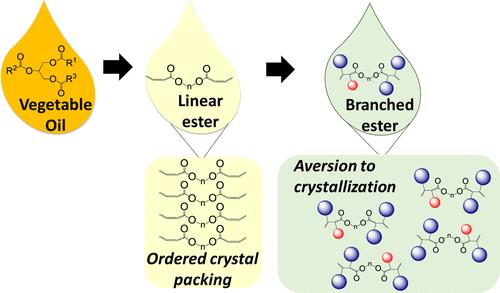
A vegetable oil based diester (1,6-hexyldioleate) was branched with propanoic acid (C3) using a green synthetic approach involving solvent- and catalyst-free epoxide ring opening followed by in situ normal esterification. A total of three branched ester derivatives possessing varied numbers of internal protruding branched ester and hydroxyl groups were obtained. All of the pure branched derivatives were comprised of mixtures of positional and/or stereoisomers. Differential scanning calorimetry showed that, regardless of the compositional inhomogeneity of each branched derivative, crystallization was suppressed completely in all of the branched compounds and they all demonstrated glass transitions below ?65 °C. This unique thermal behavior is attributed to the internal protruding branched moieties and hydroxyl groups which dramatically slowed mass transfer. The viscosity of the branched compounds was 1 order of magnitude larger than that of the starting diester due to the increased resistance to flow associated with increased branching and hydrogen bonding introduced by the OH groups. Overall, these branched diesters demonstrated superior low temperature and flow properties comparable to existing nonsustainable commercial lubricants and analogous biobased materials, making them suitable alternatives for use in lubricant formulations, particularly in high performance industrial gear and bearing biolubricants.
期刊介绍:
ACS Sustainable Chemistry & Engineering is a prestigious weekly peer-reviewed scientific journal published by the American Chemical Society. Dedicated to advancing the principles of green chemistry and green engineering, it covers a wide array of research topics including green chemistry, green engineering, biomass, alternative energy, and life cycle assessment.
The journal welcomes submissions in various formats, including Letters, Articles, Features, and Perspectives (Reviews), that address the challenges of sustainability in the chemical enterprise and contribute to the advancement of sustainable practices. Join us in shaping the future of sustainable chemistry and engineering.



 京公网安备 11010802042870号
京ICP备2023020795号-1
京公网安备 11010802042870号
京ICP备2023020795号-1

 分享
分享
 求助内容:
求助内容: 应助结果提醒方式:
 扫码关注我们
