{"title":"THE INTERACTION OF CORTICOSTEROIDS AND ANTIMICROBIAL AGENTS USED IN TOPICAL THERAPY*","authors":"WOLFGANG P. RAAB","doi":"10.1111/j.1365-2133.1971.tb02547.x","DOIUrl":null,"url":null,"abstract":"—By measuring the oxygen consumption of resting and proliferating bacteria and yeasts, the effects of combinations of antimicrobials and glucocorticoids were studied. An attempt was made to determine whether the stimulating effect of glucocorticoids or their influences on enzyme systems and membranes would impair the effectiveness of antimicrobials with which they are combined in topical therapy. The following microbicidals and antibiotics were studied: chlorohydroxybenzoic acid n-butylamide, l-p-chlorobenzyl-2-methylbenzimidazole, dodecyldi(^-hydroxyethyl)-benzylammonium chloride, dodecyltriphenylphosphonium bromide, neomycin, gentamicin, chloramphenicol, gramicidine, oxytetracycline, polymyxin B, fusidic acid, nystatin. natamycin (— pimaricin) and hamycin. These compounds were investigated for interactions with the following glucocorticoids in activating concentrations: hydrocortisone, prednisolone, beta-methasone valerate, fluocinolone acetonide, fluocinolone acetonide acetate, methylprednisolone and triamcinolone acetonide. In most instances the compounds studied were examined in the same concentrations as used in dermatological therapy. Marked interactions with glucocorticoids (inhibition of antimicrobial activity) were encountered in the case of fusidic acid, a steroid antibiotic, and of hamycin. Weak interactions were found in some other cases. Similar experiments are recommended before antimicrobials and glucocorticoids are combined in new dermatological formulations.","PeriodicalId":9238,"journal":{"name":"British Journal of Dermatology","volume":"84 6","pages":"582-589"},"PeriodicalIF":9.6000,"publicationDate":"1971-06-01","publicationTypes":"Journal Article","fieldsOfStudy":null,"isOpenAccess":false,"openAccessPdf":"https://sci-hub-pdf.com/10.1111/j.1365-2133.1971.tb02547.x","citationCount":"17","resultStr":null,"platform":"Semanticscholar","paperid":null,"PeriodicalName":"British Journal of Dermatology","FirstCategoryId":"3","ListUrlMain":"https://onlinelibrary.wiley.com/doi/10.1111/j.1365-2133.1971.tb02547.x","RegionNum":1,"RegionCategory":"医学","ArticlePicture":[],"TitleCN":null,"AbstractTextCN":null,"PMCID":null,"EPubDate":"","PubModel":"","JCR":"Q1","JCRName":"DERMATOLOGY","Score":null,"Total":0}
引用次数: 17
Abstract
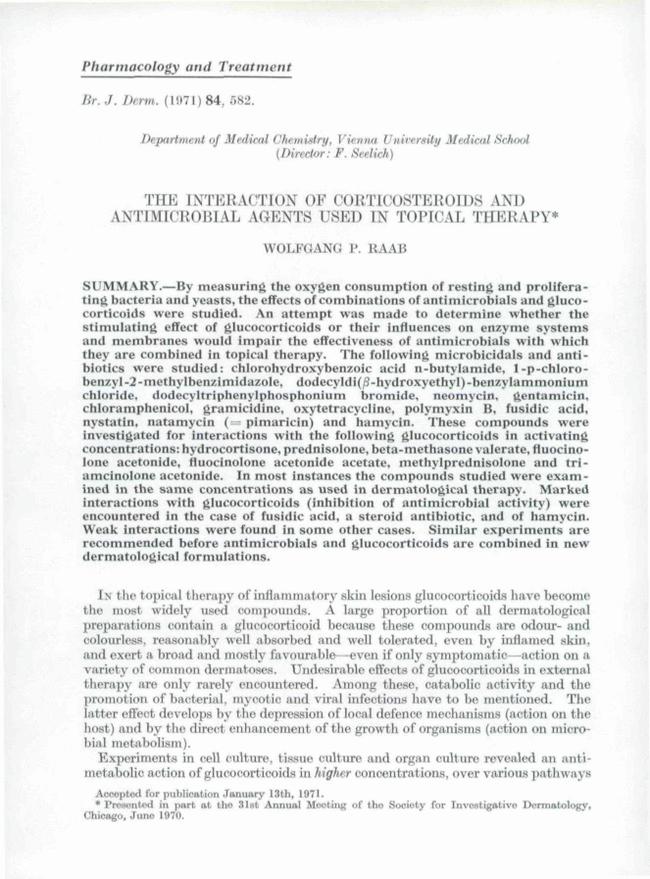
—By measuring the oxygen consumption of resting and proliferating bacteria and yeasts, the effects of combinations of antimicrobials and glucocorticoids were studied. An attempt was made to determine whether the stimulating effect of glucocorticoids or their influences on enzyme systems and membranes would impair the effectiveness of antimicrobials with which they are combined in topical therapy. The following microbicidals and antibiotics were studied: chlorohydroxybenzoic acid n-butylamide, l-p-chlorobenzyl-2-methylbenzimidazole, dodecyldi(^-hydroxyethyl)-benzylammonium chloride, dodecyltriphenylphosphonium bromide, neomycin, gentamicin, chloramphenicol, gramicidine, oxytetracycline, polymyxin B, fusidic acid, nystatin. natamycin (— pimaricin) and hamycin. These compounds were investigated for interactions with the following glucocorticoids in activating concentrations: hydrocortisone, prednisolone, beta-methasone valerate, fluocinolone acetonide, fluocinolone acetonide acetate, methylprednisolone and triamcinolone acetonide. In most instances the compounds studied were examined in the same concentrations as used in dermatological therapy. Marked interactions with glucocorticoids (inhibition of antimicrobial activity) were encountered in the case of fusidic acid, a steroid antibiotic, and of hamycin. Weak interactions were found in some other cases. Similar experiments are recommended before antimicrobials and glucocorticoids are combined in new dermatological formulations.
期刊介绍:
The British Journal of Dermatology (BJD) is committed to publishing the highest quality dermatological research. Through its publications, the journal seeks to advance the understanding, management, and treatment of skin diseases, ultimately aiming to improve patient outcomes.



 京公网安备 11010802042870号
京ICP备2023020795号-1
京公网安备 11010802042870号
京ICP备2023020795号-1

 分享
分享
 求助内容:
求助内容: 应助结果提醒方式:
 扫码关注我们
