Application of axisymmetric drop shape analysis and brewster angle microscopy for assessment of clinical samples from prematurely born infants with NRDS
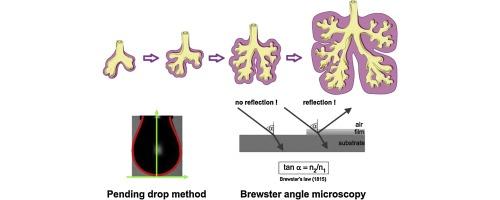
{"title":"Application of axisymmetric drop shape analysis and brewster angle microscopy for assessment of clinical samples from prematurely born infants with NRDS","authors":"Maya Bangyozova , Albena Jordanova , Asya Tsanova , Vishnya Stoyanova , Elena Tasheva , Krasimira Ivanova , Roumen Todorov , Emilia Hristova , Zdravko Lalchev","doi":"10.1016/j.colsurfa.2016.05.062","DOIUrl":null,"url":null,"abstract":"<div><p>Axisymmetric drop shape analysis (ADSA) is a powerful technique for surface tension measurement of a pendant drop, requiring only 50 microliters of the tested clinical sample. In addition, Brewster angle microscopy (BAM) is a well-established and useful method for visualization of ultra-thin surface films, such as Langmuir monolayers, on air-water interface. In the present study we analysed the surface properties of gastric aspirates (GAs) from prematurely born infants with neonatal respiratory distress syndrome (NRDS) and healthy full term infants with regard to find an approachable method for assessment of surfactant maturity at birth. The measurement of dynamic surface characteristics of GA by ADSA showed significantly higher mean values of the minimal surface tension in the premature infants as compared to the full term babies. This parameter proves to be the most reliable parameter for lung maturity assessment. In addition, the hysteresis curves of the surface tension vs. drop surface area indicated more stable surface behavior of alveolar surfactant from healthy children, as compared to the NRDS infants. The morphology of the monolayers composed of GAs also showed considerable differences between the samples from both groups studied. In conclusion, ADSA and BAM methods could be used into the clinical practice for rapid and sensitive surfactant's assessment in premature infants with regard to administration of exogenous surfactant.</p></div>","PeriodicalId":278,"journal":{"name":"Colloids and Surfaces A: Physicochemical and Engineering Aspects","volume":"519 ","pages":"Pages 187-191"},"PeriodicalIF":5.4000,"publicationDate":"2017-04-20","publicationTypes":"Journal Article","fieldsOfStudy":null,"isOpenAccess":false,"openAccessPdf":"https://sci-hub-pdf.com/10.1016/j.colsurfa.2016.05.062","citationCount":"3","resultStr":null,"platform":"Semanticscholar","paperid":null,"PeriodicalName":"Colloids and Surfaces A: Physicochemical and Engineering Aspects","FirstCategoryId":"92","ListUrlMain":"https://www.sciencedirect.com/science/article/pii/S0927775716303880","RegionNum":2,"RegionCategory":"化学","ArticlePicture":[],"TitleCN":null,"AbstractTextCN":null,"PMCID":null,"EPubDate":"2016/6/15 0:00:00","PubModel":"Epub","JCR":"Q2","JCRName":"CHEMISTRY, PHYSICAL","Score":null,"Total":0}
引用次数: 3
Abstract
Axisymmetric drop shape analysis (ADSA) is a powerful technique for surface tension measurement of a pendant drop, requiring only 50 microliters of the tested clinical sample. In addition, Brewster angle microscopy (BAM) is a well-established and useful method for visualization of ultra-thin surface films, such as Langmuir monolayers, on air-water interface. In the present study we analysed the surface properties of gastric aspirates (GAs) from prematurely born infants with neonatal respiratory distress syndrome (NRDS) and healthy full term infants with regard to find an approachable method for assessment of surfactant maturity at birth. The measurement of dynamic surface characteristics of GA by ADSA showed significantly higher mean values of the minimal surface tension in the premature infants as compared to the full term babies. This parameter proves to be the most reliable parameter for lung maturity assessment. In addition, the hysteresis curves of the surface tension vs. drop surface area indicated more stable surface behavior of alveolar surfactant from healthy children, as compared to the NRDS infants. The morphology of the monolayers composed of GAs also showed considerable differences between the samples from both groups studied. In conclusion, ADSA and BAM methods could be used into the clinical practice for rapid and sensitive surfactant's assessment in premature infants with regard to administration of exogenous surfactant.
期刊介绍:
Colloids and Surfaces A: Physicochemical and Engineering Aspects is an international journal devoted to the science underlying applications of colloids and interfacial phenomena.
The journal aims at publishing high quality research papers featuring new materials or new insights into the role of colloid and interface science in (for example) food, energy, minerals processing, pharmaceuticals or the environment.



 京公网安备 11010802042870号
京ICP备2023020795号-1
京公网安备 11010802042870号
京ICP备2023020795号-1

 分享
分享
 求助内容:
求助内容: 应助结果提醒方式:
 扫码关注我们
