Cátia V. Almeida Santos , Marco Gomes da Silva , Maria João Cabrita
{"title":"Impact of SO2 and bentonite addition during fermentation on volatile profile of two varietal white wines","authors":"Cátia V. Almeida Santos , Marco Gomes da Silva , Maria João Cabrita","doi":"10.1016/j.lwt.2020.109893","DOIUrl":null,"url":null,"abstract":"<div><p>To understand the impact of SO<sub>2</sub> and ascorbic acid (AA) in must fermentation, Arinto and Síria musts were fermented under the same conditions, but in the presence of different doses of SO<sub>2</sub> and with or without bentonite addition. Arinto was fermented with 0, 50, 100 mg/L of SO<sub>2</sub> and 100 mg/L of AA. Síria was fermented with 0, 15, 30, 45 mg/L of SO<sub>2</sub> and 100 mg/L of AA. The volatile organic compounds (VOCs) were analysed by HS-SPME-GC/MS.</p><p>Based on PCA results obtained from VOCs profiles for both varieties, first and second principal components were responsible for more than 60% of the respective system's variance. In both wines, the presence or absence of bentonite was clearly discriminated. This work also shows that depending on the different doses of SO<sub>2</sub> used, the resulting VOC profiles clearly discriminate these different fermentation conditions. The use of AA in both varieties resulted in a different VOC profile compared to the use of SO<sub>2</sub>. From this study it was also possible to verify from the VOCs profile, that Arinto wine is less resilient to fermentation changes then Síria wine, which may impact technological choices.</p></div>","PeriodicalId":382,"journal":{"name":"LWT - Food Science and Technology","volume":"133 ","pages":"Article 109893"},"PeriodicalIF":6.6000,"publicationDate":"2020-11-01","publicationTypes":"Journal Article","fieldsOfStudy":null,"isOpenAccess":false,"openAccessPdf":"https://sci-hub-pdf.com/10.1016/j.lwt.2020.109893","citationCount":"12","resultStr":null,"platform":"Semanticscholar","paperid":null,"PeriodicalName":"LWT - Food Science and Technology","FirstCategoryId":"97","ListUrlMain":"https://www.sciencedirect.com/science/article/pii/S0023643820308823","RegionNum":1,"RegionCategory":"农林科学","ArticlePicture":[],"TitleCN":null,"AbstractTextCN":null,"PMCID":null,"EPubDate":"","PubModel":"","JCR":"Q1","JCRName":"FOOD SCIENCE & TECHNOLOGY","Score":null,"Total":0}
引用次数: 12
Abstract
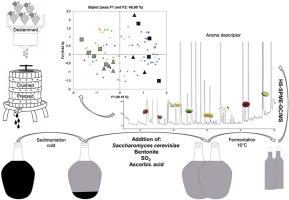
To understand the impact of SO2 and ascorbic acid (AA) in must fermentation, Arinto and Síria musts were fermented under the same conditions, but in the presence of different doses of SO2 and with or without bentonite addition. Arinto was fermented with 0, 50, 100 mg/L of SO2 and 100 mg/L of AA. Síria was fermented with 0, 15, 30, 45 mg/L of SO2 and 100 mg/L of AA. The volatile organic compounds (VOCs) were analysed by HS-SPME-GC/MS.
Based on PCA results obtained from VOCs profiles for both varieties, first and second principal components were responsible for more than 60% of the respective system's variance. In both wines, the presence or absence of bentonite was clearly discriminated. This work also shows that depending on the different doses of SO2 used, the resulting VOC profiles clearly discriminate these different fermentation conditions. The use of AA in both varieties resulted in a different VOC profile compared to the use of SO2. From this study it was also possible to verify from the VOCs profile, that Arinto wine is less resilient to fermentation changes then Síria wine, which may impact technological choices.
期刊介绍:
LWT - Food Science and Technology is an international journal that publishes innovative papers in the fields of food chemistry, biochemistry, microbiology, technology and nutrition. The work described should be innovative either in the approach or in the methods used. The significance of the results either for the science community or for the food industry must also be specified. Contributions written in English are welcomed in the form of review articles, short reviews, research papers, and research notes. Papers featuring animal trials and cell cultures are outside the scope of the journal and will not be considered for publication.



 京公网安备 11010802042870号
京ICP备2023020795号-1
京公网安备 11010802042870号
京ICP备2023020795号-1

 分享
分享
 求助内容:
求助内容: 应助结果提醒方式:
 扫码关注我们
