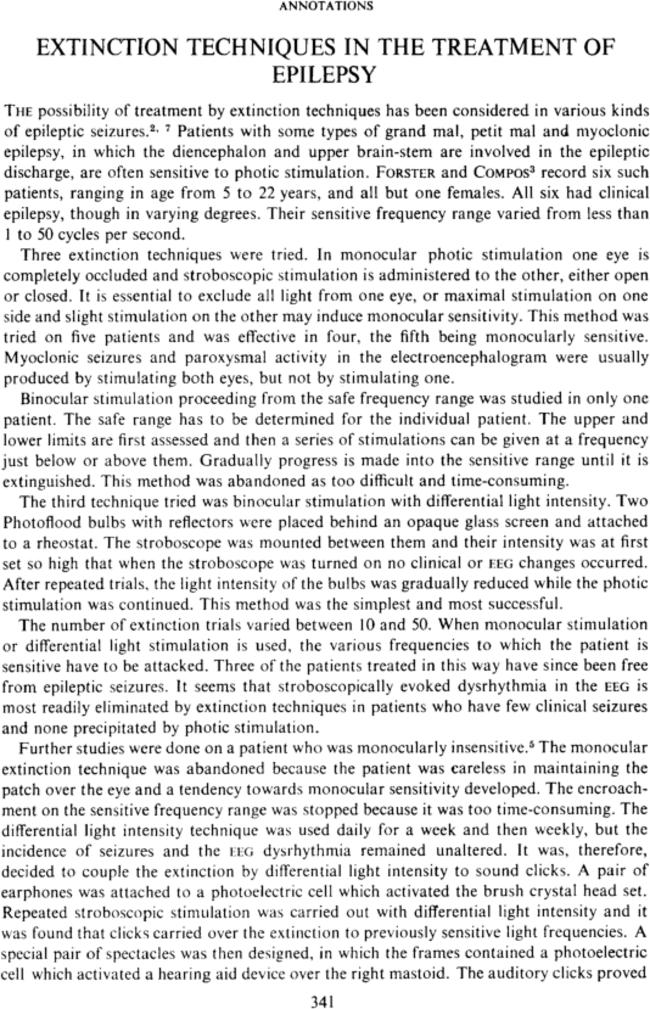
{"title":"Extinction Techniques In The Treatment Of Epilepsy","authors":"Neil Gordon","doi":"10.1111/j.1469-8749.1966.tb01759.x","DOIUrl":null,"url":null,"abstract":"THE possibility of treatment by extinction techniques has been considered in various kinds of epileptic seizures.2, Patients with some types of grand mal, petit ma1 and niyoclonic epilepsy, in which the diencephalon and upper brain-stem are involved in the epileptic discharge, are often sensitive to photic stimulation. FORSTER and COMPOS~ record six such patients, ranging in age from 5 to 22 years, and all but one females. All six had clinical epilepsy, though in varying degrees. Their sensitive frequency range varied from less than 1 to 50 cycles per second. Three extinction techniques were tried. In monocular photic stimulation one eye is completely occluded and stroboscopic stimulation is administered to the other, either open or closed. It is essential to exclude all light from one eye, or maximal stimulation on one side and slight stimulation on the other may induce monocular sensitivity. This method was tried on five patients and was effective in four, the fifth being monocularly sensitive. Myoclonic seizures and paroxysmal activity in the electroencephalogram were usually produced by stimulating both eyes, but not by stimulating one. Binocular stimulation proceeding from the safe frequency range was studied in only one patient. The safe range has to be determined for the individual patient. The upper and lower limits are first assessed and then a series of stimulations can be given at a frequency just below or above them. Gradually progress is made into the sensitive range until it is extinguished. This method was abandoned as too difficult and time-consuming. The third technique tried was binocular stimulation with differential light intensity. Two Photoflood bulbs with reflectors were placed behind an opaque glass screen and attached to a rheostat. The stroboscope was mounted between them and their intensity was at first set so high that when the stroboscope was turned on no clinical or EEG changes occurred. After repeated trials, the light intensity of the bulbs was gradually reduced while the photic stimulation was continued. This method was the simplest and most successful. The number of extinction trials varied between 10 and 50. When monocular stimulation or differential light stimulation is used, the various frequencies to which the patient is sensitive have to be attacked. Three of the patients treated in this way have since been free from epileptic seizures. I t seems that stroboscopically evoked dysrhythmia in the EEG is most readily eliminated by extinction techniques in patients who have few clinical seizures and none precipitated by photic stimulation. Further studies were done on a patient who was monocularly in~ensitive.~ The monocular extinction technique was abandoned because the patient was careless in maintaining the patch over the eye and a tendency towards monocular sensitivity developed. The encroachment on the sensitive frequency range was stopped because it was too time-consuming. The differential light intensity technique was used daily for a week and then weekly, but the incidence of seizures and the EEG dysrhythmia remained unaltered. I t was, therefore, decided to couple the extinction by differential light intensity to sound clicks. A pair of earphones was attached to a photoelectric cell which activated the brush crystal head set. Repeated stroboscopic stimulation was carried out with differential light intensity and it was found that clicks carried over the extinction to previously sensitive light frequencies. A special pair of spectacles was then designed, in which the frames contained a photoelectric cell which activated a hearing aid device over the right mastoid. The auditory clicks proved","PeriodicalId":50587,"journal":{"name":"Developmental Medicine and Child Neurology","volume":"8 3","pages":"341-343"},"PeriodicalIF":4.3000,"publicationDate":"1966-06-01","publicationTypes":"Journal Article","fieldsOfStudy":null,"isOpenAccess":false,"openAccessPdf":"https://sci-hub-pdf.com/10.1111/j.1469-8749.1966.tb01759.x","citationCount":"0","resultStr":null,"platform":"Semanticscholar","paperid":null,"PeriodicalName":"Developmental Medicine and Child Neurology","FirstCategoryId":"3","ListUrlMain":"https://onlinelibrary.wiley.com/doi/10.1111/j.1469-8749.1966.tb01759.x","RegionNum":2,"RegionCategory":"医学","ArticlePicture":[],"TitleCN":null,"AbstractTextCN":null,"PMCID":null,"EPubDate":"","PubModel":"","JCR":"Q1","JCRName":"CLINICAL NEUROLOGY","Score":null,"Total":0}
引用次数: 0
Abstract
THE possibility of treatment by extinction techniques has been considered in various kinds of epileptic seizures.2, Patients with some types of grand mal, petit ma1 and niyoclonic epilepsy, in which the diencephalon and upper brain-stem are involved in the epileptic discharge, are often sensitive to photic stimulation. FORSTER and COMPOS~ record six such patients, ranging in age from 5 to 22 years, and all but one females. All six had clinical epilepsy, though in varying degrees. Their sensitive frequency range varied from less than 1 to 50 cycles per second. Three extinction techniques were tried. In monocular photic stimulation one eye is completely occluded and stroboscopic stimulation is administered to the other, either open or closed. It is essential to exclude all light from one eye, or maximal stimulation on one side and slight stimulation on the other may induce monocular sensitivity. This method was tried on five patients and was effective in four, the fifth being monocularly sensitive. Myoclonic seizures and paroxysmal activity in the electroencephalogram were usually produced by stimulating both eyes, but not by stimulating one. Binocular stimulation proceeding from the safe frequency range was studied in only one patient. The safe range has to be determined for the individual patient. The upper and lower limits are first assessed and then a series of stimulations can be given at a frequency just below or above them. Gradually progress is made into the sensitive range until it is extinguished. This method was abandoned as too difficult and time-consuming. The third technique tried was binocular stimulation with differential light intensity. Two Photoflood bulbs with reflectors were placed behind an opaque glass screen and attached to a rheostat. The stroboscope was mounted between them and their intensity was at first set so high that when the stroboscope was turned on no clinical or EEG changes occurred. After repeated trials, the light intensity of the bulbs was gradually reduced while the photic stimulation was continued. This method was the simplest and most successful. The number of extinction trials varied between 10 and 50. When monocular stimulation or differential light stimulation is used, the various frequencies to which the patient is sensitive have to be attacked. Three of the patients treated in this way have since been free from epileptic seizures. I t seems that stroboscopically evoked dysrhythmia in the EEG is most readily eliminated by extinction techniques in patients who have few clinical seizures and none precipitated by photic stimulation. Further studies were done on a patient who was monocularly in~ensitive.~ The monocular extinction technique was abandoned because the patient was careless in maintaining the patch over the eye and a tendency towards monocular sensitivity developed. The encroachment on the sensitive frequency range was stopped because it was too time-consuming. The differential light intensity technique was used daily for a week and then weekly, but the incidence of seizures and the EEG dysrhythmia remained unaltered. I t was, therefore, decided to couple the extinction by differential light intensity to sound clicks. A pair of earphones was attached to a photoelectric cell which activated the brush crystal head set. Repeated stroboscopic stimulation was carried out with differential light intensity and it was found that clicks carried over the extinction to previously sensitive light frequencies. A special pair of spectacles was then designed, in which the frames contained a photoelectric cell which activated a hearing aid device over the right mastoid. The auditory clicks proved
期刊介绍:
Wiley-Blackwell is pleased to publish Developmental Medicine & Child Neurology (DMCN), a Mac Keith Press publication and official journal of the American Academy for Cerebral Palsy and Developmental Medicine (AACPDM) and the British Paediatric Neurology Association (BPNA).
For over 50 years, DMCN has defined the field of paediatric neurology and neurodisability and is one of the world’s leading journals in the whole field of paediatrics. DMCN disseminates a range of information worldwide to improve the lives of disabled children and their families. The high quality of published articles is maintained by expert review, including independent statistical assessment, before acceptance.



 京公网安备 11010802042870号
京ICP备2023020795号-1
京公网安备 11010802042870号
京ICP备2023020795号-1

 分享
分享
 求助内容:
求助内容: 应助结果提醒方式:
 扫码关注我们
