Federico Locardi , Ester Canepa , Silvia Villa , Ilaria Nelli , Chiara Lambruschini , Maurizio Ferretti , Fabio Canepa
{"title":"Thermogravimetry and evolved gas analysis for the investigation of ligand-exchange reaction in thiol-functionalized gold nanoparticles","authors":"Federico Locardi , Ester Canepa , Silvia Villa , Ilaria Nelli , Chiara Lambruschini , Maurizio Ferretti , Fabio Canepa","doi":"10.1016/j.jaap.2018.03.023","DOIUrl":null,"url":null,"abstract":"<div><p>The increasing use of gold nanoparticles (AuNPs), especially in biomedical applications, requires strict chemico-physical characteristics achievable by organic functionalization <em>via</em> ligand – exchange process. Nowadays, one of the most common synthetic procedures to obtain small and hydrophilic AuNPs consists on the synthesis of 1-Dodecanethiol (1–D) coated AuNPs, afterwards functionalized by a partial substitution of the previous alkyl hydrophobic moiety with carboxylic species, such as the 11-Mercaptoundecanoic acid (11 – MUA). It is evident that the characterization of the organic coating and the quantification of the ligand – exchange reaction become crucial for the nanoparticles real applicability. We report the use of thermogravimetry (TG) and evolved gas analysis, performed through gas chromatography – mass spectrometry (GC – MS), for the investigation of 1–D and mixed 1 – D/11–MUA functionalized AuNPs. The two samples present different thermal behaviours, discernible through the GC – MS use, thus allowing the quantification of the 1 – D/11 – MUA ratio. The insertion of GC before the MS analysis provides an accurate identification of the gaseous products and supplies additional information on the ligand − surface interaction. The results demonstrate that TG is a rapid and satisfactory method for the quantification of the ligands amount on the nanoparticles surface; moreover, the coupling with GC – MS provides additional information (more discernible respect to the only use of MS) on the decomposition products.</p></div>","PeriodicalId":345,"journal":{"name":"Journal of Analytical and Applied Pyrolysis","volume":"132 ","pages":"Pages 11-18"},"PeriodicalIF":6.2000,"publicationDate":"2018-06-01","publicationTypes":"Journal Article","fieldsOfStudy":null,"isOpenAccess":false,"openAccessPdf":"https://sci-hub-pdf.com/10.1016/j.jaap.2018.03.023","citationCount":"5","resultStr":null,"platform":"Semanticscholar","paperid":null,"PeriodicalName":"Journal of Analytical and Applied Pyrolysis","FirstCategoryId":"92","ListUrlMain":"https://www.sciencedirect.com/science/article/pii/S0165237017310239","RegionNum":2,"RegionCategory":"化学","ArticlePicture":[],"TitleCN":null,"AbstractTextCN":null,"PMCID":null,"EPubDate":"","PubModel":"","JCR":"Q1","JCRName":"CHEMISTRY, ANALYTICAL","Score":null,"Total":0}
引用次数: 5
Abstract
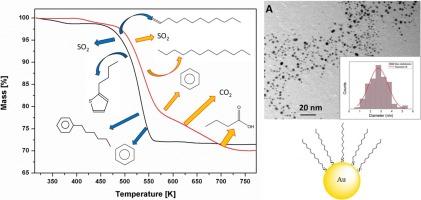
The increasing use of gold nanoparticles (AuNPs), especially in biomedical applications, requires strict chemico-physical characteristics achievable by organic functionalization via ligand – exchange process. Nowadays, one of the most common synthetic procedures to obtain small and hydrophilic AuNPs consists on the synthesis of 1-Dodecanethiol (1–D) coated AuNPs, afterwards functionalized by a partial substitution of the previous alkyl hydrophobic moiety with carboxylic species, such as the 11-Mercaptoundecanoic acid (11 – MUA). It is evident that the characterization of the organic coating and the quantification of the ligand – exchange reaction become crucial for the nanoparticles real applicability. We report the use of thermogravimetry (TG) and evolved gas analysis, performed through gas chromatography – mass spectrometry (GC – MS), for the investigation of 1–D and mixed 1 – D/11–MUA functionalized AuNPs. The two samples present different thermal behaviours, discernible through the GC – MS use, thus allowing the quantification of the 1 – D/11 – MUA ratio. The insertion of GC before the MS analysis provides an accurate identification of the gaseous products and supplies additional information on the ligand − surface interaction. The results demonstrate that TG is a rapid and satisfactory method for the quantification of the ligands amount on the nanoparticles surface; moreover, the coupling with GC – MS provides additional information (more discernible respect to the only use of MS) on the decomposition products.
期刊介绍:
The Journal of Analytical and Applied Pyrolysis (JAAP) is devoted to the publication of papers dealing with innovative applications of pyrolysis processes, the characterization of products related to pyrolysis reactions, and investigations of reaction mechanism. To be considered by JAAP, a manuscript should present significant progress in these topics. The novelty must be satisfactorily argued in the cover letter. A manuscript with a cover letter to the editor not addressing the novelty is likely to be rejected without review.



 京公网安备 11010802042870号
京ICP备2023020795号-1
京公网安备 11010802042870号
京ICP备2023020795号-1

 分享
分享
 求助内容:
求助内容: 应助结果提醒方式:
 扫码关注我们
