Yun Wang , Yuanyuan Li , Xu Bao , Juan Han , Jinchen Xia , Xiaoyu Tian , Liang Ni
{"title":"A smartphone-based colorimetric reader coupled with a remote server for rapid on-site catechols analysis","authors":"Yun Wang , Yuanyuan Li , Xu Bao , Juan Han , Jinchen Xia , Xiaoyu Tian , Liang Ni","doi":"10.1016/j.talanta.2016.07.012","DOIUrl":null,"url":null,"abstract":"<div><p><span>The search of a practical method to analyze cis-diol-containing compounds outside laboratory settings remains a substantial scientific challenge. Herein, a smartphone-based colorimetric reader was coupled with a remote server for rapid on-site analysis of catechols. A smallest-scale 2×2 colorimetric sensor array composed of pH indicators and </span>phenylboronic acid was configured. The array was able to distinguish 13 catechols at 6 serial concentrations, through simultaneous treatment via principal component analysis, hierarchical cluster analysis, and linear discriminant analysis. After both the discriminatory power of the array and the prediction ability of the partial least squares quantitative models were proved to be predominant, the smartphone was coupled to the remote server. All the ΔRGB data were uploaded to the remote server wherein linear discriminant analysis and partial least squares processing modules were established to provide qualitative discrimination and quantitative calculation, respectively, of the analytes in real time. The applicability of this novel method to a real-life scenario was confirmed by the on-site analysis of various catechols from a water sample of the Yangtze River; the feedback result in the smartphone showed the method was able to identify the catechols with 100% accuracy and predict the concentrations to within 0.706–2.240 standard deviation.</p></div>","PeriodicalId":435,"journal":{"name":"Talanta","volume":"160 ","pages":"Pages 194-204"},"PeriodicalIF":6.1000,"publicationDate":"2016-11-01","publicationTypes":"Journal Article","fieldsOfStudy":null,"isOpenAccess":false,"openAccessPdf":"https://sci-hub-pdf.com/10.1016/j.talanta.2016.07.012","citationCount":"43","resultStr":null,"platform":"Semanticscholar","paperid":null,"PeriodicalName":"Talanta","FirstCategoryId":"92","ListUrlMain":"https://www.sciencedirect.com/science/article/pii/S0039914016305069","RegionNum":1,"RegionCategory":"化学","ArticlePicture":[],"TitleCN":null,"AbstractTextCN":null,"PMCID":null,"EPubDate":"","PubModel":"","JCR":"Q1","JCRName":"CHEMISTRY, ANALYTICAL","Score":null,"Total":0}
引用次数: 43
Abstract
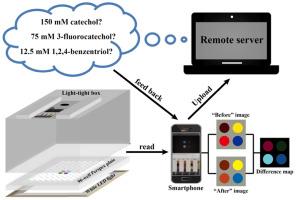
The search of a practical method to analyze cis-diol-containing compounds outside laboratory settings remains a substantial scientific challenge. Herein, a smartphone-based colorimetric reader was coupled with a remote server for rapid on-site analysis of catechols. A smallest-scale 2×2 colorimetric sensor array composed of pH indicators and phenylboronic acid was configured. The array was able to distinguish 13 catechols at 6 serial concentrations, through simultaneous treatment via principal component analysis, hierarchical cluster analysis, and linear discriminant analysis. After both the discriminatory power of the array and the prediction ability of the partial least squares quantitative models were proved to be predominant, the smartphone was coupled to the remote server. All the ΔRGB data were uploaded to the remote server wherein linear discriminant analysis and partial least squares processing modules were established to provide qualitative discrimination and quantitative calculation, respectively, of the analytes in real time. The applicability of this novel method to a real-life scenario was confirmed by the on-site analysis of various catechols from a water sample of the Yangtze River; the feedback result in the smartphone showed the method was able to identify the catechols with 100% accuracy and predict the concentrations to within 0.706–2.240 standard deviation.
期刊介绍:
Talanta provides a forum for the publication of original research papers, short communications, and critical reviews in all branches of pure and applied analytical chemistry. Papers are evaluated based on established guidelines, including the fundamental nature of the study, scientific novelty, substantial improvement or advantage over existing technology or methods, and demonstrated analytical applicability. Original research papers on fundamental studies, and on novel sensor and instrumentation developments, are encouraged. Novel or improved applications in areas such as clinical and biological chemistry, environmental analysis, geochemistry, materials science and engineering, and analytical platforms for omics development are welcome.
Analytical performance of methods should be determined, including interference and matrix effects, and methods should be validated by comparison with a standard method, or analysis of a certified reference material. Simple spiking recoveries may not be sufficient. The developed method should especially comprise information on selectivity, sensitivity, detection limits, accuracy, and reliability. However, applying official validation or robustness studies to a routine method or technique does not necessarily constitute novelty. Proper statistical treatment of the data should be provided. Relevant literature should be cited, including related publications by the authors, and authors should discuss how their proposed methodology compares with previously reported methods.