Vibeke M. Breinholt, Salka E. Rasmussen, Kim Brøsen, Thomas H. Friedberg
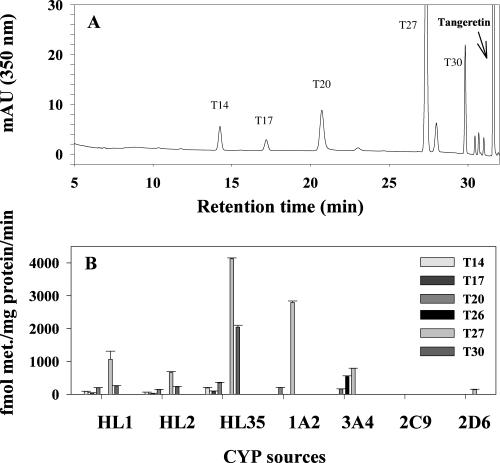
{"title":"In vitro Metabolism of Genistein and Tangeretin by Human and Murine Cytochrome P450s","authors":"Vibeke M. Breinholt, Salka E. Rasmussen, Kim Brøsen, Thomas H. Friedberg","doi":"10.1034/j.1600-0773.2003.930102.x","DOIUrl":null,"url":null,"abstract":"<p><b>Abstract:</b> Recombinant cytochrome P450 (CYP) 1A2, 3A4, 2C9 or 2D6 enzymes obtained from <i>Escherichia coli</i> and human liver microsomes samples were used to investigate the ability of human CYP enzymes to metabolize the two dietary flavonoids, genistein and tangeretin. Analysis of the metabolic profile from incubations with genistein and human liver microsomes revealed the production of five different metabolites, of which three were obtained in sufficient amounts to allow a more detailed elucidation of the structure. One of these metabolites was identified as orobol, the 3′-hydroxylated metabolite of genistein. The remaining two metabolites were also hydroxylated metabolites as evidenced by LC/MS. Orobol was the only metabolite formed after incubation with CYP1A2. The two major product peaks after incubation of tangeretin with human microsomes were identical with 4′-hydroxy-5,6,7,8-tetramethoxyflavone and 5,6-dihydroxy-4′,7,8-trimethoxyflavone, previously identified in rat urine in our laboratory. By comparison with UV spectra and LC/MS fragmentation patterns of previously obtained standards, the remaining metabolites eluting after 14, 17 and 20 min. were found to be demethylated at the 4′,7-, 4′,6-positions or hydroxylated at the 3′- and demethylated at the 4′-positions, respectively. Metabolism of tangeretin by recombinant CYP1A2, 3A4, 2D6 and 2C9 resulted in metabolic profiles that qualitatively were identical to those observed in the human microsomes. Inclusion of the CYP1A2 inhibitor fluvoxamine in the incubation mixture with human liver microsomes resulted in potent inhibition of tangeretin and genistein metabolism. Other isozymes-selective CYP inhibitors had only minor effects on tangeretin or genistein metabolism. Overall the presented observations suggest major involvement of CYP1A2 in the hepatic metabolism of these two flavonoids.</p>","PeriodicalId":8733,"journal":{"name":"Basic & Clinical Pharmacology & Toxicology","volume":"93 1","pages":"14-22"},"PeriodicalIF":3.3000,"publicationDate":"2003-06-26","publicationTypes":"Journal Article","fieldsOfStudy":null,"isOpenAccess":false,"openAccessPdf":"https://sci-hub-pdf.com/10.1034/j.1600-0773.2003.930102.x","citationCount":"72","resultStr":null,"platform":"Semanticscholar","paperid":null,"PeriodicalName":"Basic & Clinical Pharmacology & Toxicology","FirstCategoryId":"3","ListUrlMain":"https://onlinelibrary.wiley.com/doi/10.1034/j.1600-0773.2003.930102.x","RegionNum":4,"RegionCategory":"医学","ArticlePicture":[],"TitleCN":null,"AbstractTextCN":null,"PMCID":null,"EPubDate":"","PubModel":"","JCR":"Q2","JCRName":"PHARMACOLOGY & PHARMACY","Score":null,"Total":0}
引用次数: 72
Abstract
Abstract: Recombinant cytochrome P450 (CYP) 1A2, 3A4, 2C9 or 2D6 enzymes obtained from Escherichia coli and human liver microsomes samples were used to investigate the ability of human CYP enzymes to metabolize the two dietary flavonoids, genistein and tangeretin. Analysis of the metabolic profile from incubations with genistein and human liver microsomes revealed the production of five different metabolites, of which three were obtained in sufficient amounts to allow a more detailed elucidation of the structure. One of these metabolites was identified as orobol, the 3′-hydroxylated metabolite of genistein. The remaining two metabolites were also hydroxylated metabolites as evidenced by LC/MS. Orobol was the only metabolite formed after incubation with CYP1A2. The two major product peaks after incubation of tangeretin with human microsomes were identical with 4′-hydroxy-5,6,7,8-tetramethoxyflavone and 5,6-dihydroxy-4′,7,8-trimethoxyflavone, previously identified in rat urine in our laboratory. By comparison with UV spectra and LC/MS fragmentation patterns of previously obtained standards, the remaining metabolites eluting after 14, 17 and 20 min. were found to be demethylated at the 4′,7-, 4′,6-positions or hydroxylated at the 3′- and demethylated at the 4′-positions, respectively. Metabolism of tangeretin by recombinant CYP1A2, 3A4, 2D6 and 2C9 resulted in metabolic profiles that qualitatively were identical to those observed in the human microsomes. Inclusion of the CYP1A2 inhibitor fluvoxamine in the incubation mixture with human liver microsomes resulted in potent inhibition of tangeretin and genistein metabolism. Other isozymes-selective CYP inhibitors had only minor effects on tangeretin or genistein metabolism. Overall the presented observations suggest major involvement of CYP1A2 in the hepatic metabolism of these two flavonoids.
期刊介绍:
Basic & Clinical Pharmacology and Toxicology is an independent journal, publishing original scientific research in all fields of toxicology, basic and clinical pharmacology. This includes experimental animal pharmacology and toxicology and molecular (-genetic), biochemical and cellular pharmacology and toxicology. It also includes all aspects of clinical pharmacology: pharmacokinetics, pharmacodynamics, therapeutic drug monitoring, drug/drug interactions, pharmacogenetics/-genomics, pharmacoepidemiology, pharmacovigilance, pharmacoeconomics, randomized controlled clinical trials and rational pharmacotherapy. For all compounds used in the studies, the chemical constitution and composition should be known, also for natural compounds.



 京公网安备 11010802042870号
京ICP备2023020795号-1
京公网安备 11010802042870号
京ICP备2023020795号-1

 分享
分享
 求助内容:
求助内容: 应助结果提醒方式:
 扫码关注我们
