{"title":"Citius, Altius, Fortius: Performance in a Bottle for CAR T-Cells.","authors":"Asma Ayari, Roddy S O'Connor","doi":"10.33696/haematology.1.015","DOIUrl":null,"url":null,"abstract":"The renewed interest in understanding how activated T cells alter their metabolism to support their growth and differentiation has led to several innovative advances in synthetic biology; culminating in a number of genetic and pharmacologic approaches aimed at improving the antitumor function of adoptively transferred T cells. Indeed, the growing field of immunometabolism has accelerated rapidly giving rise to exciting discoveries and exploratory studies revealing how T cells balance metabolic adaptations in response to intrinsic and extrinsic regulatory cues. Central to this body of work, we showed how chimeric antigen receptors (CAR)-induced metabolic reprogramming is an important determinant of efficacy and clinical outcome in blood-based malignancies [1]. CAR T-cell production involves a rigorous, and systematic ex-vivo expansion regime involving activation; genetic modification with either a CAR or tumor-specific T cell receptor (TCR); and proliferative phase which often lasts 14 days. As CAR T-cells progressively differentiate over time in culture, a process that impairs engraftment and potency following adoptive transfer, it’s surprising that the metabolic composition of clinical grade cell culture mediums has been largely understudied. Increasing evidence suggests that subtle adjustments in medium formulation can have a dramatic impact on T cell bioactivity and anti-tumor function in several preclinical models of cancer. In a recent article, we provide direct evidence that standard medium formulations are suboptimal, and introduce a serum-free, concentrated, platelet extract as a superior alternative to human serum in clinical-grade medium for CAR T-cells [2].","PeriodicalId":87297,"journal":{"name":"Journal of clinical haematology","volume":"1 3","pages":"103-106"},"PeriodicalIF":0.0000,"publicationDate":"2020-01-01","publicationTypes":"Journal Article","fieldsOfStudy":null,"isOpenAccess":false,"openAccessPdf":"https://www.ncbi.nlm.nih.gov/pmc/articles/PMC7861513/pdf/","citationCount":"1","resultStr":null,"platform":"Semanticscholar","paperid":null,"PeriodicalName":"Journal of clinical haematology","FirstCategoryId":"1085","ListUrlMain":"https://doi.org/10.33696/haematology.1.015","RegionNum":0,"RegionCategory":null,"ArticlePicture":[],"TitleCN":null,"AbstractTextCN":null,"PMCID":null,"EPubDate":"","PubModel":"","JCR":"","JCRName":"","Score":null,"Total":0}
引用次数: 1
Abstract
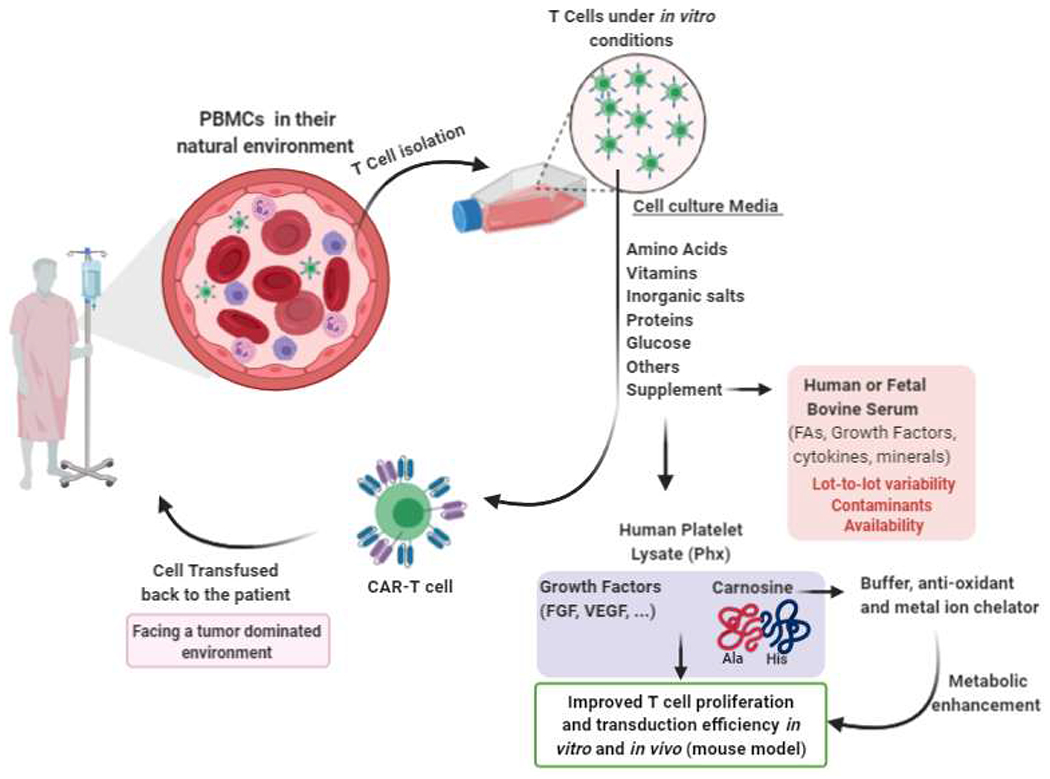
The renewed interest in understanding how activated T cells alter their metabolism to support their growth and differentiation has led to several innovative advances in synthetic biology; culminating in a number of genetic and pharmacologic approaches aimed at improving the antitumor function of adoptively transferred T cells. Indeed, the growing field of immunometabolism has accelerated rapidly giving rise to exciting discoveries and exploratory studies revealing how T cells balance metabolic adaptations in response to intrinsic and extrinsic regulatory cues. Central to this body of work, we showed how chimeric antigen receptors (CAR)-induced metabolic reprogramming is an important determinant of efficacy and clinical outcome in blood-based malignancies [1]. CAR T-cell production involves a rigorous, and systematic ex-vivo expansion regime involving activation; genetic modification with either a CAR or tumor-specific T cell receptor (TCR); and proliferative phase which often lasts 14 days. As CAR T-cells progressively differentiate over time in culture, a process that impairs engraftment and potency following adoptive transfer, it’s surprising that the metabolic composition of clinical grade cell culture mediums has been largely understudied. Increasing evidence suggests that subtle adjustments in medium formulation can have a dramatic impact on T cell bioactivity and anti-tumor function in several preclinical models of cancer. In a recent article, we provide direct evidence that standard medium formulations are suboptimal, and introduce a serum-free, concentrated, platelet extract as a superior alternative to human serum in clinical-grade medium for CAR T-cells [2].



 京公网安备 11010802042870号
京ICP备2023020795号-1
京公网安备 11010802042870号
京ICP备2023020795号-1

 分享
分享

 求助内容:
求助内容: 应助结果提醒方式:
 扫码关注我们
