{"title":"Use of concurrent multiple methods of contraception in the United States, 2008 to 2015","authors":"Megan L. Kavanaugh , Emma Pliskin , Jenna Jerman","doi":"10.1016/j.conx.2021.100060","DOIUrl":null,"url":null,"abstract":"<div><h3>Objective</h3><p>To identify prevalence of, characteristics associated with, and combinations of, use of more than one method of contraception at last intercourse among US women between 2008 and 2015.</p></div><div><h3>Methods</h3><p>We conducted bivariate and multivariable logistic regression analyses using data on concurrent contraceptive use from 2 nationally representative samples of women ages 15 to 44 who had used some form of contraception at last intercourse in the past 3 months in the 2006–2010 (<em>n</em> = 6601) and 2013–2017 (<em>n</em> = 5562) cycles of the National Survey of Family Growth.</p></div><div><h3>Results</h3><p>Use of more than one method of contraception at last sex increased from 14% in 2008 to 18% in 2015 (<em>p</em><0.001), with increases in use documented across many population groups. Among multiple method users, the majority combined condoms with other methods (58%), while the rest combined other methods (42%). When compared to single method users, dual method users employing condoms are a more homogeneous group of individuals than are dual method users not employing condoms. As age increases, dual use with condoms decreases, but there is no similar linear relationship between age and dual method use without condoms.</p></div><div><h3>Conclusions</h3><p>A sizable proportion of US women use more than one contraceptive method during sex; current estimates of contraceptive use focused exclusively on single method use may underestimate the extent to which women are protected from unintended pregnancy. The needs and goals of individuals combining contraceptive methods in different ways may change over the life course as pregnancy desires and life circumstances change.</p></div><div><h3>Implications</h3><p>A sizable proportion of US women use more than one contraceptive method during sex; clinicians and health educators in nonclinical settings should assess and acknowledge these more complicated contraceptive strategies in order to help individuals achieve autonomy in method choice and meet their goals around pregnancy and sexually transmitted infection prevention.</p></div>","PeriodicalId":10655,"journal":{"name":"Contraception: X","volume":"3 ","pages":"Article 100060"},"PeriodicalIF":0.0000,"publicationDate":"2021-01-01","publicationTypes":"Journal Article","fieldsOfStudy":null,"isOpenAccess":false,"openAccessPdf":"https://sci-hub-pdf.com/10.1016/j.conx.2021.100060","citationCount":"13","resultStr":null,"platform":"Semanticscholar","paperid":null,"PeriodicalName":"Contraception: X","FirstCategoryId":"1085","ListUrlMain":"https://www.sciencedirect.com/science/article/pii/S2590151621000071","RegionNum":0,"RegionCategory":null,"ArticlePicture":[],"TitleCN":null,"AbstractTextCN":null,"PMCID":null,"EPubDate":"","PubModel":"","JCR":"Q2","JCRName":"Medicine","Score":null,"Total":0}
引用次数: 13
Abstract
Objective
To identify prevalence of, characteristics associated with, and combinations of, use of more than one method of contraception at last intercourse among US women between 2008 and 2015.
Methods
We conducted bivariate and multivariable logistic regression analyses using data on concurrent contraceptive use from 2 nationally representative samples of women ages 15 to 44 who had used some form of contraception at last intercourse in the past 3 months in the 2006–2010 (n = 6601) and 2013–2017 (n = 5562) cycles of the National Survey of Family Growth.
Results
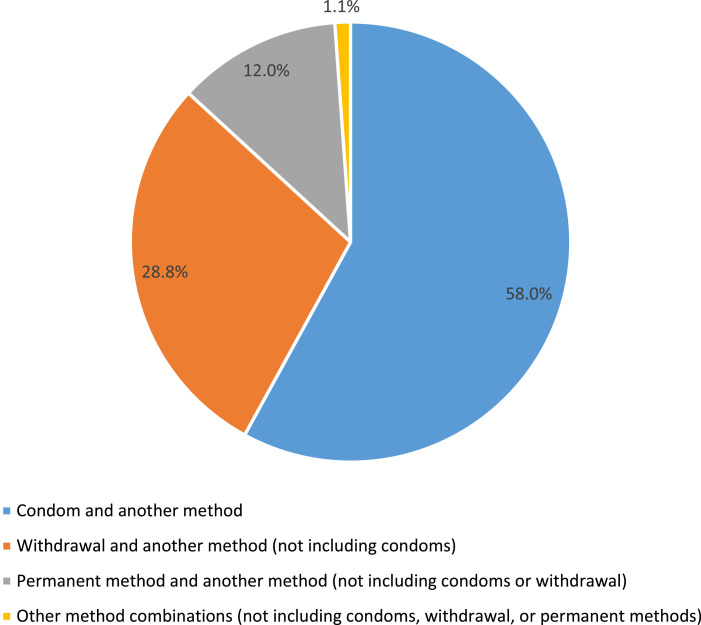
Use of more than one method of contraception at last sex increased from 14% in 2008 to 18% in 2015 (p<0.001), with increases in use documented across many population groups. Among multiple method users, the majority combined condoms with other methods (58%), while the rest combined other methods (42%). When compared to single method users, dual method users employing condoms are a more homogeneous group of individuals than are dual method users not employing condoms. As age increases, dual use with condoms decreases, but there is no similar linear relationship between age and dual method use without condoms.
Conclusions
A sizable proportion of US women use more than one contraceptive method during sex; current estimates of contraceptive use focused exclusively on single method use may underestimate the extent to which women are protected from unintended pregnancy. The needs and goals of individuals combining contraceptive methods in different ways may change over the life course as pregnancy desires and life circumstances change.
Implications
A sizable proportion of US women use more than one contraceptive method during sex; clinicians and health educators in nonclinical settings should assess and acknowledge these more complicated contraceptive strategies in order to help individuals achieve autonomy in method choice and meet their goals around pregnancy and sexually transmitted infection prevention.



 京公网安备 11010802042870号
京ICP备2023020795号-1
京公网安备 11010802042870号
京ICP备2023020795号-1

 分享
分享
 求助内容:
求助内容: 应助结果提醒方式:
 扫码关注我们
