Renaud Sabatier, Johan Martin, Cécile Vicier, Mathilde Guérin, Audrey Monneur, Magali Provansal, Louis Tassy, Carole Tarpin, Jean-Marc Extra, Frédéric Viret, Anthony Goncalves
{"title":"Eribulin Efficacy on Brain Metastases in Heavily Pretreated Patients with Metastatic Breast Cancer.","authors":"Renaud Sabatier, Johan Martin, Cécile Vicier, Mathilde Guérin, Audrey Monneur, Magali Provansal, Louis Tassy, Carole Tarpin, Jean-Marc Extra, Frédéric Viret, Anthony Goncalves","doi":"10.3390/jcm10061272","DOIUrl":null,"url":null,"abstract":"<p><p>The onset of brain metastases (BM) is a major turning point during advanced breast cancer (ABC) evolution, with only few treatment options when local therapies have failed. The therapeutic effect of eribulin, a wildly used drug in the treatment of ABC, remains unclear in this setting.</p><p><strong>Patients and methods: </strong>We performed a retrospective observational study to assess eribulin efficacy in patients with ABC who displayed BM at time of eribulin initiation. We collected data from the medical files of all ABC patients who received eribulin at our institution from 2012 until 2020. Our main endpoint was the central nervous system (CNS) progression-free survival. (CNS-PFS). Other evaluation criteria were extra-cranial progression free survival (PFS) and overall survival (OS).</p><p><strong>Results: </strong>Twenty patients with BM monitoring data available were selected out of the 549 who received eribulin during the inclusion period. Fifteen patients (75%) had BM progressive as the best response, three patients (15%) had disease stabilization for more than 6 months and only one patient had a partial response according to RECIST 1.1 criteria. Median CNS-PFS was 3.39 months (95CI (3.02-3.76)). Cox univariate analysis identified molecular subtype as the only prognostic parameter in our cohort, with patients with hormone-receptor positive tumors less likely to experience CNS progression than those with triple-negative MBC (HR = 0.23 (95CI = 0.07-0.80), <i>p</i> = 0.021). Median extra-cranial PFS was 2.67 months (95CI (2.33-3.01)). Median OS was 7.68 months (95CI (0-17.41)).</p><p><strong>Conclusion: </strong>Eribulin seems to have only a limited impact on BM evolution. Hormone receptors expression may identify a subset of patients with better BM control.</p>","PeriodicalId":15533,"journal":{"name":"Journal of Clinical Medicine","volume":" ","pages":""},"PeriodicalIF":2.9000,"publicationDate":"2021-03-18","publicationTypes":"Journal Article","fieldsOfStudy":null,"isOpenAccess":false,"openAccessPdf":"https://sci-hub-pdf.com/10.3390/jcm10061272","citationCount":"1","resultStr":null,"platform":"Semanticscholar","paperid":null,"PeriodicalName":"Journal of Clinical Medicine","FirstCategoryId":"3","ListUrlMain":"https://doi.org/10.3390/jcm10061272","RegionNum":3,"RegionCategory":"医学","ArticlePicture":[],"TitleCN":null,"AbstractTextCN":null,"PMCID":null,"EPubDate":"","PubModel":"","JCR":"Q1","JCRName":"MEDICINE, GENERAL & INTERNAL","Score":null,"Total":0}
引用次数: 1
Abstract
The onset of brain metastases (BM) is a major turning point during advanced breast cancer (ABC) evolution, with only few treatment options when local therapies have failed. The therapeutic effect of eribulin, a wildly used drug in the treatment of ABC, remains unclear in this setting.
Patients and methods: We performed a retrospective observational study to assess eribulin efficacy in patients with ABC who displayed BM at time of eribulin initiation. We collected data from the medical files of all ABC patients who received eribulin at our institution from 2012 until 2020. Our main endpoint was the central nervous system (CNS) progression-free survival. (CNS-PFS). Other evaluation criteria were extra-cranial progression free survival (PFS) and overall survival (OS).
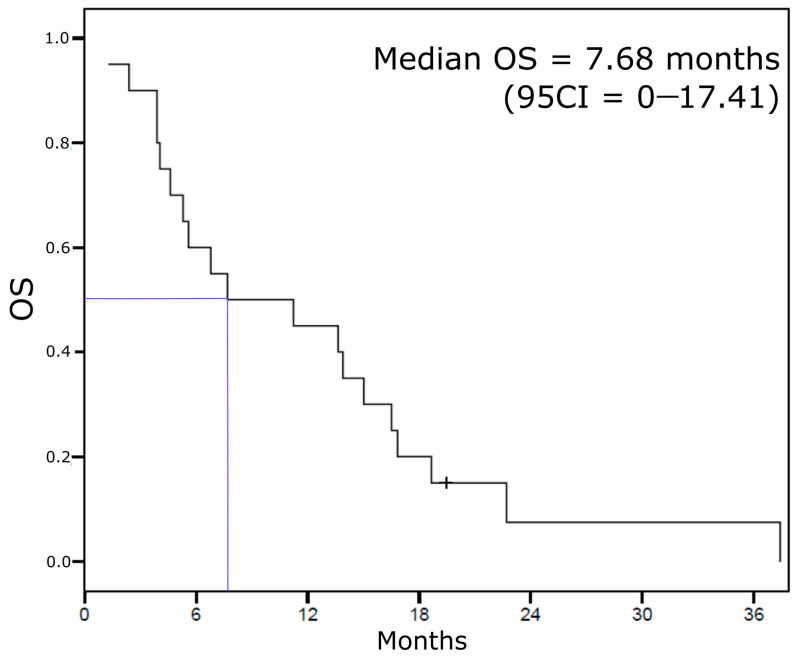
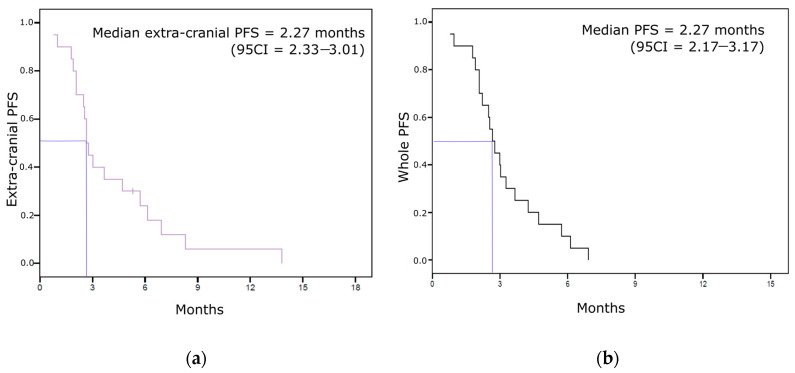
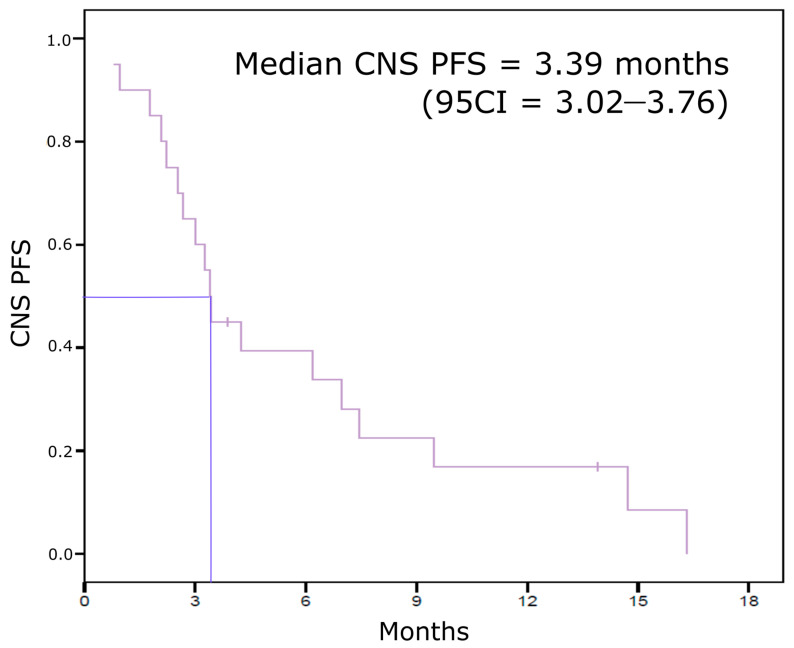
Results: Twenty patients with BM monitoring data available were selected out of the 549 who received eribulin during the inclusion period. Fifteen patients (75%) had BM progressive as the best response, three patients (15%) had disease stabilization for more than 6 months and only one patient had a partial response according to RECIST 1.1 criteria. Median CNS-PFS was 3.39 months (95CI (3.02-3.76)). Cox univariate analysis identified molecular subtype as the only prognostic parameter in our cohort, with patients with hormone-receptor positive tumors less likely to experience CNS progression than those with triple-negative MBC (HR = 0.23 (95CI = 0.07-0.80), p = 0.021). Median extra-cranial PFS was 2.67 months (95CI (2.33-3.01)). Median OS was 7.68 months (95CI (0-17.41)).
Conclusion: Eribulin seems to have only a limited impact on BM evolution. Hormone receptors expression may identify a subset of patients with better BM control.
期刊介绍:
Journal of Clinical Medicine (ISSN 2077-0383), is an international scientific open access journal, providing a platform for advances in health care/clinical practices, the study of direct observation of patients and general medical research. This multi-disciplinary journal is aimed at a wide audience of medical researchers and healthcare professionals.
Unique features of this journal:
manuscripts regarding original research and ideas will be particularly welcomed.JCM also accepts reviews, communications, and short notes.
There is no limit to publication length: our aim is to encourage scientists to publish their experimental and theoretical results in as much detail as possible.



 京公网安备 11010802042870号
京ICP备2023020795号-1
京公网安备 11010802042870号
京ICP备2023020795号-1

 分享
分享
 求助内容:
求助内容: 应助结果提醒方式:
 扫码关注我们
