S M Mahmudul Hasan, Mosiur Rahman, Keiko Nakamura, Yuri Tashiro, Ayano Miyashita, Kaoruko Seino
{"title":"Relationship between diabetes self-care practices and control of periodontal disease among type2 diabetes patients in Bangladesh.","authors":"S M Mahmudul Hasan, Mosiur Rahman, Keiko Nakamura, Yuri Tashiro, Ayano Miyashita, Kaoruko Seino","doi":"10.1371/journal.pone.0249011","DOIUrl":null,"url":null,"abstract":"<p><strong>Introduction: </strong>The prevalence of periodontal disease is high in diabetes patients worldwide, including Bangladesh. Although associations of periodontal disease outcomes and clinical determinants of diabetes have been investigated, few studies have reported on the relationship between periodontal diseases outcomes with modifiable factors, such as self-care and oral hygiene practices, in patients with diabetes. Moreover, in order to develop targeted strategies, it is also important to estimate their aggregated contribution separately from that of the established sociodemographic and diabetics related clinical determinates. Therefore, this study was performed to elucidate 1) the relationship of diabetes patients' self-care and oral hygiene practices to periodontal disease and 2) the relative contributions of selected factors to periodontal disease outcome in type 2 diabetes patients.</p><p><strong>Methods: </strong>The data were obtained from the baseline survey of a multicentre, prospective cohort study. A total of 379 adult patients with type 2 diabetes from three diabetic centres in Dhaka, Rajshahi and Barishal, received periodontal examinations using the community periodontal index (CPI) probe, glycated haemoglobin examination, other clinical examinations, and structured questionnaires. Multiple logistics regression analyses were performed to assess the associations between selected factors and prevalence of any periodontal disease and its severity.</p><p><strong>Results: </strong>More than half of the participants were female (53.8%) and 66.8% of the total participants was 21-50 years old. The prevalence of any (CPI code 2+3+4; 75.7%) and severe form (CPI code 4; 35.1%) of periodontal disease were high in type 2 diabetes patients. In multivariate analysis, the odds of periodontal disease increased with unfavourable glycaemic control indicated by HbA1c ≥ 7%, and decreased by 64%, 85% and 92% with adherence to recommended diet, physical activity, and oral hygiene practices, respectively. Diabetes self-care practice explained the highest proportion of the variance (13.9%) followed by oral hygiene practices (10.9%) by modelling any periodontal disease versus no disease. Variables of diabetes conditions and oral hygiene practices explained 10.9% and 7.3% of the variance by modelling severe (CPI code 4) or moderate (CPI code 3) forms of periodontal disease versus mild form of periodontal disease. Findings also conferred that while poor diabetes control had an individually adverse association with any form of periodontal diseases and its severity, the risk of diseases was moderated by oral hygiene practices.</p><p><strong>Conclusions: </strong>This study suggested that, in addition to diabetes-related clinical determinants, self-care practices, and oral hygiene practices must be taken into consideration for prevention and control of periodontal disease in patients with diabetes.</p>","PeriodicalId":2,"journal":{"name":"ACS Applied Bio Materials","volume":" ","pages":"e0249011"},"PeriodicalIF":5.6000,"publicationDate":"2021-04-06","publicationTypes":"Journal Article","fieldsOfStudy":null,"isOpenAccess":false,"openAccessPdf":"https://www.ncbi.nlm.nih.gov/pmc/articles/PMC8023471/pdf/","citationCount":"0","resultStr":null,"platform":"Semanticscholar","paperid":null,"PeriodicalName":"ACS Applied Bio Materials","FirstCategoryId":"103","ListUrlMain":"https://doi.org/10.1371/journal.pone.0249011","RegionNum":0,"RegionCategory":null,"ArticlePicture":[],"TitleCN":null,"AbstractTextCN":null,"PMCID":null,"EPubDate":"2021/1/1 0:00:00","PubModel":"eCollection","JCR":"Q2","JCRName":"MATERIALS SCIENCE, BIOMATERIALS","Score":null,"Total":0}
引用次数: 0
Abstract
Introduction: The prevalence of periodontal disease is high in diabetes patients worldwide, including Bangladesh. Although associations of periodontal disease outcomes and clinical determinants of diabetes have been investigated, few studies have reported on the relationship between periodontal diseases outcomes with modifiable factors, such as self-care and oral hygiene practices, in patients with diabetes. Moreover, in order to develop targeted strategies, it is also important to estimate their aggregated contribution separately from that of the established sociodemographic and diabetics related clinical determinates. Therefore, this study was performed to elucidate 1) the relationship of diabetes patients' self-care and oral hygiene practices to periodontal disease and 2) the relative contributions of selected factors to periodontal disease outcome in type 2 diabetes patients.
Methods: The data were obtained from the baseline survey of a multicentre, prospective cohort study. A total of 379 adult patients with type 2 diabetes from three diabetic centres in Dhaka, Rajshahi and Barishal, received periodontal examinations using the community periodontal index (CPI) probe, glycated haemoglobin examination, other clinical examinations, and structured questionnaires. Multiple logistics regression analyses were performed to assess the associations between selected factors and prevalence of any periodontal disease and its severity.
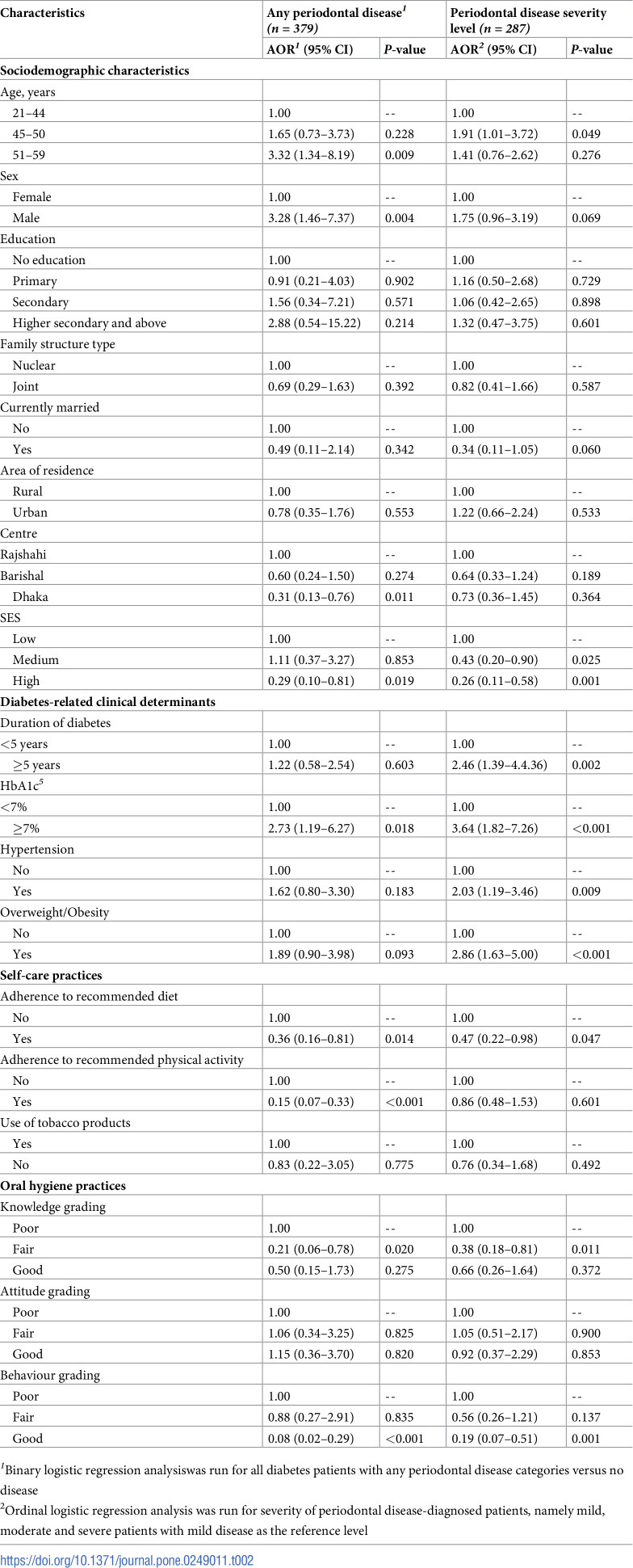
Results: More than half of the participants were female (53.8%) and 66.8% of the total participants was 21-50 years old. The prevalence of any (CPI code 2+3+4; 75.7%) and severe form (CPI code 4; 35.1%) of periodontal disease were high in type 2 diabetes patients. In multivariate analysis, the odds of periodontal disease increased with unfavourable glycaemic control indicated by HbA1c ≥ 7%, and decreased by 64%, 85% and 92% with adherence to recommended diet, physical activity, and oral hygiene practices, respectively. Diabetes self-care practice explained the highest proportion of the variance (13.9%) followed by oral hygiene practices (10.9%) by modelling any periodontal disease versus no disease. Variables of diabetes conditions and oral hygiene practices explained 10.9% and 7.3% of the variance by modelling severe (CPI code 4) or moderate (CPI code 3) forms of periodontal disease versus mild form of periodontal disease. Findings also conferred that while poor diabetes control had an individually adverse association with any form of periodontal diseases and its severity, the risk of diseases was moderated by oral hygiene practices.
Conclusions: This study suggested that, in addition to diabetes-related clinical determinants, self-care practices, and oral hygiene practices must be taken into consideration for prevention and control of periodontal disease in patients with diabetes.
期刊介绍:
ACS Applied Bio Materials is an interdisciplinary journal publishing original research covering all aspects of biomaterials and biointerfaces including and beyond the traditional biosensing, biomedical and therapeutic applications.
The journal is devoted to reports of new and original experimental and theoretical research of an applied nature that integrates knowledge in the areas of materials, engineering, physics, bioscience, and chemistry into important bio applications. The journal is specifically interested in work that addresses the relationship between structure and function and assesses the stability and degradation of materials under relevant environmental and biological conditions.







 京公网安备 11010802042870号
京ICP备2023020795号-1
京公网安备 11010802042870号
京ICP备2023020795号-1

 分享
分享
 求助内容:
求助内容: 应助结果提醒方式:
 扫码关注我们
