B Price Kerfoot, Harley Baker, Thomas L Jackson, William C Hulbert, Daniel D Federman, Robert D Oates, William C DeWolf
{"title":"A multi-institutional randomized controlled trial of adjuvant Web-based teaching to medical students.","authors":"B Price Kerfoot, Harley Baker, Thomas L Jackson, William C Hulbert, Daniel D Federman, Robert D Oates, William C DeWolf","doi":"10.1097/00001888-200603000-00004","DOIUrl":null,"url":null,"abstract":"<p><strong>Purpose: </strong>To investigate the impact of an adjuvant Web-based teaching program on medical students' learning during clinical rotations.</p><p><strong>Method: </strong>From April 2003 to May 2004, 351 students completing clinical rotations in surgery-urology at four U.S. medical schools were invited to volunteer for the study. Web-based teaching cases were developed covering four core urologic topics. Students were block randomized to receive Web-based teaching on two of the four topics. Before and after a designated duration at each institution (ranging one to three weeks), students completed a validated 28-item Web-based test (Cronbach's alpha = .76) covering all four topics. The test was also administered to a subset of students at one school at the conclusion of their third-year to measure long-term learning.</p><p><strong>Results: </strong>Eighty-one percent of all eligible students (286/351) volunteered to participate in the study, 73% of whom (210/286) completed the Web-based program. Compared to controls, Web-based teaching significantly increased test scores in the four topics at each medical school (p < .001, mixed analysis of variance), corresponding to a Cohen's d effect size of 1.52 (95% confidence interval [CI], 1.23-1.80). Learning efficiency was increased three-fold by Web-based teaching (Cohen's d effect size 1.16; 95% CI 1.13-1.19). Students who were tested a median of 4.8 months later demonstrated significantly higher scores for Web-based teaching compared to non-Web-based teaching (p = .007, paired t-test). Limited learning was noted in the absence of Web-based teaching.</p><p><strong>Conclusions: </strong>This randomized controlled trial provides Class I evidence that Web-based teaching as an adjunct to clinical experiences can significantly and durably improve medical students' learning.</p>","PeriodicalId":50929,"journal":{"name":"Academic Medicine","volume":"81 3","pages":"224-30"},"PeriodicalIF":5.2000,"publicationDate":"2006-03-01","publicationTypes":"Journal Article","fieldsOfStudy":null,"isOpenAccess":false,"openAccessPdf":"https://sci-hub-pdf.com/10.1097/00001888-200603000-00004","citationCount":"99","resultStr":null,"platform":"Semanticscholar","paperid":null,"PeriodicalName":"Academic Medicine","FirstCategoryId":"95","ListUrlMain":"https://doi.org/10.1097/00001888-200603000-00004","RegionNum":2,"RegionCategory":"教育学","ArticlePicture":[],"TitleCN":null,"AbstractTextCN":null,"PMCID":null,"EPubDate":"","PubModel":"","JCR":"Q1","JCRName":"EDUCATION, SCIENTIFIC DISCIPLINES","Score":null,"Total":0}
引用次数: 99
Abstract
Purpose: To investigate the impact of an adjuvant Web-based teaching program on medical students' learning during clinical rotations.
Method: From April 2003 to May 2004, 351 students completing clinical rotations in surgery-urology at four U.S. medical schools were invited to volunteer for the study. Web-based teaching cases were developed covering four core urologic topics. Students were block randomized to receive Web-based teaching on two of the four topics. Before and after a designated duration at each institution (ranging one to three weeks), students completed a validated 28-item Web-based test (Cronbach's alpha = .76) covering all four topics. The test was also administered to a subset of students at one school at the conclusion of their third-year to measure long-term learning.
Results: Eighty-one percent of all eligible students (286/351) volunteered to participate in the study, 73% of whom (210/286) completed the Web-based program. Compared to controls, Web-based teaching significantly increased test scores in the four topics at each medical school (p < .001, mixed analysis of variance), corresponding to a Cohen's d effect size of 1.52 (95% confidence interval [CI], 1.23-1.80). Learning efficiency was increased three-fold by Web-based teaching (Cohen's d effect size 1.16; 95% CI 1.13-1.19). Students who were tested a median of 4.8 months later demonstrated significantly higher scores for Web-based teaching compared to non-Web-based teaching (p = .007, paired t-test). Limited learning was noted in the absence of Web-based teaching.
Conclusions: This randomized controlled trial provides Class I evidence that Web-based teaching as an adjunct to clinical experiences can significantly and durably improve medical students' learning.
期刊介绍:
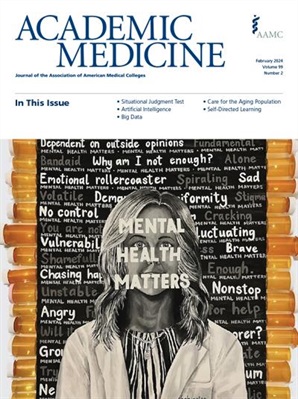
Academic Medicine, the official peer-reviewed journal of the Association of American Medical Colleges, acts as an international forum for exchanging ideas, information, and strategies to address the significant challenges in academic medicine. The journal covers areas such as research, education, clinical care, community collaboration, and leadership, with a commitment to serving the public interest.




 京公网安备 11010802042870号
京ICP备2023020795号-1
京公网安备 11010802042870号
京ICP备2023020795号-1

 分享
分享
 求助内容:
求助内容: 应助结果提醒方式:
 扫码关注我们
