Holly A Garriock, Pedro Delgado, Mitchel A Kling, Linda L Carpenter, Michael Burke, William J Burke, Thomas Schwartz, Lauren B Marangell, Mustafa Husain, Robert P Erickson, Francisco A Moreno
{"title":"Number of risk genotypes is a risk factor for major depressive disorder: a case control study.","authors":"Holly A Garriock, Pedro Delgado, Mitchel A Kling, Linda L Carpenter, Michael Burke, William J Burke, Thomas Schwartz, Lauren B Marangell, Mustafa Husain, Robert P Erickson, Francisco A Moreno","doi":"10.1186/1744-9081-2-24","DOIUrl":null,"url":null,"abstract":"<p><strong>Background: </strong>The objective of the study was to determine the genetic basis of Major Depressive Disorder, and the capacity to respond to antidepressant treatment. An association study of 21 candidate polymorphisms relevant to monoamine function and the mechanism of antidepressant response was conducted in 3 phenotypically distinct samples: a group with chronic or recurrent depression unable to respond to antidepressants (non-responders) (n = 58), a group capable of symptomatic improvement with or without treatment (responders) (n = 39), and volunteer controls (n = 85). The responders and non-responders constituted a larger group of depressed subjects.</p><p><strong>Methods: </strong>A candidate gene approach was employed to asses the genetics basis of Major Depressive Disorder. The genotypic frequencies of selected polymorphisms were compared between the controls and depressed subjects. To asses the genetics basis of the capacity to respond to antidepressant treatment, the responders were compared to the non-responders. Candidate genes were chosen based on functional studies and proximity to whole genome linkage findings in the literature. Risk genotypes were identified by previous functional studies and association studies.</p><p><strong>Results: </strong>A statistically significant difference in genotype frequency for the SLC6A4 intron 2 VNTR was detected between the subjects with a history of depression and controls (p = 0.004). Surprisingly, a statistically significant difference was detected between responders and non-responders for the DRD4 exon III VNTR genotype frequencies (p = 0.009). Furthermore, a difference between the controls and depressed subjects as well as between the controls and non-responders was detected for the number and distribution of risk genotypes in each group.</p><p><strong>Conclusion: </strong>An association between several monoamine-related genes and Major Depressive Disorder is supported. The data suggest that the two depressive phenotypes are genetically different, inferring that the genetic basis for the capacity to respond to standard antidepressant treatment, and the genetic susceptibility to Major Depressive Disorder may be independent. In addition, a proof of concept is provided demonstrating that the number of risk genotypes may be an indication of susceptibility of major depressive disorder and the severity of the disorder.</p>","PeriodicalId":8729,"journal":{"name":"Behavioral and Brain Functions","volume":"2 ","pages":"24"},"PeriodicalIF":3.3000,"publicationDate":"2006-07-05","publicationTypes":"Journal Article","fieldsOfStudy":null,"isOpenAccess":false,"openAccessPdf":"https://sci-hub-pdf.com/10.1186/1744-9081-2-24","citationCount":"36","resultStr":null,"platform":"Semanticscholar","paperid":null,"PeriodicalName":"Behavioral and Brain Functions","FirstCategoryId":"102","ListUrlMain":"https://doi.org/10.1186/1744-9081-2-24","RegionNum":2,"RegionCategory":"心理学","ArticlePicture":[],"TitleCN":null,"AbstractTextCN":null,"PMCID":null,"EPubDate":"","PubModel":"","JCR":"Q1","JCRName":"BEHAVIORAL SCIENCES","Score":null,"Total":0}
引用次数: 36
Abstract
Background: The objective of the study was to determine the genetic basis of Major Depressive Disorder, and the capacity to respond to antidepressant treatment. An association study of 21 candidate polymorphisms relevant to monoamine function and the mechanism of antidepressant response was conducted in 3 phenotypically distinct samples: a group with chronic or recurrent depression unable to respond to antidepressants (non-responders) (n = 58), a group capable of symptomatic improvement with or without treatment (responders) (n = 39), and volunteer controls (n = 85). The responders and non-responders constituted a larger group of depressed subjects.
Methods: A candidate gene approach was employed to asses the genetics basis of Major Depressive Disorder. The genotypic frequencies of selected polymorphisms were compared between the controls and depressed subjects. To asses the genetics basis of the capacity to respond to antidepressant treatment, the responders were compared to the non-responders. Candidate genes were chosen based on functional studies and proximity to whole genome linkage findings in the literature. Risk genotypes were identified by previous functional studies and association studies.
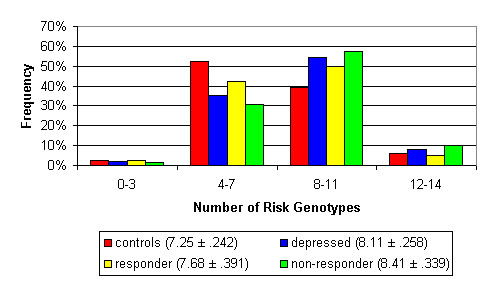
Results: A statistically significant difference in genotype frequency for the SLC6A4 intron 2 VNTR was detected between the subjects with a history of depression and controls (p = 0.004). Surprisingly, a statistically significant difference was detected between responders and non-responders for the DRD4 exon III VNTR genotype frequencies (p = 0.009). Furthermore, a difference between the controls and depressed subjects as well as between the controls and non-responders was detected for the number and distribution of risk genotypes in each group.
Conclusion: An association between several monoamine-related genes and Major Depressive Disorder is supported. The data suggest that the two depressive phenotypes are genetically different, inferring that the genetic basis for the capacity to respond to standard antidepressant treatment, and the genetic susceptibility to Major Depressive Disorder may be independent. In addition, a proof of concept is provided demonstrating that the number of risk genotypes may be an indication of susceptibility of major depressive disorder and the severity of the disorder.
期刊介绍:
A well-established journal in the field of behavioral and cognitive neuroscience, Behavioral and Brain Functions welcomes manuscripts which provide insight into the neurobiological mechanisms underlying behavior and brain function, or dysfunction. The journal gives priority to manuscripts that combine both neurobiology and behavior in a non-clinical manner.




 京公网安备 11010802042870号
京ICP备2023020795号-1
京公网安备 11010802042870号
京ICP备2023020795号-1

 分享
分享
 求助内容:
求助内容: 应助结果提醒方式:
 扫码关注我们
