Fyodor K. Verkhov , Alexandrina D. Skolyapova , Vyacheslav I. Krasnov , Irina Yu. Bagryanskaya , Rodion V. Andreev , Elena V. Karpova , Evgenya E. Kalizhnikova , Galina A. Selivanova
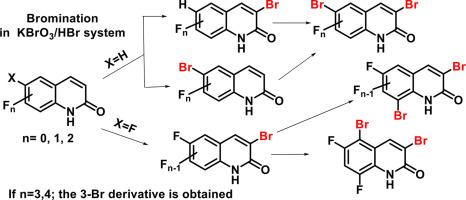
{"title":"Bromination of quinolin-2(1H)-ones fluorinated on the benzene moiety","authors":"Fyodor K. Verkhov , Alexandrina D. Skolyapova , Vyacheslav I. Krasnov , Irina Yu. Bagryanskaya , Rodion V. Andreev , Elena V. Karpova , Evgenya E. Kalizhnikova , Galina A. Selivanova","doi":"10.1016/j.jfluchem.2023.110132","DOIUrl":null,"url":null,"abstract":"<div><p>Bromination of ten known fluorinated quinolin-2(1H)-ones by the KBrO<sub>3</sub>/HBr system is investigated. If there is no F atom in the position 6 of substrate, the Br atom is introduced into position 3 or 6 to form monobromo derivative, the second Br atom is introduced into the same positions leading to 3,6-dibromo product. If a F atom is in position 6, the 3-bromo product is initially obtained, which gives a 3,5-dibromo or 3,8-dibromo derivatives upon further bromination depending on the F atoms positions. In this case, when both positions 5 and 8 of 3-bromoquinolin-2(1<em>H</em>)-one are unsubstituted, the second Br atom is introduced into position 8. If there are more than two F atoms in the benzene moiety, the sole 3-bromo product is obtained. Relative (ΔE) energies of the considered σ−complexes estimated by DFT calculations for the reactions in question are consistent with the experimentally observed regioselectivity.</p></div>","PeriodicalId":357,"journal":{"name":"Journal of Fluorine Chemistry","volume":"268 ","pages":"Article 110132"},"PeriodicalIF":1.9000,"publicationDate":"2023-05-01","publicationTypes":"Journal Article","fieldsOfStudy":null,"isOpenAccess":false,"openAccessPdf":"","citationCount":"0","resultStr":null,"platform":"Semanticscholar","paperid":null,"PeriodicalName":"Journal of Fluorine Chemistry","FirstCategoryId":"92","ListUrlMain":"https://www.sciencedirect.com/science/article/pii/S0022113923000477","RegionNum":4,"RegionCategory":"化学","ArticlePicture":[],"TitleCN":null,"AbstractTextCN":null,"PMCID":null,"EPubDate":"","PubModel":"","JCR":"Q3","JCRName":"CHEMISTRY, INORGANIC & NUCLEAR","Score":null,"Total":0}
引用次数: 0
Abstract
Bromination of ten known fluorinated quinolin-2(1H)-ones by the KBrO3/HBr system is investigated. If there is no F atom in the position 6 of substrate, the Br atom is introduced into position 3 or 6 to form monobromo derivative, the second Br atom is introduced into the same positions leading to 3,6-dibromo product. If a F atom is in position 6, the 3-bromo product is initially obtained, which gives a 3,5-dibromo or 3,8-dibromo derivatives upon further bromination depending on the F atoms positions. In this case, when both positions 5 and 8 of 3-bromoquinolin-2(1H)-one are unsubstituted, the second Br atom is introduced into position 8. If there are more than two F atoms in the benzene moiety, the sole 3-bromo product is obtained. Relative (ΔE) energies of the considered σ−complexes estimated by DFT calculations for the reactions in question are consistent with the experimentally observed regioselectivity.
期刊介绍:
The Journal of Fluorine Chemistry contains reviews, original papers and short communications. The journal covers all aspects of pure and applied research on the chemistry as well as on the applications of fluorine, and of compounds or materials where fluorine exercises significant effects. This can include all chemistry research areas (inorganic, organic, organometallic, macromolecular and physical chemistry) but also includes papers on biological/biochemical related aspects of Fluorine chemistry as well as medicinal, agrochemical and pharmacological research. The Journal of Fluorine Chemistry also publishes environmental and industrial papers dealing with aspects of Fluorine chemistry on energy and material sciences. Preparative and physico-chemical investigations as well as theoretical, structural and mechanistic aspects are covered. The Journal, however, does not accept work of purely routine nature.
For reviews and special issues on particular topics of fluorine chemistry or from selected symposia, please contact the Regional Editors for further details.



 京公网安备 11010802042870号
京ICP备2023020795号-1
京公网安备 11010802042870号
京ICP备2023020795号-1

 分享
分享
 求助内容:
求助内容: 应助结果提醒方式:
 扫码关注我们
