David J. Jaekel , Daniel W. MacDonald , Steven M. Kurtz
{"title":"Characterization of PEEK biomaterials using the small punch test","authors":"David J. Jaekel , Daniel W. MacDonald , Steven M. Kurtz","doi":"10.1016/j.jmbbm.2011.04.014","DOIUrl":null,"url":null,"abstract":"<div><p><span>The small punch test is widely used to characterize the ductility and </span>fracture resistance<span><span><span><span> in metals and ceramics, when only a small volume of material is available. This study was conducted to investigate the suitability of the small punch test for characterizing polyetheretherketone (PEEK) </span>polymeric biomaterials<span> for changes in material grade, crystallinity, and </span></span>molding process. The small punch test reproducibly characterized the </span>mechanical behavior of PEEK and was able to distinguish differences induced by molding process alterations and annealing. Peak load was most sensitive to changes in crystallinity, grade, molding process, and increased with increasing crystallinity, but decreased with the addition of image contrast materials. The ultimate displacement was negatively correlated with crystallinity. Molding process conditions had the greatest influence on metrics of the small punch test, when compared with the effects of annealing and the addition of a radiopacifier. The results of this study validate the small punch test as a repeatable method for measuring the mechanical behavior of PEEK biomaterials.</span></p></div>","PeriodicalId":380,"journal":{"name":"Journal of the Mechanical Behavior of Biomedical Materials","volume":"4 7","pages":"Pages 1275-1282"},"PeriodicalIF":3.5000,"publicationDate":"2011-10-01","publicationTypes":"Journal Article","fieldsOfStudy":null,"isOpenAccess":false,"openAccessPdf":"https://sci-hub-pdf.com/10.1016/j.jmbbm.2011.04.014","citationCount":"59","resultStr":null,"platform":"Semanticscholar","paperid":null,"PeriodicalName":"Journal of the Mechanical Behavior of Biomedical Materials","FirstCategoryId":"5","ListUrlMain":"https://www.sciencedirect.com/science/article/pii/S175161611100097X","RegionNum":2,"RegionCategory":"医学","ArticlePicture":[],"TitleCN":null,"AbstractTextCN":null,"PMCID":null,"EPubDate":"2011/4/22 0:00:00","PubModel":"Epub","JCR":"Q2","JCRName":"ENGINEERING, BIOMEDICAL","Score":null,"Total":0}
引用次数: 59
Abstract
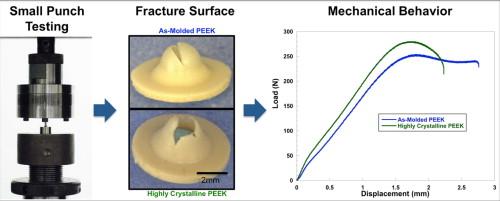
The small punch test is widely used to characterize the ductility and fracture resistance in metals and ceramics, when only a small volume of material is available. This study was conducted to investigate the suitability of the small punch test for characterizing polyetheretherketone (PEEK) polymeric biomaterials for changes in material grade, crystallinity, and molding process. The small punch test reproducibly characterized the mechanical behavior of PEEK and was able to distinguish differences induced by molding process alterations and annealing. Peak load was most sensitive to changes in crystallinity, grade, molding process, and increased with increasing crystallinity, but decreased with the addition of image contrast materials. The ultimate displacement was negatively correlated with crystallinity. Molding process conditions had the greatest influence on metrics of the small punch test, when compared with the effects of annealing and the addition of a radiopacifier. The results of this study validate the small punch test as a repeatable method for measuring the mechanical behavior of PEEK biomaterials.
期刊介绍:
The Journal of the Mechanical Behavior of Biomedical Materials is concerned with the mechanical deformation, damage and failure under applied forces, of biological material (at the tissue, cellular and molecular levels) and of biomaterials, i.e. those materials which are designed to mimic or replace biological materials.
The primary focus of the journal is the synthesis of materials science, biology, and medical and dental science. Reports of fundamental scientific investigations are welcome, as are articles concerned with the practical application of materials in medical devices. Both experimental and theoretical work is of interest; theoretical papers will normally include comparison of predictions with experimental data, though we recognize that this may not always be appropriate. The journal also publishes technical notes concerned with emerging experimental or theoretical techniques, letters to the editor and, by invitation, review articles and papers describing existing techniques for the benefit of an interdisciplinary readership.



 京公网安备 11010802042870号
京ICP备2023020795号-1
京公网安备 11010802042870号
京ICP备2023020795号-1

 分享
分享
 求助内容:
求助内容: 应助结果提醒方式:
 扫码关注我们
